Kickstarter Fees Explained: What You Keep From Every Pledge

Written byJasmine KhachatryanMarketing Writer & influencer marketing specialist
Kickstarter fees come in two parts. Kickstarter keeps 5% of the money you raise, and Stripe, its payment processor, takes 3% + $0.30 per pledge in the US (rates as of November 2026). For most US campaigns, they cost 8-12% of the total. Where you land in that range depends on pledge size: 500 backers at $20 cost more in fees than 100 backers at $100, because every pledge pays its own 30 cents.
Kickstarter also runs on all-or-nothing funding. Backers pay only when the campaign reaches its goal, and so do you.
Key Takeaways
- Kickstarter charges a 5% platform fee, and only when a campaign reaches its goal.
- US payment processing costs 3% + $0.30 per pledge, or 5% + $0.08 for pledges under $10. Rates change by country: Hong Kong, Singapore and Mexico charge 4% plus a fixed fee, and Japan charges a flat 4.5%.
- $10,000 from 100 backers at $100 costs $830 in fees (8.3%). The same $10,000 from 2,000 backers at $5 costs $1,160 (11.6%).
- Kickstarter charges backers at the deadline and starts your payout 14 days later. Your bank then takes 3-14 business days.
- Late Pledges carry the same fees as campaign pledges, and so does Kickstarter’s Pledge Manager. Pledge Over Time pays the processing fee on each of its three payments.
- Kickstarter charges no fees on dropped pledges.
How Much Does Kickstarter Take?
Every pledge pays two fees on its way to your bank account, one to Kickstarter and one to its payment processor.
Platform fee
Kickstarter takes 5% of everything your backers pay. It’s the same 5% for every project on the platform, from a $500 zine to the most funded Kickstarter project ever, the eufyMake E1 UV printer, which raised $46.8 million and handed Kickstarter about $2.3 million of it. Kickstarter deducts the fee from your payout, so you never pay it separately.
Payment processing fees
This fee goes to Stripe, Kickstarter’s payment processor, for handling every card payment. Its rate depends on your country. In the US, every pledge of $10 or more pays two parts:
- 3% of the pledge amount
- A flat 30 cents
A $50 pledge, for example, pays $1.50 (3%) plus 30 cents, for a total of $1.80 in processing.
Pledges under $10 get a cheaper rate: 5% of the pledge plus a flat 8 cents. A $5 pledge pays 25 cents (5%) plus 8 cents, for 33 cents total. At the regular rate, the same pledge would pay 45 cents.
A pledge of exactly $10 pays the regular rate.
Outside the US, the platform fee stays at 5% and the processing rate moves with the currency. Most countries follow the US pattern of 3% plus a fixed fee. Hong Kong, Singapore and Mexico charge 4% plus a fixed fee, and Japan charges a flat 4.5% with no per-pledge fee at all. The processing fee is roughly 3-5%, and the table below shows where each country lands. The 5% platform fee is the same in all of them.
Kickstarter pricing by country
| Country | Processing | Small pledges |
|---|---|---|
| United States | 3% + $0.30 | 5% + $0.08 under $10 |
| United Kingdom | 3% + £0.30 | 5% + £0.08 under £10 |
| Euro countries (Austria, Belgium, France, Germany, Greece, Ireland, Italy, Luxembourg, Netherlands, Slovenia, Spain) | 3% + €0.30 | 5% + €0.08 under €10 |
| Canada | 3% + CA$0.40 | 5% + CA$0.10 under CA$10 |
| Australia | 3% + AU$0.45 | 5% + AU$0.12 under AU$10 |
| New Zealand | 3% + NZ$0.50 | 5% + NZ$0.12 under NZ$10 |
| Denmark | 3% + DKK 3.50 | 5% + DKK 1.50 under DKK 100 |
| Norway | 3% + NOK 3.50 | 5% + NOK 1.50 under NOK 100 |
| Poland | 3% + PLN 1.20 | 5% + PLN 0.40 under PLN 30 |
| Sweden | 3% + SEK 3.50 | 5% + SEK 1.50 under SEK 100 |
| Switzerland | 3% + CHF 0.30 | 5% + CHF 0.08 under CHF 10 |
| Hong Kong | 4% + HK$2.50 | 5% + HK$1.25 under HK$100 |
| Singapore | 4% + S$0.40 | 5% + S$0.10 under S$10 |
| Mexico | 4% + MX$6.50 | 5% + MX$3.50 under MX$100 |
| Japan | 4.5% | Same 4.5% |
Creators in Denmark, Norway, Poland, Sweden and Switzerland have a second rate: a campaign that collects pledges in euros pays the euro rate, 3% + €0.30 (5% + €0.08 under €10).
The same rates apply after your campaign ends. Late Pledges carry the same fees as campaign pledges, and so do payments through Kickstarter’s Pledge Manager. Pledge Over Time adds no fee of its own, but Stripe charges processing on each of the three payments. On a $300 pledge, that’s 90 cents in flat fees instead of 30.
How Much Does Kickstarter Take From $10,000?
Two campaigns can raise the same amount and keep different amounts of it. The difference comes from the flat fee on every pledge. Here’s $10,000 raised three ways in the US. Kickstarter’s 5% is $500 in every case, and processing is what moves:
| Backers | Processing | Total fees | You keep |
|---|---|---|---|
| 100 backers at $100 | $300 + $30 = $330 | $830 (8.3%) | $9,170 |
| 400 backers at $25 | $300 + $120 = $420 | $920 (9.2%) | $9,080 |
| 2,000 backers at $5 | $500 + $160 = $660 | $1,160 (11.6%) | $8,840 |
“You keep” is before dropped pledges, refunds and taxes.
Nobody budgets for 30 cents, and 400 backers turn it into $120 without asking. The campaign built on $5 pledges keeps $330 less than the one built on $100 pledges, from the same total.
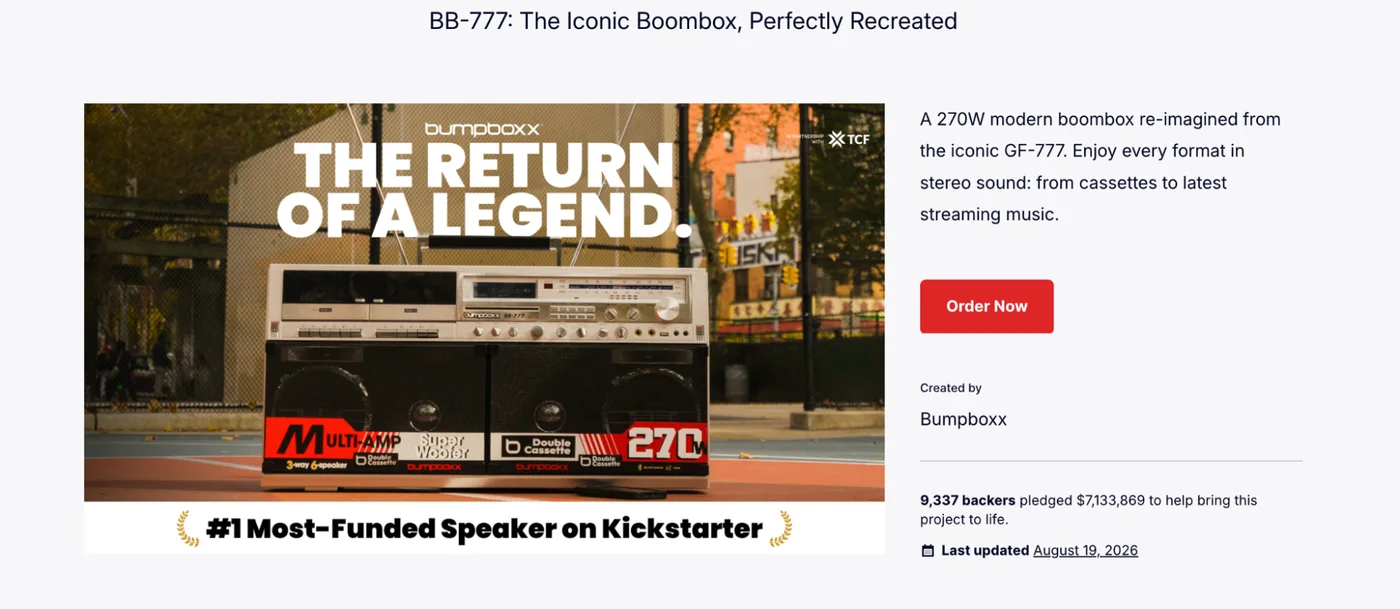
At the other end of the scale, BB-777, a retro boombox we took to Kickstarter, raised $7,133,869 from 9,337 backers. Kickstarter’s 5% alone came to $356,693, before Stripe took its share. The pledged total on the right of the campaign page is the figure that 5% comes from.
Once your payout arrives, Kickstarter lets you download an invoice with your own fee breakdown.
Kickstarter Fee Calculator
Your own numbers will land somewhere between these examples. Enter them below to see what you keep.
Japan charges one flat 4.5% processing rate on every pledge, so pledge size makes no difference.
You keep
$9,170.00
- Kickstarter fee (5%)
- $500.00
- Payment processing
- $330.00
- Total fees
- $830.00 (8.3%)
This estimate assumes every pledge collects. Taxes, refunds and dropped pledges change the final number. Kickstarter rates as of November 2026.
Whatever the result, set your goal above what you need. To net $10,000 at 8-9% in fees, the goal needs to be about $11,000. Low reward tiers lose the most: a $1 tier pays 5 cents to Kickstarter and 13 cents in processing (5% + $0.08), so 18% of it goes to fees. Keep that in mind when you price your reward tiers.
Sales Tax, VAT and Income Tax on Kickstarter
Kickstarter’s Pledge Manager handles most sales tax for you. In the US, it collects sales tax from backers and pays it to the state on rewards shipped to all 50 states. It does the same with GST/HST in Canada.
EU and UK VAT takes more reading. The Pledge Manager collects it on rewards shipped to backers there, and Kickstarter pays it to the tax office for smaller parcels shipped in from outside the EU or UK. For everything else, Kickstarter passes the VAT to you to pay. You can also switch VAT collection off, and if you use a different pledge manager, VAT stays your job.
On Pledge Manager payments, the 5% fee excludes taxes, while Stripe’s processing fee applies to the full amount, tax included.
Income tax sits outside all of this. Kickstarter’s tax guide says US creators should generally count the money they raise as income, so you may owe income tax on it.
Other Kickstarter Costs to Budget for
Kickstarter’s fees are the easy part to predict. The bigger bills arrive after the campaign, when you need to make and ship the rewards you promised.
Manufacturing comes first, and your quote should cover packaging along with the product itself. Kickstarter fulfillment comes next, and international backers add customs paperwork and higher carrier rates to the shipping bill.
Then there’s the pledge manager. Kickstarter’s own Pledge Manager has no upfront cost, though its payments carry the same fees as your campaign. A third-party pledge manager brings its own pricing.
Build all of this into your campaign budget before you set a funding goal, so the amount you raise covers the amount you spend. Then put the budget at the top of your Kickstarter checklist.
Dropped, Canceled and Refunded Pledges
The total on your campaign page is the most you can collect. A few things can shrink the payout from there.
When a backer’s card declines
Kickstarter charges every backer at the deadline, and some cards decline. Kickstarter then emails those backers every 48 hours for 7 days to update their payment details, and retries the card once at the end. If that last try declines too, the pledge drops. For Pledge Over Time, the second and third payments get 14 days instead of 7.
Kickstarter charges no fees on dropped pledges, since it charges fees only on money it collects. You still lose the pledge itself. Your campaign page keeps showing the deadline total and backer count, so the public number and your payout can differ.
A reminder in your last update before the deadline, asking backers to check their card details, gives the retry less work to do.
Canceled pledges
Backers can cancel a Kickstarter pledge or lower it any time before the deadline, with one exception. In the last 24 hours, Kickstarter blocks any cancellation that would drop the project below its goal.
Refunds
After a successful campaign, you decide on refunds. Who pays the fees depends on timing:
- Refund before your payout: Kickstarter returns its 5% and the processing fee to the backer.
- Refund after your payout: you cover the fees.
- Refund through Kickstarter’s Pledge Manager: Kickstarter treats every one as after-payout, so you cover the fees whenever you issue it.
When Does Kickstarter Charge You, and When Do You Get Paid?
Nobody pays anything while the campaign runs. The money moves after the deadline, on a schedule Kickstarter sets.
When backers pay
- Campaign pledges: Kickstarter charges every backer when the campaign ends, and only if it reaches its goal.
- Late Pledges: Kickstarter charges the card right away.
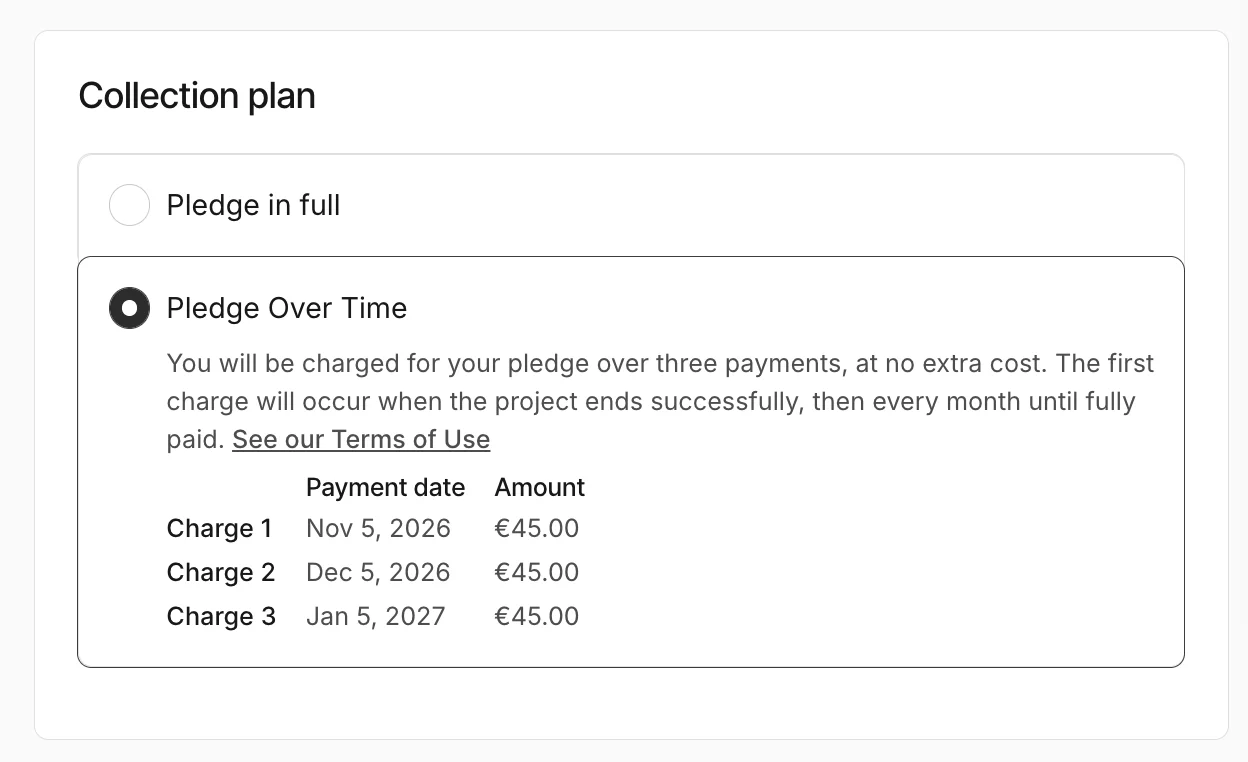
- Pledge Over Time: backers split pledges of $125 or more (in US dollars) into three monthly payments. The first payment comes out at the deadline, and the next two follow one and two months later.
Backers who pick Pledge Over Time see all three charge dates at checkout, before they confirm the pledge.
When the money reaches you
Kickstarter starts your payout 14 days after the deadline, at the same time of day the campaign ended. A campaign that ends at 6 PM on January 1 gets its payout started at 6 PM on January 15. Kickstarter uses those 14 days to collect from backers and retry declined cards.
From there, your bank takes 3-14 business days to show the money. If day 14 falls on a weekend, the bank may show the payout only the next business day. If nothing has arrived 28 days after the deadline, Kickstarter recommends checking with your bank.
Plan your manufacturer’s deposit with that month in mind. Factories rarely accept “it’s processing” as payment.
Late Pledge, Pledge Over Time and Pledge Manager payouts
| Money from | When Kickstarter pays it out |
|---|---|
| Campaign pledges | Day 14 after the deadline |
| Late Pledges | Day 21, then every 7 days |
| Pledge Over Time, payments 2 and 3 | About 8 and 12 weeks after the deadline |
| Pledge Manager | Every 14 days, starting 21 days after it opens |
FAQ
How much does Kickstarter take in fees?
For most US campaigns, Kickstarter’s fees come to 8-12% of what you raise. That’s the 5% platform fee plus payment processing of 3% + $0.30 per pledge, or 5% + $0.08 for pledges under $10. Campaigns built on small pledges land at the top of that range, since every pledge pays a flat fee. Kickstarter’s fees page lists rates for every country.
Does Kickstarter take a cut if you don’t reach your goal?
No. Kickstarter runs on all-or-nothing funding, so backers pay only when a campaign reaches its goal. If it falls short, nobody gets charged, and Kickstarter collects nothing from you.
When does Kickstarter charge you?
Kickstarter charges backers when the campaign ends, and only if it reaches its goal. Late Pledges get charged right away. Pledge Over Time splits pledges of $125 or more (in US dollars) into three monthly payments, starting at the deadline.
When does Kickstarter pay out?
Kickstarter starts your payout 14 days after the deadline, and your bank then takes 3-14 business days. If the money is still missing 28 days after the deadline, Kickstarter suggests checking with your bank. Pledge Over Time money follows at about 8 and 12 weeks.
Do Kickstarter backers get money back?
Backers of a campaign that misses its goal never pay in the first place. After a successful campaign, Kickstarter leaves refunds to the creator. You decide whether to refund, and the timing decides who covers the fees.
Are Kickstarter fees different outside the US?
Yes, for payment processing. The 5% platform fee stays the same everywhere, but processing changes by country. Most countries charge 3% plus a flat fee in local currency, Hong Kong, Singapore and Mexico charge 4% plus a flat fee, and Japan charges 4.5% flat. Kickstarter’s fees page has the full list.
What is the downside to Kickstarter?
The main trade-off is all-or-nothing funding: miss your goal and you raise nothing. A successful US campaign then typically pays 8-12% in fees and waits 14 days for the payout to start, plus bank time. Refunds and reward delivery stay your responsibility.
Which is better, GoFundMe or Kickstarter?
They serve different projects. Kickstarter suits creators offering backers a reward, usually a product, and bans equity or financial returns. GoFundMe suits personal causes and charges no platform fee, with 2.9% + $0.30 per donation in the US. For product launches, our Indiegogo vs Kickstarter comparison covers the closer match.