

In this article
At TCF, we tracked Q2 2026 on Kickstarter and analyzed the data so you don’t have to.
The data is clear: backers funded capability. Across the quarter, creators raised roughly $210 million from more than 1.23 million backers across about 3,930 projects, 33 of the campaigns crossing the million-dollar mark.
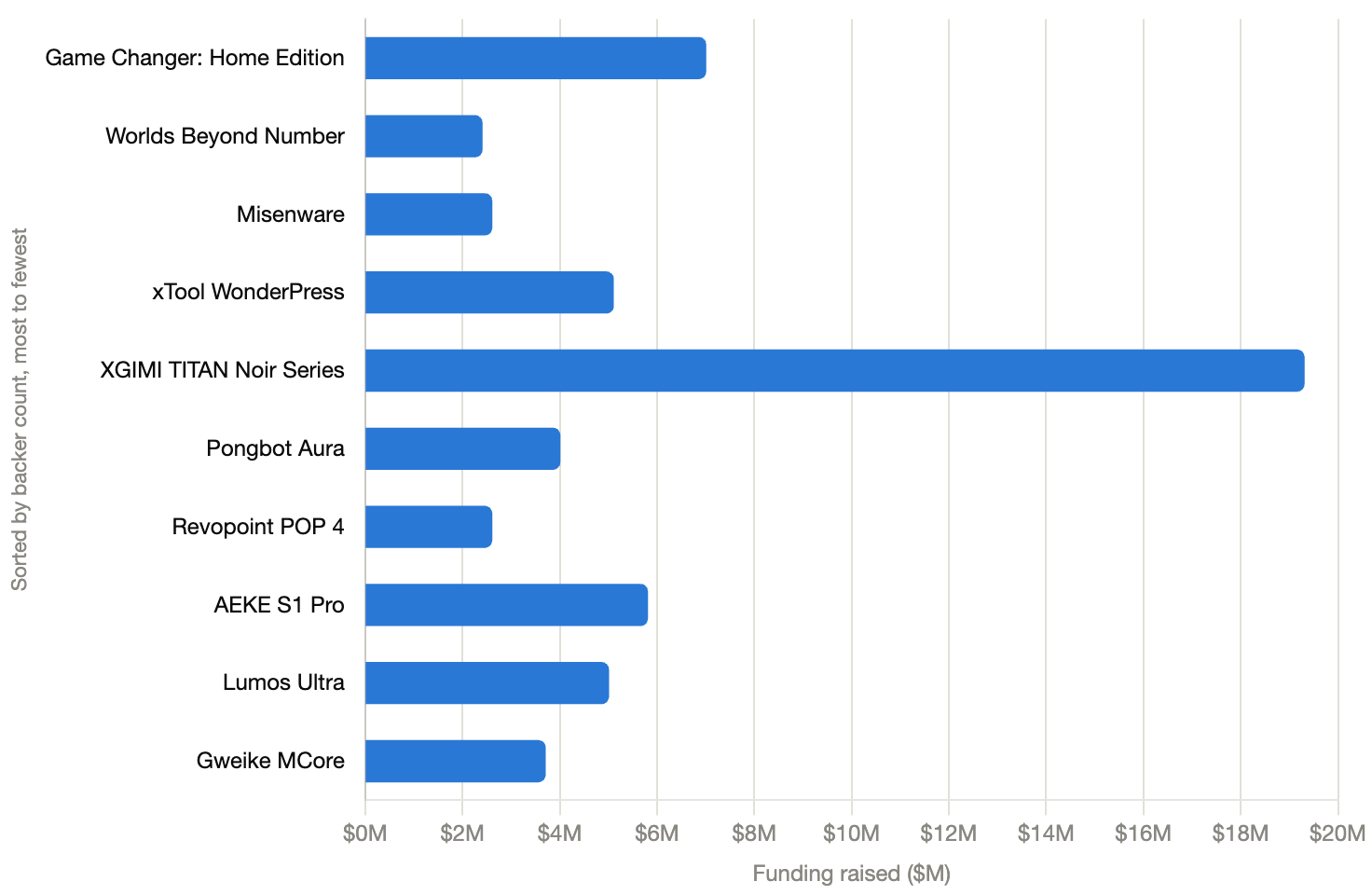
10 Most-funded Campaigns Of Q2 2026 At A Glance
Lined up together, the gap between the top and bottom of this list gets easy to see.
1. XGIMI TITAN Noir Series - $19.3M, 6,100+ backers
XGIMI, an established projector brand founded in 2013, didn't launch cold. The company previewed the TITAN Noir at CES 2026 and built pre-launch momentum with a reservation program on its own site that converted early deposits into additional discounts. The campaign centered on a specific engineering claim: Dual Intelligent Iris System hitting up to 10,000:1 native contrast, marketed as "Engineered for Absolute Black."
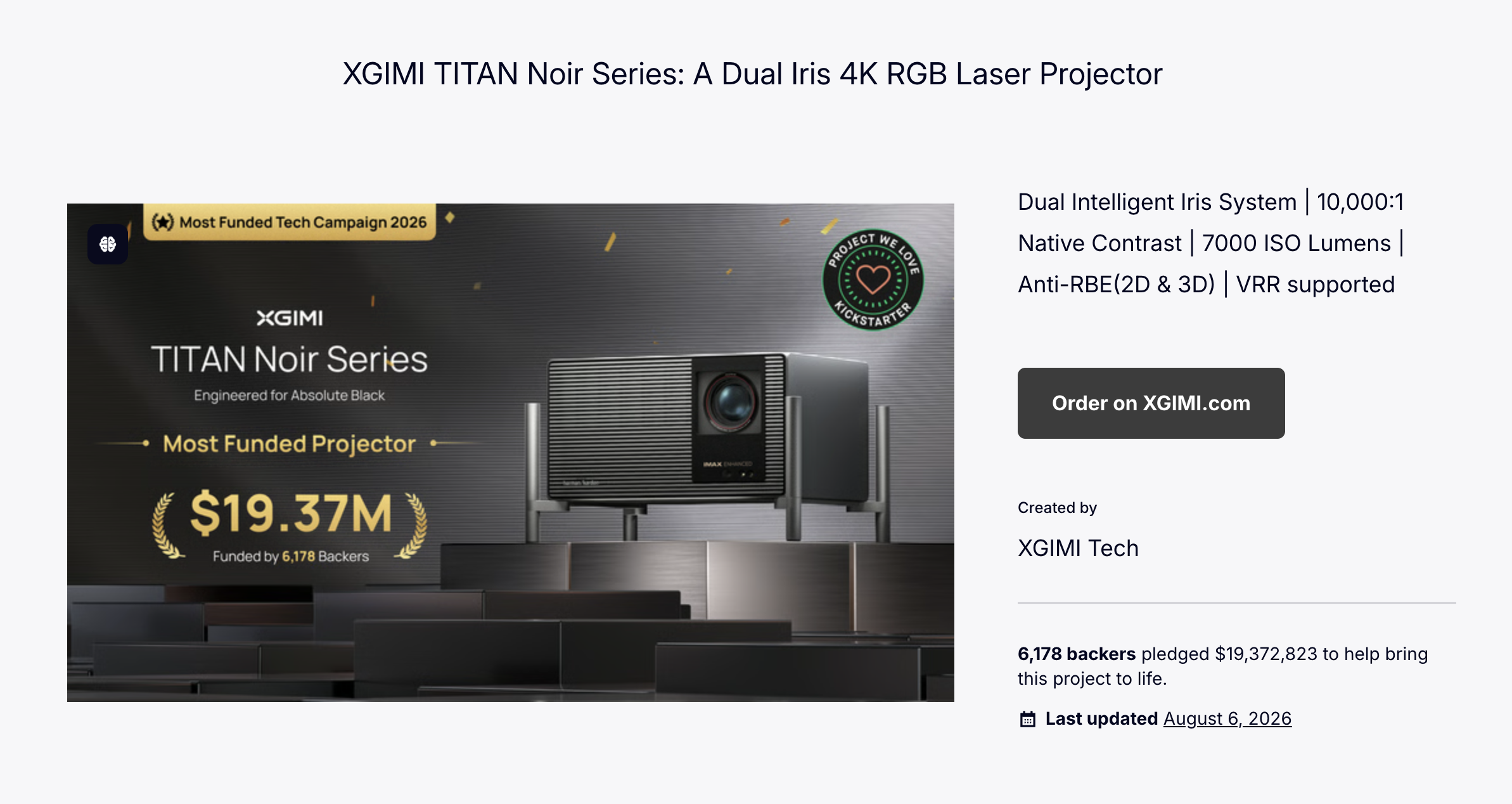
Pricing ran about 50% off retail. The $2,999 early-bird tier alone pulled 5,260 backers. Momentum peaked early: 3,000+ backers on day one, past $10M within a week, sustained climb to around 6,100 total backers. Roughly 3,600 of those were newcomers, which is about 58% first-timers despite the brand's pedigree. When the product and price are clear enough, even premium hardware recruits at scale.
Even at $19.3M, XGIMI's total falls well short of the all-time most funded Kickstarter campaigns, two of which have crossed $40M.
2. Game Changer: Home Edition - $7.0M, 48,824 backers
Sam Reich, Dropout's CEO and host of the underlying show (running since 2019), converted an existing streaming fandom directly to Kickstarter. The campaign itself was gamified: backers completed absurdist missions (in-joke comments, cardboard-cutout photos) to unlock stretch rewards for everyone, mirroring the show's tone.
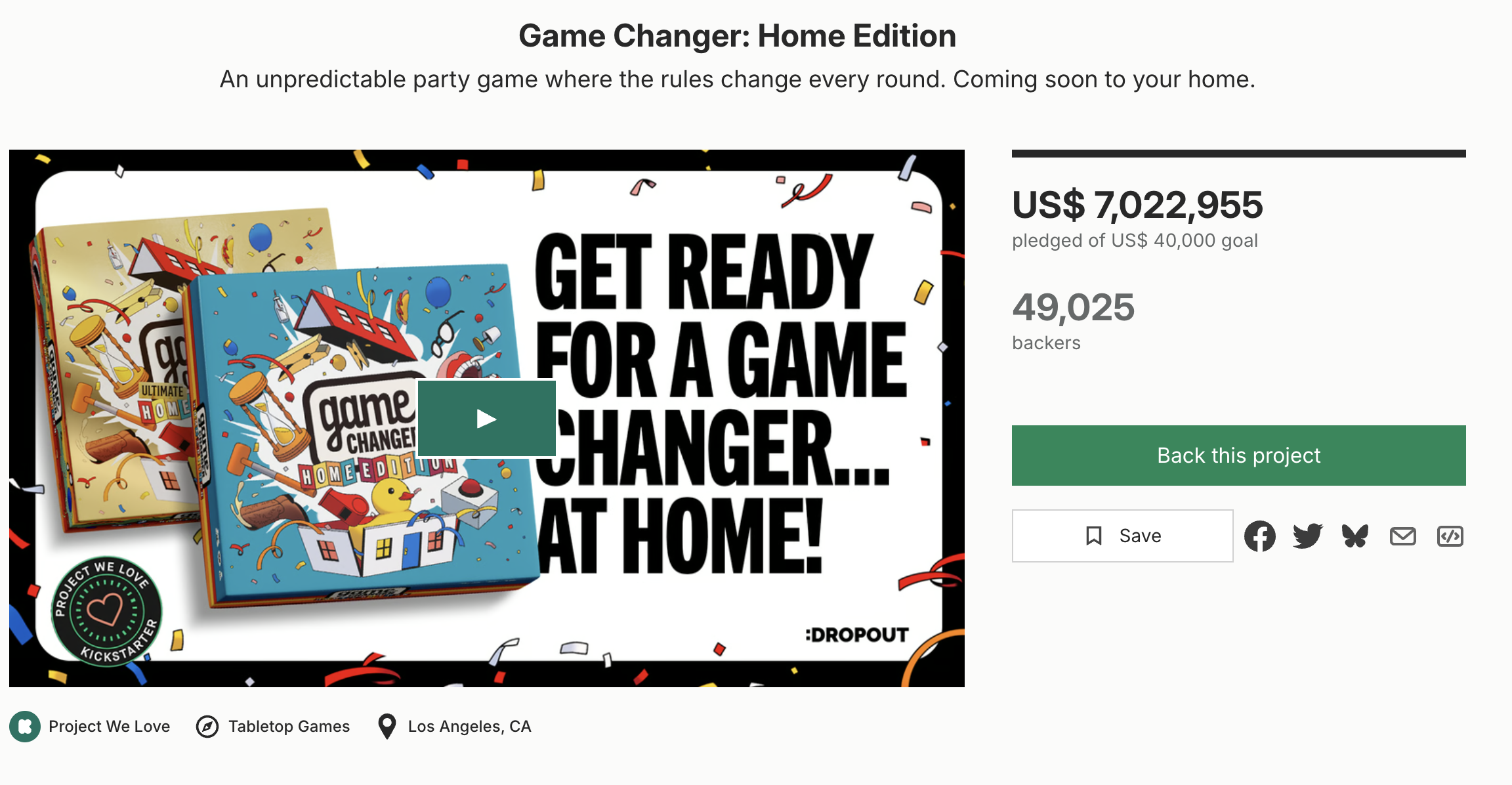
The pacing was extraordinary. They hit the $40,000 goal in 4 minutes. $1M in about 2 hours. Past $3M (75x goal) by day 4. Average pledge landed near $143.89 against a token goal, brand trust and fandom size doing all the work. The campaign pulled an enormous crowd (48,824 backers), the most-backed project of Q2 by a wide margin.
3. AEKE S1 Pro - $5.8M, 1,885 backers
AEKE, a NY-based AI fitness company founded 2022, arrived with 200+ sports scientists, hardware engineers, and AI specialists already on staff. The positioning took a direct jab at connected fitness's subscription model: lifetime AI-coaching access, no recurring fee. The super-early-bird tier ran $2,999 against a stated $4,599 MSRP.
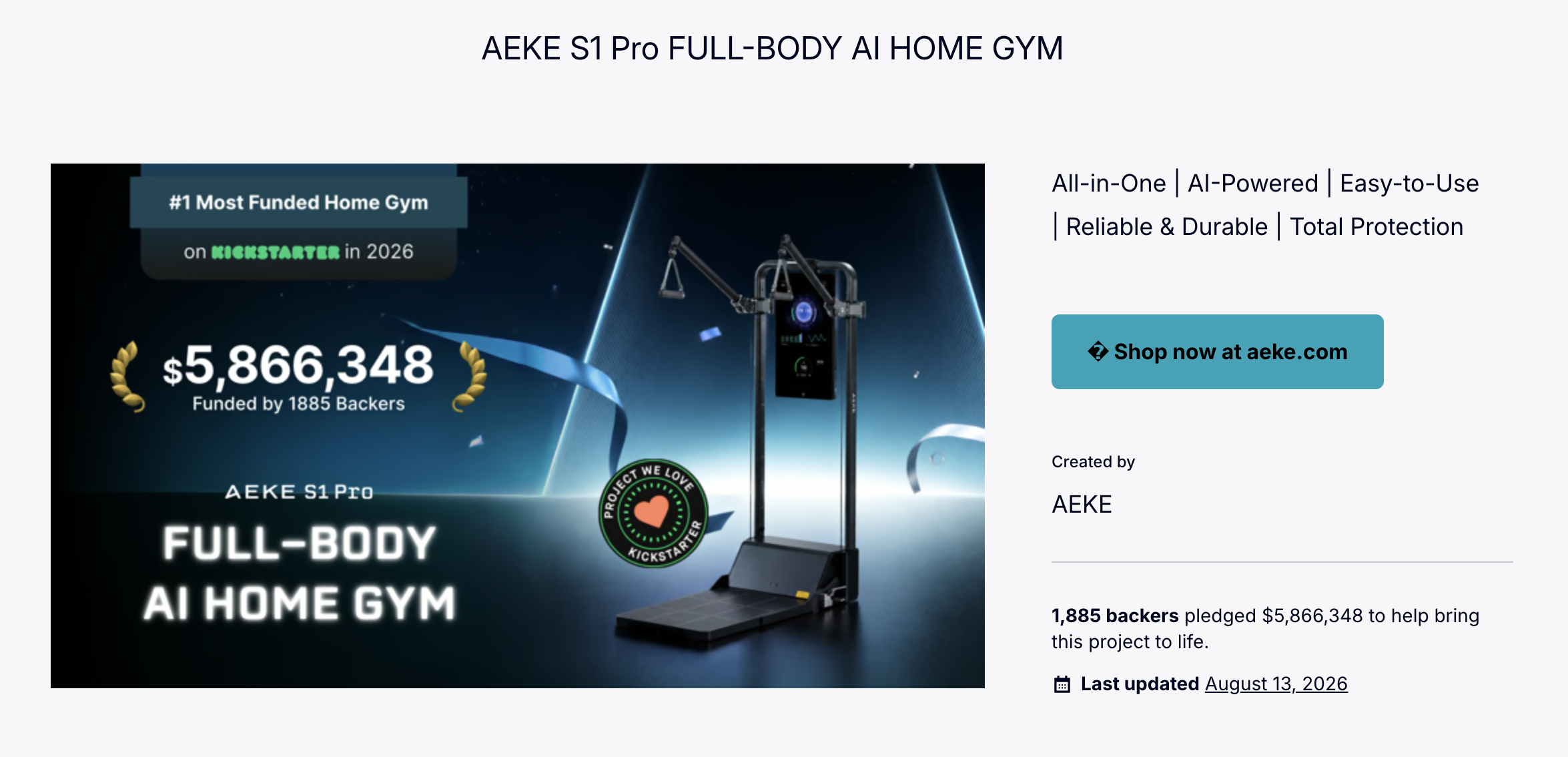
Closed at $5.8M from 1,885 backers over 39 days, the most-funded home-gym project on the platform to date. Per-backer commitment landed at $3,113, among the highest in this top 10, reflecting a high-intent buyer base willing to commit large sums to owned, private AI.
4. xTool WonderPress - $5.1M, 9,251 backers
xTool, a spinoff of Makeblock (a major STEAM-education hardware company), called itself the "world's #1 desktop creative tools brand" with 500,000+ existing users, launching into a warm customer base. It consolidates five machines in one unit (heat press, 3D sublimation, vacuum forming, craft baking, DTF curing) consolidating machines makers otherwise buy separately.
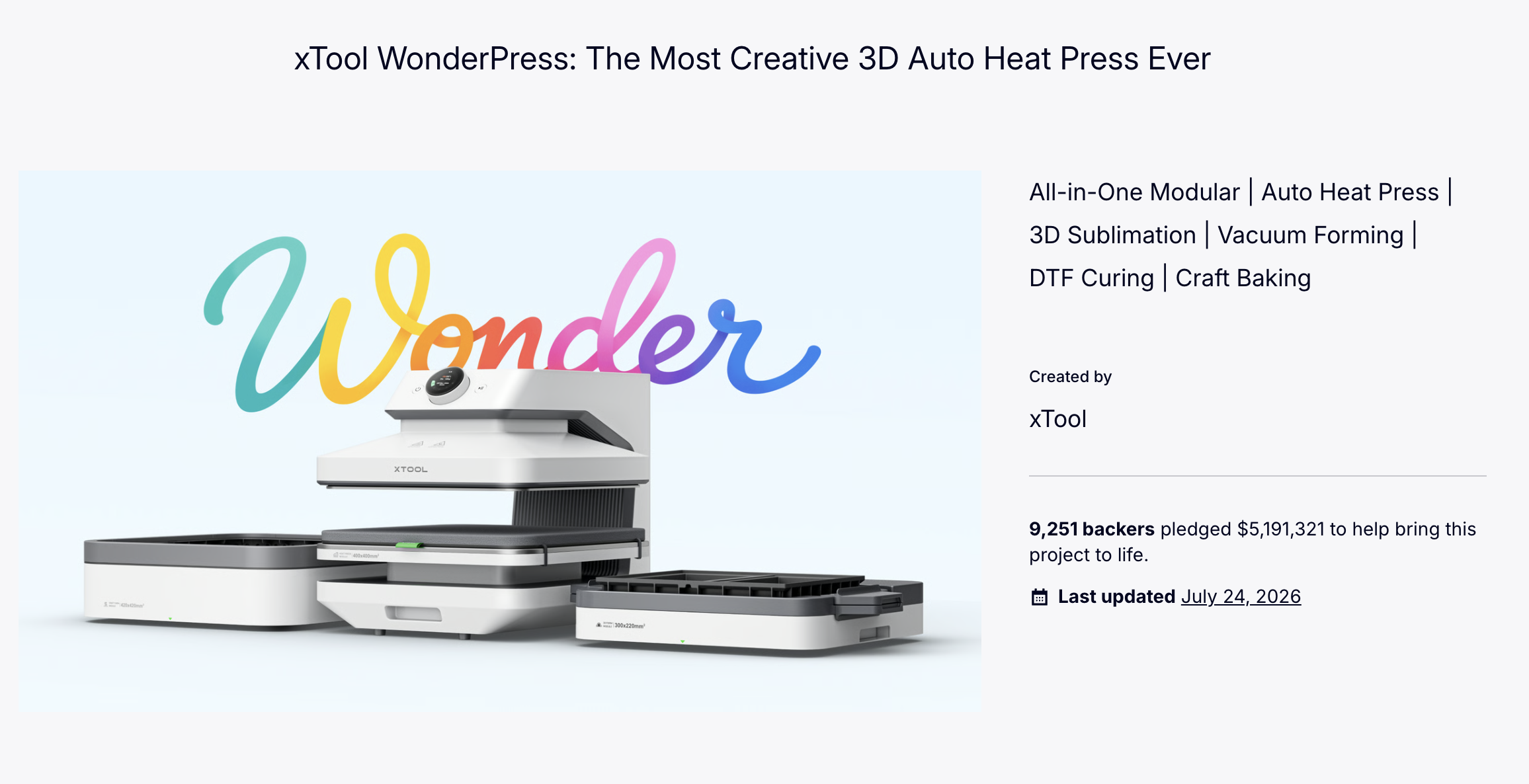
They crossed $1M in 4 hours from an existing mailing list. Super-early-bird base module $279 (MSRP $399, 30% off), all-in-one bundle $599 (MSRP $919, 35% off). Despite being a repeat-brand campaign, roughly 4,500 newcomers backed it, plausibly the unusually low $279 entry tier pulling in price-sensitive first-timers. Post-campaign, the full kit now sells at full retail.
5. Lumos Ultra - ~$5.0M, 701 backers
WeCreat, a small design-focused startup that had shipped three prior products, launched against a modest $100,000 goal on April 21. Positioned around a specific pain point: creators otherwise need separate UV and MOPA/fiber machines for delicate materials vs. metal. One chassis, one-click mode switching unified them.
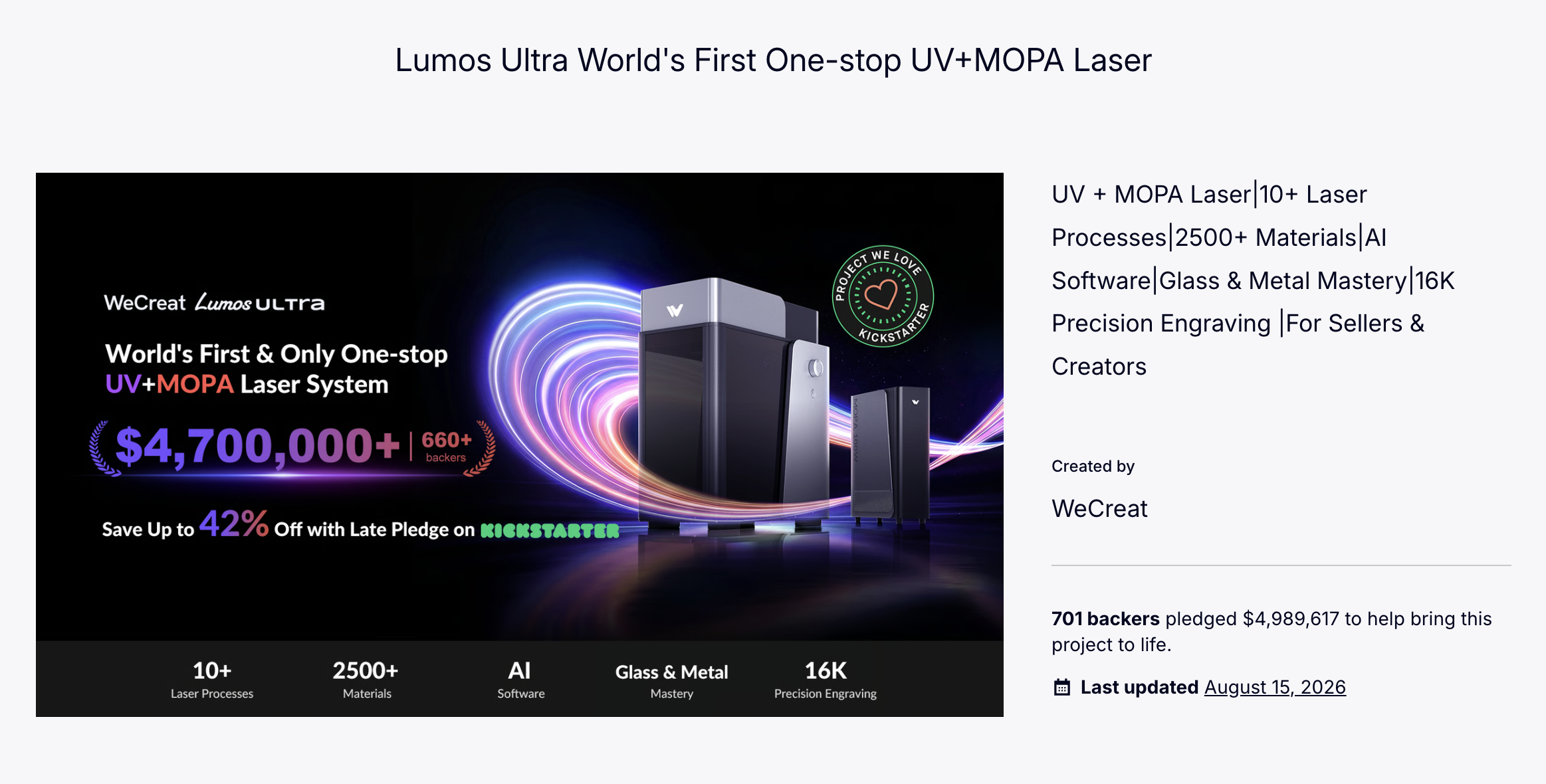
Closed at nearly $5M from 701 backers, it became the highest dollars-per-backer (~$7,118) campaign in this top 10. The narrow, surgical buyer base reflected super-early-bird pricing at $4,999 (MSRP $6,999, 28% off).
6. Pongbot Aura - ~$4.0M, ~3,500 backers
Pongbot, founded in 2019 by Fred Zhang (formerly lead of AI training-robot R&D for China's national table tennis team), had shipped the Pace S Series in 2024 to 2,500+ backers and earned Kickstarter's "Best of" recognition. Aura was the multi-sport expansion into tennis, pickleball, and padel.
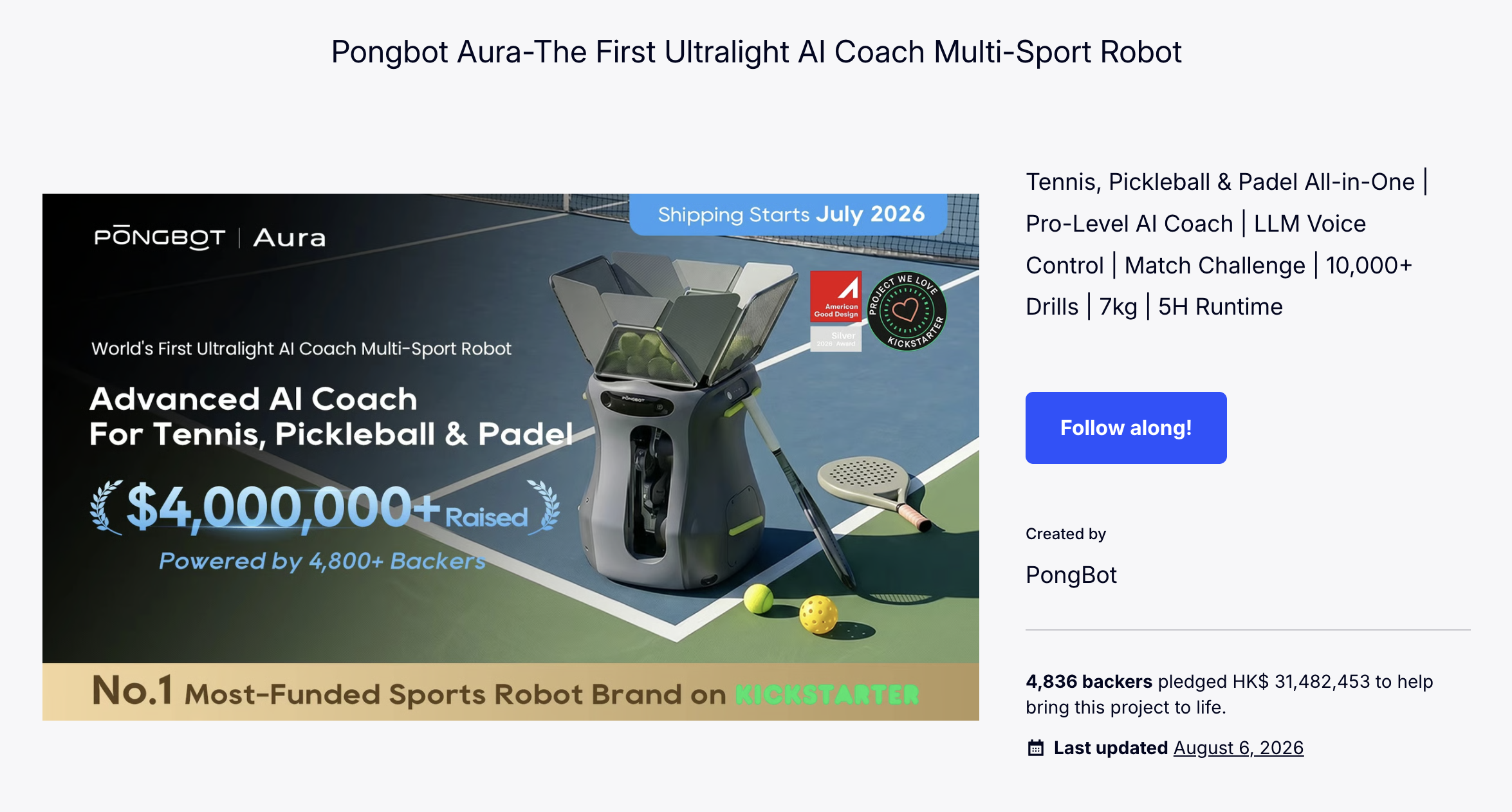
Introductory pricing: $499 (VIP deposit $469) against a stated $999 post-campaign MSRP, approximately half the cheapest single-sport competitor.
Crossed $1M within the first 5 hours. Despite Pongbot's repeat-brand pedigree, almost 60% of backers (~2,400) tried Kickstarter for the first time. The pivot from table tennis to broader hobbyist sports reached a larger market. Mainstream appeal pulled newcomers at scale.
7. Gweike MCore - $3.7M, 635 backers
Gweike Laser is an established B2B player, a 22-year veteran industrial laser manufacturer (founded 2004) with 200,000 m² production base and 130+ patents. Positioned on eliminating a workflow pain point: one chassis, one-click switching between 400W fiber laser (metal) and 80W CO2 (non-metal).
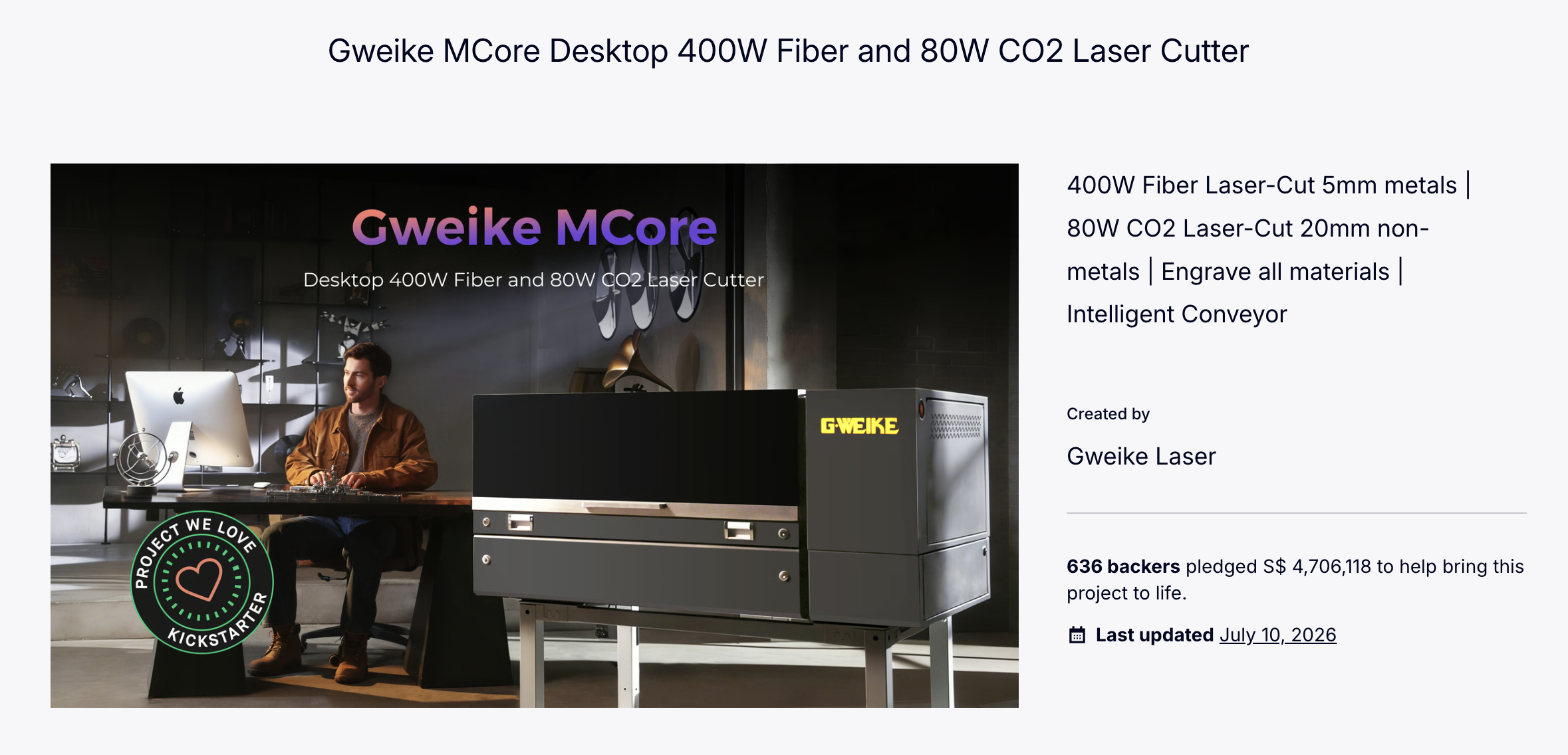
Super-early-bird $4,999 (MSRP $6,999, 28% off). Only 635 backers, but highest average pledge ($5,827) in this top 10. It ran concurrently with xTool WonderPress and Lumos Ultra, three competing desktop-fab campaigns splitting the same audience.
8. Misenware - $2.6M, 18,000 backers
Misen, founded 2015 by Omar Rada, had already run eight Kickstarters and raised roughly $14M from 131,000 backers across them all. Misenware is the ninth campaign. Positioned as "everything-safe", one container line rated for microwave, oven, grill, freezer, and dishwasher, stackable stainless steel.
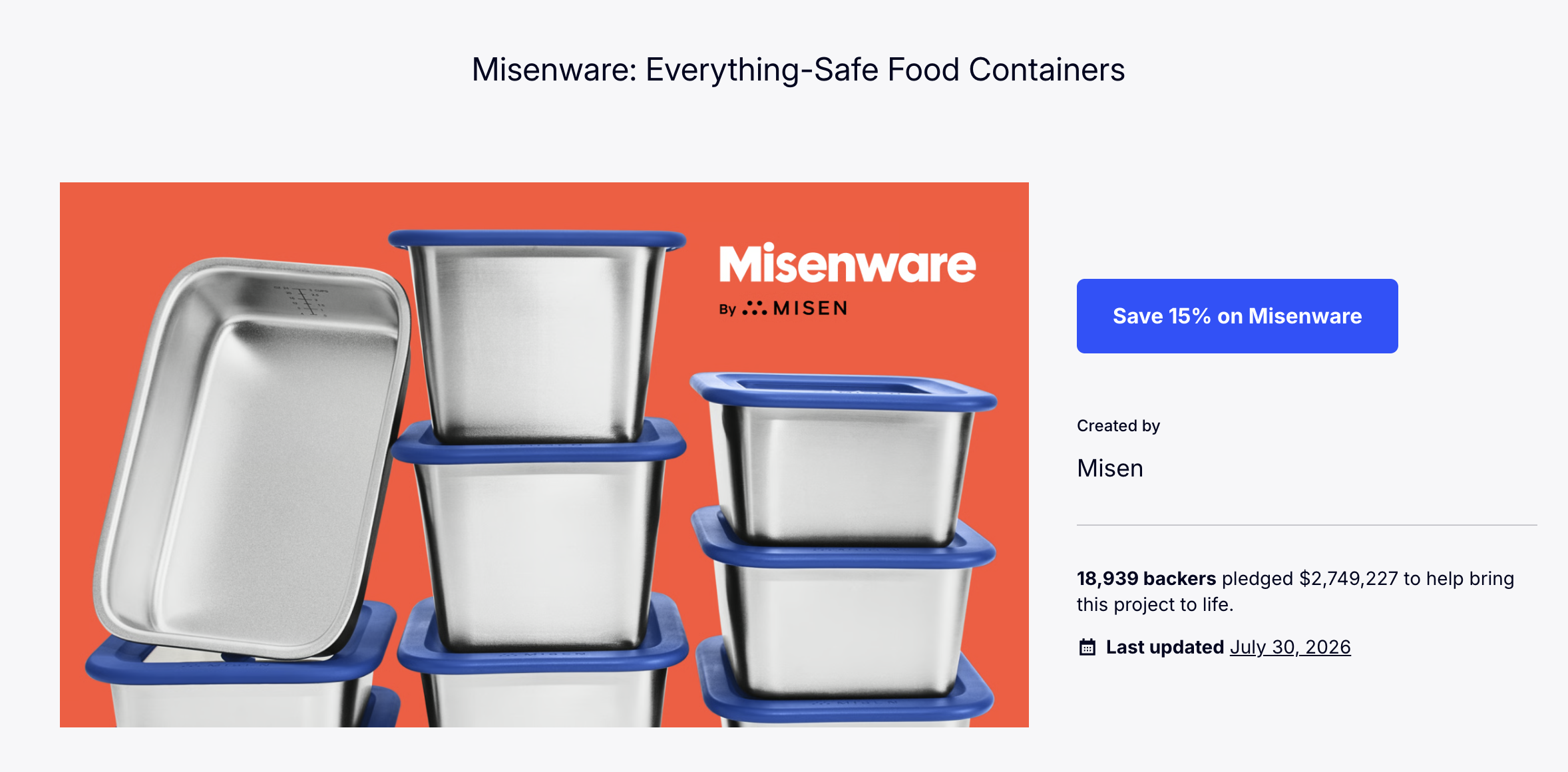
Drew more than $2.6M from over 18,000 backers, with about 3,100 newcomers. The average discount compressed from 31% off at super-early-bird to 21% off once that tier sold out, add-on shipping cut by up to 76% mid-campaign. They adjusted pricing throughout the campaign. Given eight prior fulfilled campaigns, the newcomers likely represent new-to-Misen reach and most of the rest were repeat Misen customers.
9. Revopoint POP 4 - $2.6M, 3,373 backers
Revopoint is also a repeat crowdfunder. They had shipped multiple prior POP scanner generations, launching with an established install base. Positioned as a hybrid blue-laser + near-infrared scanner handling "almost any object," including black and shiny surfaces, targeting design, VR/AR, automotive, and heritage-preservation users.
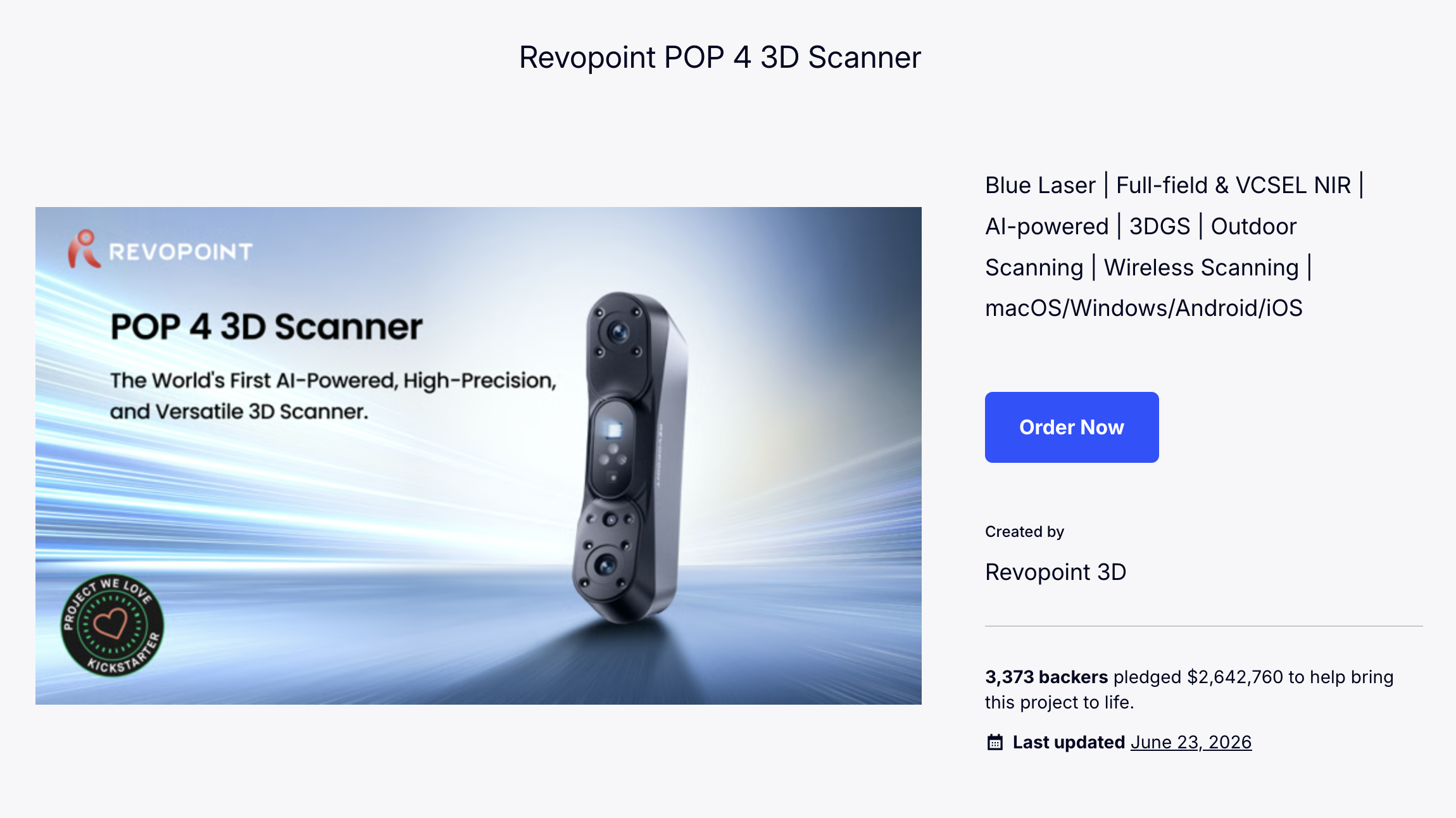
Super-early-bird $579 (MSRP $919, 37% off); post-campaign pre-order settled at roughly $755 off an $839 regular price.
Final tally: $2.6M+ from 3,373 backers, implying $783 average pledge above the base price, many backers opting into bundle and accessory tiers. The earliest backers got the steepest discount.
10. Worlds Beyond Number - $2.4M, ~19,000 backers
Worlds Beyond Number is a hit fantasy podcast created by Brennan Lee Mulligan, Erika Ishii, Aabria Iyengar, and Lou Wilson. It's an established property with a built-in fandom. Published via Skybound Entertainment (Robert Kirkman's multiplatform IP company) with its own crowdfunding track record ($1.3M+ across prior comics campaigns).
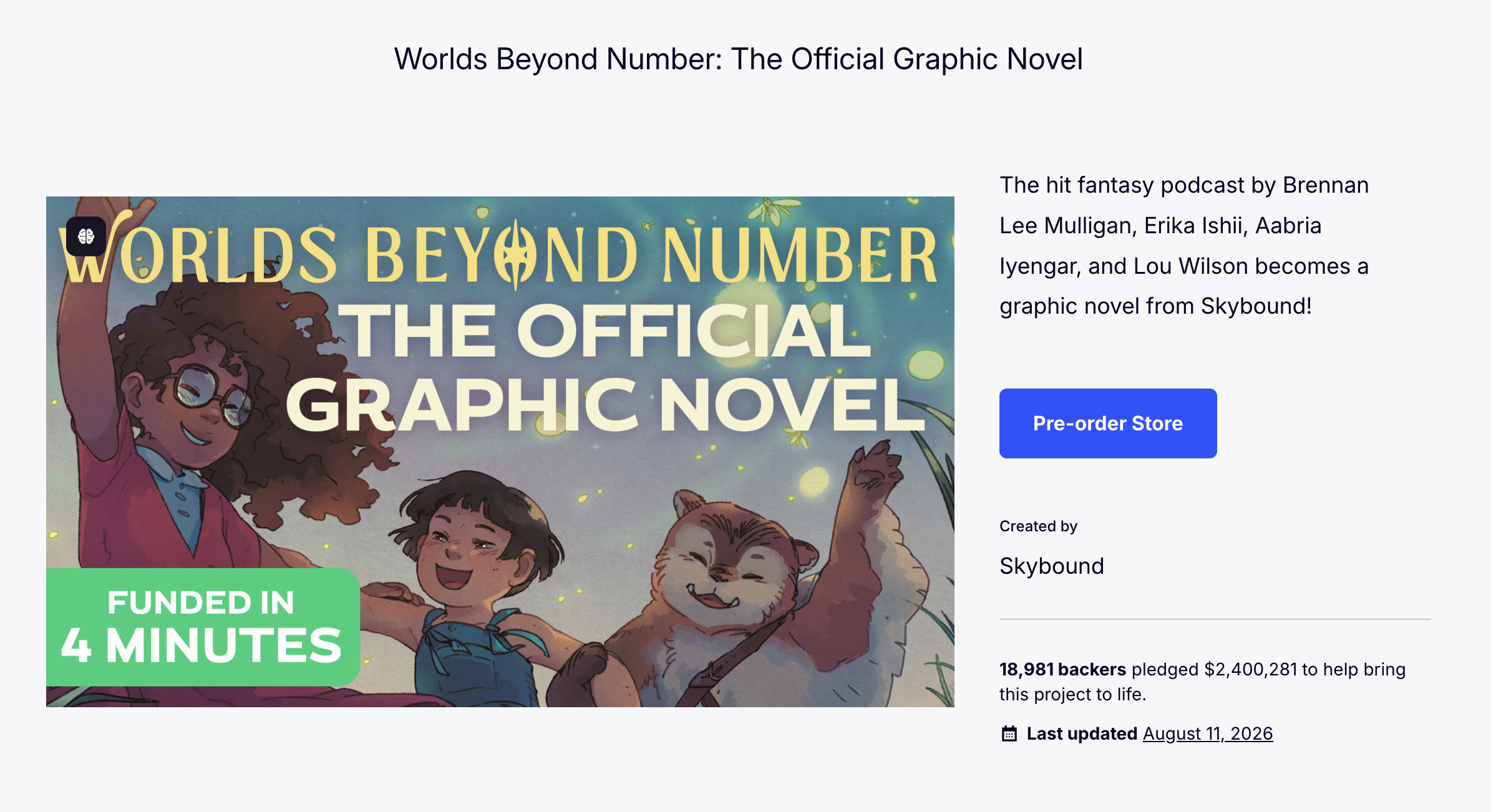
It was adapted by veteran comics writer Jadzia Axelrod (10+ years professionally) and illustrated by Sarah Webb. Campaign centers on a 240-page prelude hardcover telling a childhood-origin story for the three leads.
Pledge tiers bridged the podcast's Patreon base directly into Kickstarter: paid Patreon subscribers got a free bonus comic at $40+ physical-book levels, alongside Kickstarter-exclusive slipcase and pin rewards. This campaign embodied the creator-economy crossover that defined both games and comics in Q2.
The Patterns That Moved Q2
The top ten campaigns raised $76.2M combined. That's not random. Looking across all ten, clear patterns emerge around who backed them, how much they paid, and what came before launch.
Established brands and audiences won
9 of the top 10 had prior crowdfunding success or an existing customer base. This shows that track record moves money. Backers commit large sums to products that haven't shipped when they recognize the brand or the creator's work.
Being established is an advantage. But what it really gives you is an audience. You can build that same audience before launch through a waitlist, a deposit program, or a direct mailing list. If you don't have a track record yet, the trust signals that replace one are still buildable before you launch.
Early-bird pricing strategy
Eight of the ten campaigns priced against a stated retail MSRP, with early-bird discounts ranging from 21% off (Misenware, once early tiers sold out) to 50% off (XGIMI, Pongbot). Low entry points pulled volume. High entry points pulled high-intent backers. Both funded massive totals. The math differs but the outcome works either way. Game Changer and Worlds Beyond Number skipped the MSRP-discount model. They priced against fandom and a token goal instead. Post-campaign, all discounts evaporated and prices returned to full MSRP. The crowdfunding discount serves as a conversion tool.
Per-backer commitment ranged from $126 to $7,118
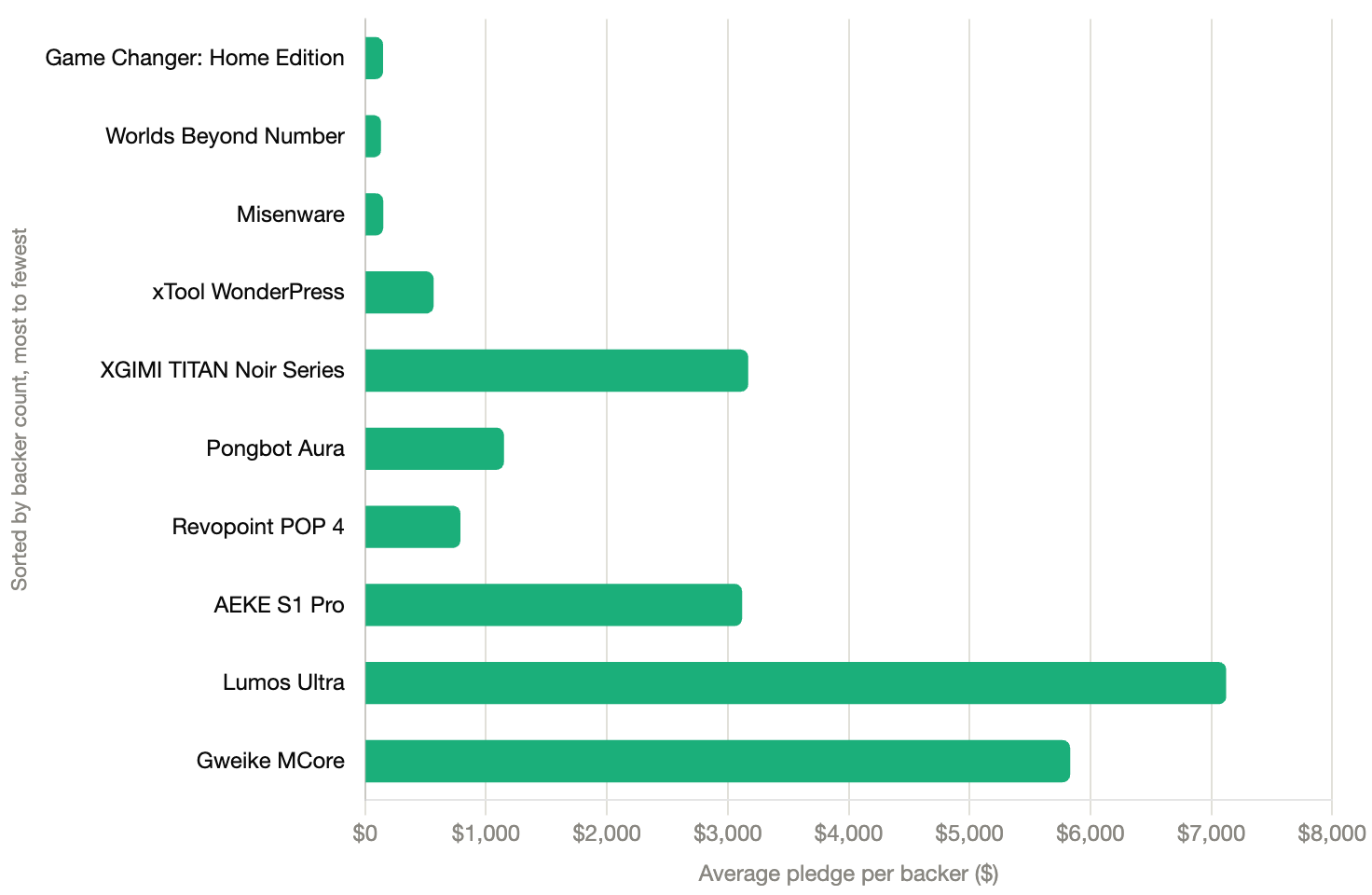
Games and design averaged $126-$144 per backer. Premium hardware averaged $3,000-$7,000 per backer. The gap is about what you're selling and how you tier it.
Higher AOV comes from clear product differentiation and pricing tiers that justify a premium. If you're selling commodity or entertainment, you'll compete on volume and price. If you're selling capability (a tool, a system, hardware that does something concrete) you can push higher commitment per backer. The product category matters, but so does how you position it, something we dug into further in the most funded Kickstarter Categories in Q2 2026.
Mainstream products recruited newcomers at scale
Across Q2 technology campaigns, roughly 74% of backers were returning users, per our internal Q2 tracking. But the top campaigns reversed that, XGIMI hitting 58% first-timers, Pongbot 60%, xTool pulling an estimated 4,500 newcomers.
They were people looking to solve a problem: a home theater, a fitness tool, a fabrication machine. These products appeal to mainstream consumers. Newcomers backed them because the product mattered, but reaching backers beyond your existing audience still takes deliberate work to get backers on Kickstarter.
Geography stayed American
Based on TCF's Q2 tracking data, nearly 51% of backers came from the United States. The UK, Germany, Canada, and Australia formed the next tier. For these campaigns, fulfillment planning and logistics assumed a US-majority base.
If you're launching on Kickstarter, assume your audience leans American and English-speaking unless you've built something intentionally international. That shapes logistics costs, shipping times, and customer support load. Build your fulfillment plan around where your backers actually are, not where you hope they'll be.
Conclusion
At TCF, we track this data every quarter. We saw that Q2 2026 rewarded clarity. The most successful campaigns had an audience before launch, priced their entry tier deliberately, and sold something with an obvious purpose. Established brands had an edge, but the underlying asset was the audience they'd already built, brand name aside.
If you're planning a launch, the pattern holds regardless of category. Build reach before you go live. Decide whether you want a large crowd or fewer backers paying more, then price your entry tier to match. Make the product's value legible enough that someone backing for the first time understands it in seconds.
Come back after Q3 to see if these patterns hold.
Frequently asked questions about Q2 2026 Kickstarter results
What was the most funded Kickstarter campaign of Q2 2026?
XGIMI TITAN Noir Series raised $19.3M from over 6,100 backers, the highest funding total of any campaign we tracked in Q2 2026.
How much did the top 10 Kickstarter campaigns raise in Q2 2026?
Combined, the top 10 campaigns raised $76.2M. Across the full quarter, creators raised roughly $210 million from more than 1.23 million backers across about 3,930 projects.
Which Kickstarter campaign had the most backers in Q2 2026?
Game Changer: Home Edition pulled in 48,824 backers, the most-backed project of the quarter by a wide margin, built on an existing streaming fandom rather than a new audience.
What was the average pledge per backer in Q2 2026's top campaigns?
Per-backer spend ranged from $126 (Worlds Beyond Number) to $7,118 (Lumos Ultra). Games and entertainment campaigns averaged $126 to $144 per backer, while premium hardware campaigns averaged $3,000 to $7,000 per backer.
Did most Q2 2026 Kickstarter backers come from the United States?
Yes. Nearly 51% of backers came from the United States, per TCF's Q2 tracking data, with the UK, Germany, Canada, and Australia forming the next tier.
[[cta2]]

.avif)
.avif)


.jpg)
%20(1).png)