

In this article
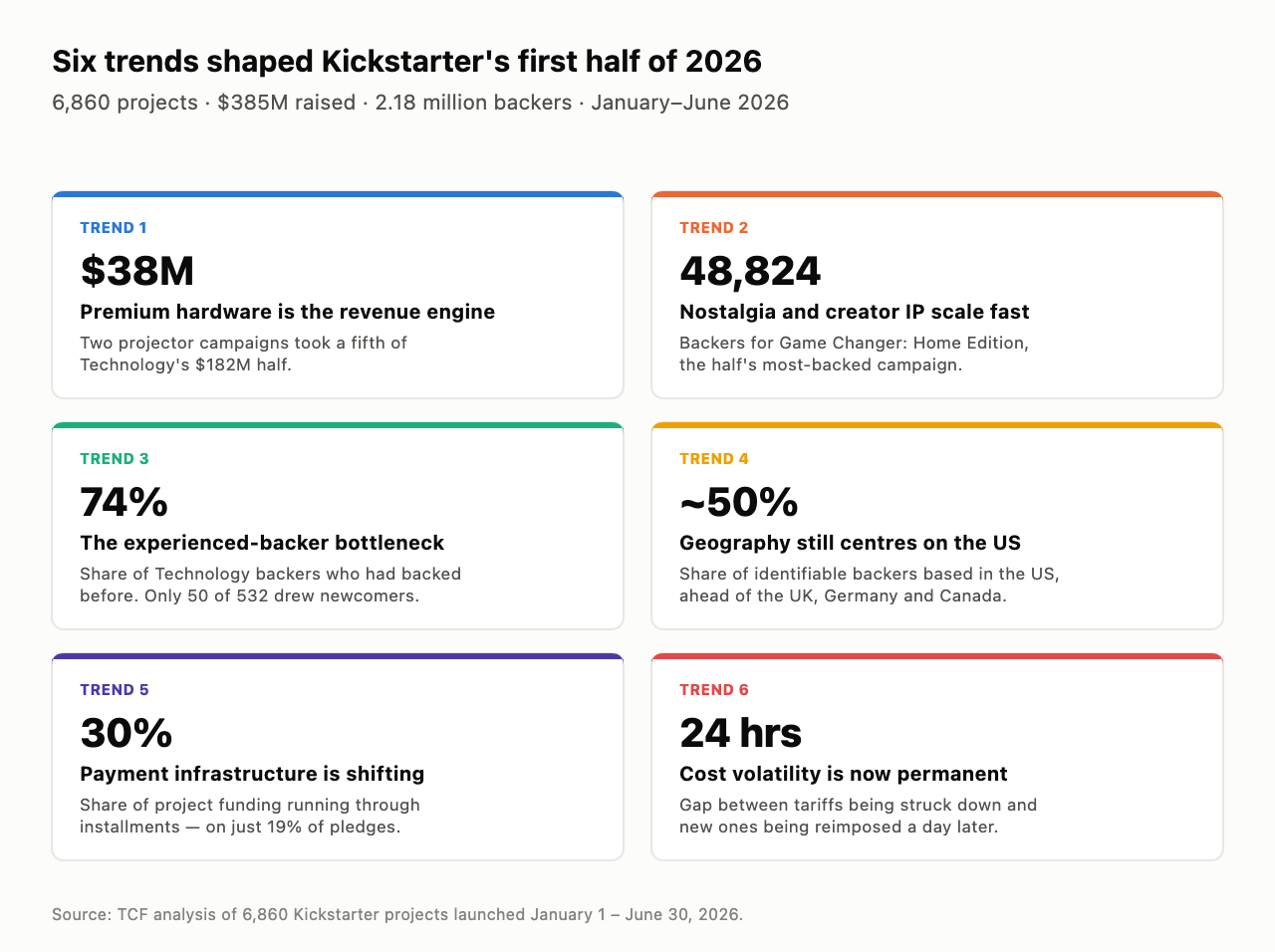
Two projector campaigns raised nearly $38 million on Kickstarter in the first half of 2026, making premium hardware one of the clearest signals of where crowdfunding demand is concentrating.
To identify the biggest Kickstarter trends of H1 2026, TCF analyzed 6,860 projects launched between January and June 2026. Together, these projects raised $385 million from 2.18 million backers, with 66 campaigns surpassing $1 million in funding. Monthly funding also gained momentum, rising from a slower January to a much stronger June.
Our analysis identified six key trends shaping Kickstarter in H1 2026, from the categories and products attracting the most funding to changes in how backers pay and how creators manage campaigns.
Methodology
TCF, one of the best Kickstarter agencies, analyzed 6,860 Kickstarter projects launched between January 1 and June 30, 2026. The analysis covers campaign funding, backer counts, category performance, reward values, backer composition, and geography. Unless otherwise stated, the figures in this article are based on TCF's analysis of Kickstarter campaign data. For a closer look at the second quarter on its own, see Kickstarter Q2 2026 by the numbers.
The 6 Biggest Kickstarter Trends in H1 2026
Trend 1: Premium Hardware Is the New Revenue Engine
Technology raised more money than any other category on Kickstarter in H1 2026, a lead it held in Q2's category breakdown on its own too: $182 million total for the half.
Two campaigns did most of the work.The XGIMI TITAN Noir Series, a dual-iris 4K laser projector, raised over $19.3 million from more than 6,100 backers, the highest-funded campaign of the half. Right behind it, the AWOL Vision Aetherion, an ultra-short-throw laser projector, pulled in $18.6 million from about 7,000 backers. Together, two products accounted for nearly $38 million, a fifth of the entire Technology category, in one Kickstarter funding window.
We broke down pledge amounts by category to see how far this went. Technology backers pledged well above their most common range, while Design stayed tighter.
Median and mean sit close together in Design because the category has no expensive tail pulling the average up.
XGIMI's own reward structure shows what a high-ticket tier can do when it's priced right. The $2,999 early-bird slot drew 5,260 backers, a striking number for a reward at that price. Add-ons brought in far less everywhere: about 5% of Technology revenue, 8% of Design's. The core product tier carries the campaign.
Trend 2: Nostalgia and Creator IP Turn Into Big Raises
Nostalgia sold hard in H1 2026. The BB-777, a 270-watt recreation of a classic boombox, raised over $7.1 million from more than 9,300 backers, the half's fourth-biggest raise. Backers recognized the product on sight, before reading a single pledge tier.
Creator IP worked through a different door. Game Changer: Home Edition, the party-game adaptation of Dropout's hit show, turned a $40,000 goal into nearly $7 million from 48,824 backers, the half's most-backed campaign outright. Worlds Beyond Number: The Official Graphic Novel, adapting the popular fantasy podcast, raised almost $2.4 million from close to 19,000 backers.
Both campaigns imported an audience that already existed elsewhere, a streaming platform or a podcast feed, and brought it straight to Kickstarter. Backers already trusted the source. The campaign just gave them a reason to spend.
Trend 3: The Experienced-Backer Bottleneck
Kickstarter's biggest categories run on people who've backed before.
Most campaigns in these categories win over people who already understand how backing works, backers willing to commit real money before a product ships.
That concentration makes the exceptions worth studying. Across 532 Technology campaigns with community data, only 50 had more first-timers than returning backers. In Design, the split was 38 out of 440.
Two campaigns from that group posted some of the half's biggest raises anyway. The BB-777 boombox pulled about 54% first-time backers, because its nostalgia hook reached buyers who recognized the product on sight but had never backed a Kickstarter campaign before. The Pongbot Aura, an AI coach for tennis and pickleball, went further: roughly 60% of its backers were funding a Kickstarter project for the first time. That was a sign that a mass-market sports use case pulled in everyday players rather than the tech enthusiasts who typically dominate that category.
Design had its own newcomer magnets. CardputerZero, a pocket maker computer, brought in about 5,800 new backers, the category's highest count. Misenware and Polari Labs' A-BALL followed, at roughly 3,100 and 3,000 new backers each.
The pattern holds across both categories. A campaign built for backers who already know the platform leans on trust and track record. A campaign built for everyone else needs a value proposition simple enough for someone brand new to backing.
Trend 4: Geography Still Concentrates Around the US
Kickstarter's biggest categories ran on a heavily American base in H1 2026, a pattern TCF's backer demographics report also found in Q2 alone. The United States supplied roughly half of all identifiable backers (about 180,000 in Technology and 166,000 in Design), with the United Kingdom, Germany, Canada, and Australia forming the next tier of backer volume behind it.
That concentration hasn't shifted the way some might expect given crowdfunding's global reach. An English-speaking, US-led audience still drives these campaigns, and fulfillment planning should assume it from the outset: shipping costs, customs handling, and delivery timelines built around a US-first backer base, with secondary logistics for the four countries behind it.
The takeaway for creators is to design their fulfillment plan for where the backers are instead of where they hope they'll be.
Trend 5: Kickstarter's Payment Infrastructure Is Reacting in Real Time
Kickstarter rolled out Pledge Over Time in 2025, letting backers split a pledge into three interest-free installments instead of paying the full amount upfront. In beta testing:
- Average pledge amounts ran 42% higher on campaigns offering the option.
- Backers using installments pledged more than double what upfront payers did.
Those lift numbers come from the beta phase, not confirmed at full platform rollout. By 2026, Pledge Over Time accounted for 30% of total project funding and 19% of all pledges platform-wide.
At that lift level, Pledge Over Time is most likely worth enabling on rewards priced above $100, the point where splitting a pledge into installments starts to ease real friction for a backer. Below that threshold, the delayed final payment and the risk of a failed installment probably outweigh the upside.
Late Pledges changed the shape of a campaign's funding window entirely. The feature, which lets backers pledge after a campaign's official end date, grew 30% year-over-year, according to Kickstarter CEO Everette Taylor. He named it, alongside Pledge Over Time, as one of the pillars behind the platform's best revenue year on record in 2025.
Together, the two features are stretching what used to be a fixed 30-day event into something closer to an ongoing storefront. A campaign that closes its funding window is often still collecting pledges weeks or months later, and backers who couldn't afford the full pledge upfront now have a path to fund it anyway.
For creators, that means the campaign doesn't end when the countdown hits zero. It shifts into a slower, longer tail that still needs attention.
Trend 6: Cost Volatility Is the New Planning Variable
Tariffs on Chinese imports climbed as high as 145% in 2025, hitting hardware and tabletop creators directly. Kickstarter responded by building a Tariff Manager, a tool letting creators add backer-facing surcharges after a campaign funds, the first infrastructure of its kind on the platform. CMON froze production on all new board games during this period. Final Frontier Games and Greater Than Games both cited tariff pressure among the reasons for closing in April 2025.
The volatility didn't resolve in 2026. On February 20, the Supreme Court struck down the tariffs in a 6-3 ruling. Within 24 hours, the administration reimposed new tariffs, starting at 10% and rising to 15%, under different legal authority. Stonemaier Games, which paid roughly $300,000 in tariff costs against $1.5 million in exposure, called the ruling a relief but said the company isn't counting on a refund and doesn't expect prices to change in the near term.
The net effect for creators: cost planning now has to account for volatility as the default condition, not a temporary disruption to wait out. A campaign budget built around today's tariff rate carries real risk of being wrong by the time the product ships.
Conclusion
The half rewarded creators who understood their audience before they launched, whether that meant pricing a hardware tier correctly, borrowing trust from an existing fan base, or planning a budget that could survive a policy shift. Kickstarter changed alongside them. Installment pledges, extended funding windows, and new response tools for cost shocks all reshaped what a campaign looks like from open to close.
None of these trends stand alone. A creator weighing price points is also weighing fulfillment costs and tariff exposure. A creator hoping to break the newcomer bottleneck is also deciding how long a funding window needs to stay open. H1 2026 showed a platform and its creators adjusting to each other in real time, and that adjustment isn't finished.
FAQ
How much did Kickstarter raise in H1 2026?
Kickstarter raised $385 million across 6,860 projects launched between January and June 2026, from 2.18 million backers. Sixty-six campaigns surpassed $1 million in funding, and monthly totals climbed steadily from a slower January to a much stronger June.
Which Kickstarter categories raise the most money?
Technology led every category in H1 2026, pulling in $182 million. Two projector campaigns, the XGIMI TITAN Noir Series and the AWOL Vision Aetherion, accounted for nearly $38 million of that on their own, making premium hardware the clearest driver of category-level funding.
What is Pledge Over Time?
Pledge Over Time is a Kickstarter feature, rolled out in 2025, that lets backers split a pledge into three interest-free installments instead of paying the full amount upfront. In beta testing, campaigns offering it saw average pledges run 42% higher, and by 2026 it accounted for 30% of total project funding and 19% of all pledges platform-wide.
How does Kickstarter compare to Indiegogo and Gamefound in H1 2026?
Native Indiegogo raised about $93 million in H1 2026, but most of it, $57 million, came from post-campaign collection rather than new launches. Gamefound, which now runs Indiegogo's tabletop side after acquiring it in 2025, raised about $64 million, split similarly between fresh campaigns and late-stage pledges. Kickstarter still leads on genuinely new crowdfunding money.

.avif)
.avif)

.jpg)
%20(1).png)