

In this article
“I’ll just launch my campaign on Kickstarter and the backers will find me.” lol you wish..
Kickstarter won’t do the work for you. It can amplify demand, but it can’t pull a Nara Smith and create it from scratch.
So how do you actually get backers to your Kickstarter?
That’s exactly what the TCF team has spent years figuring out. We consistently raised millions of dollars for our partners, so we know a thing or two about what drives real results and what quietly kills campaigns before they take off.
And we’re not gatekeeping it.
In this article, we’re sharing the actionable tips that actually drive backers, and how they come together before and during your launch.
[[cta2]]
Key Takeaways
- Early momentum is driven by email, VIPs, and strong pre-launch demand. These are the people who show up first and signal traction to both backers and Kickstarter.
- Paid media brings reach, while retargeting and email turn that attention into actual backers. Most conversions happen after multiple touchpoints, not the first click.
- Trust and social proof from influencers, PR, and real users increase conversions across every channel. People decide faster when they see others already engaging with the product.
- Fast funding and strong final days drive a large share of total results. Early traction unlocks visibility, and late urgency pushes people to finally take action.
Where Kickstarter Backers Actually Come From
Backers usually come from two main sources, paid media and organic channels.
Most campaigns use both, but they play very different roles. Understanding that difference is what makes everything else in your strategy click.
Paid Media
Paid media is one of the most controllable ways to get backers for your campaign.
This includes:
- Paid advertising
- Influencer placements
- Affiliate promotions
- Newsletter placements
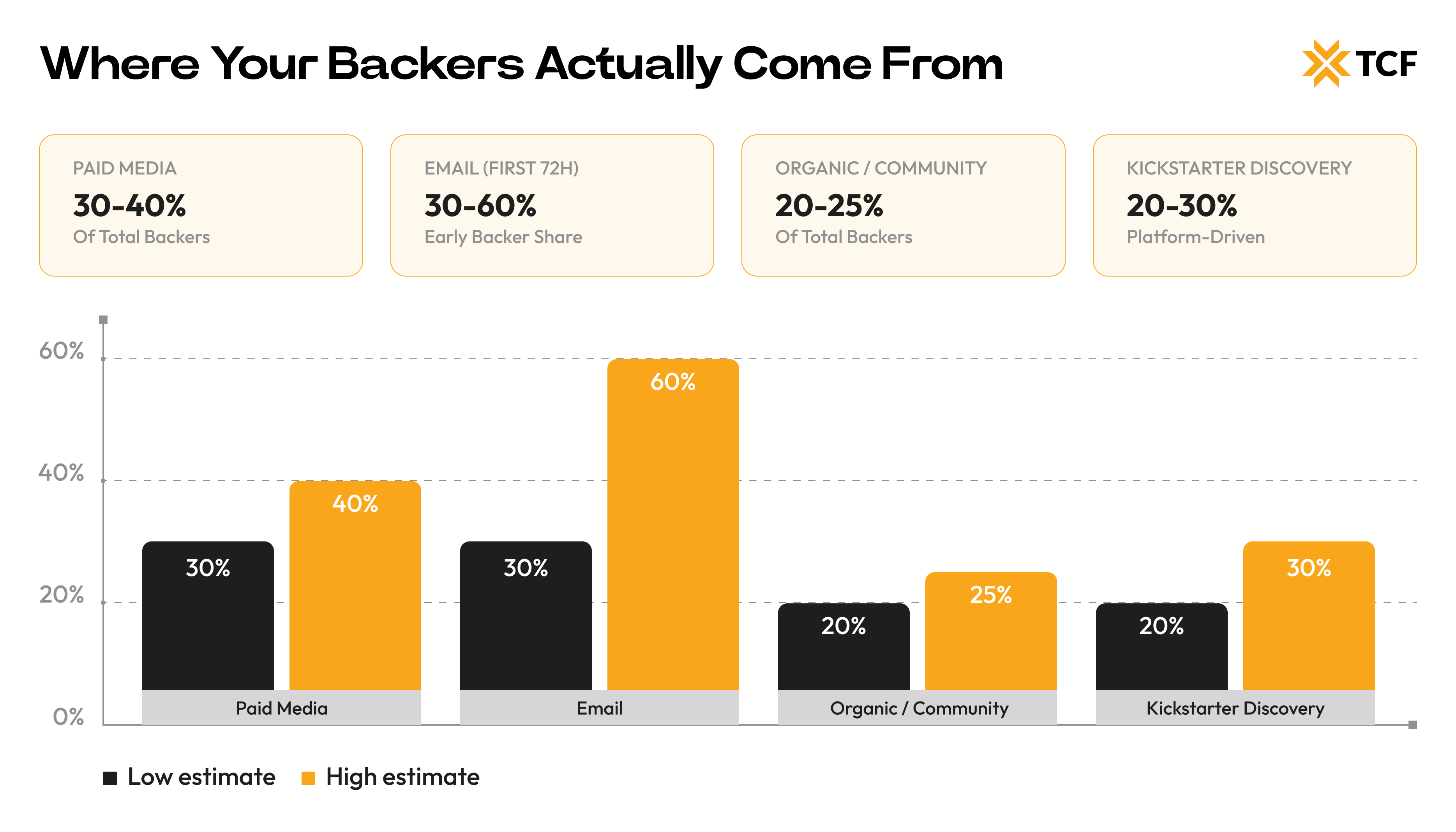
In many campaigns, paid media (mostly paid ads) contributes a meaningful share of total backers. Based on our data, ads typically drive 30–40% of all tracked revenue, with an additional ~10% that can't be directly attributed due to tracking limitations, meaning the real impact is likely higher.
It gives you the ability to generate traffic on demand and scale what’s already working, which is why it plays such a central role in many successful campaigns.
Email is the most reliable source of early backers in most Kickstarter campaigns.
This includes:
- Past customers and subscribers if there are any
- Pre-launch subscribers
- VIPs
In many campaigns, email drives a disproportionate share of early funding, often contributing 30-60% of backers in the first 24-72 hours, depending on how strong and qualified the list is.
That early conversion matters more than list size.
These are the people who show up immediately, convert faster, and drive the momentum that pushes your campaign forward.
A smaller, high-intent list will consistently outperform a larger, low-quality one.
Community and Organic Channels
Community and organic channels are where a portion of your backers comes from without direct paid distribution.
This includes:
- Social media
- Niche communities (Reddit, Discord, forums)
- PR and media coverage
- Word of mouth and referrals
- Organic website traffic (if you have an existing site with steady visitors, adding a Kickstarter banner can funnel a meaningful portion of that audience directly to your campaign)
In most campaigns, these channels contribute around 20–25% of backers, though this can be higher depending on the campaign, particularly when there's strong social media presence or significant PR coverage.
PR plays a dual role here. It’s a non-paid channel that brings in new audiences through media exposure, while also building credibility across every other channel. When people see the product featured in big-name publications, it signals legitimacy in a way that makes every other touchpoint more convincing.
Kickstarter Discovery
Kickstarter discovery is what brings in backers directly from the platform itself.
This includes:
- Homepage features
- Category pages
- Recommendations
- “Projects We Love”
In well-performing campaigns, this can account for a significant share of total backers over time, often in the 20-30% range, depending on the campaign.
But it doesn’t happen automatically.
Kickstarter surfaces campaigns that are already showing traction. Backers, activity, and early conversions signal that the project is worth promoting, which leads to more visibility across the platform.
How It All Works Together
These channels build on each other.
- Paid media brings in attention.
- Email nurtures that attention, establishing authority, keeping leads warm, and converting them into ready-to-back supporters by launch day.
- Community and organic channels reinforce trust and add volume.
- Kickstarter then amplifies what’s already working.
That sequence is what drives most successful campaigns.
You don’t need all channels performing equally. But you do need them working in the right order.
15 Tips On How To Get Backers On Kickstarter
Getting backers comes down to stacking the right actions so each one pushes the next.
We’ve rounded up a few of our best tips that focus on what actually drives backers, from creating demand to turning that interest into real support once your campaign is live.
1. Build Demand Before You Launch
Backers don’t appear on launch day. They show up because you’ve already done the work to get their attention.
This is where most campaigns fall apart.
Instead of building demand early, creators rely on the launch itself to create momentum, and end up with a slow start that never recovers.
Here’s how to actually build that demand:
- Run traffic to a single, focused landing page. Not your Kickstarter preview. Not your homepage. A simple page with one goal, capture emails from people who are interested.
- Test multiple angles. Try different hooks, creatives, and audiences early. The goal is to figure out what gets attention and what gets signups before you scale anything.
- Qualify interest. A large list doesn’t help if no one converts. Use early access, limited pricing, or small commitments to filter for people who are actually likely to back.
- Nurture your list. Send updates, show progress, share behind-the-scenes, and keep reminding people why this product matters. The goal is to move them from “interested” to “ready to back.”
- Give people a clear reason to show up on day one. Early-bird pricing, limited rewards, or exclusive perks create urgency. Without that, even interested subscribers will delay, and momentum drops.
- Track cost per lead and engagement besides signups. If you’re paying for traffic, watch both how much you pay for each email and how those people interact with your emails. Cheap, disengaged leads won’t convert.
2. Use a VIP or Early Access Mechanism to Lock in Buyers
Obviously, not all email subscribers will convert.
They might be interested, but not committed (ahem,like your, ahem, situationship.)
A VIP or early access mechanism changes that by asking people to take a small step upfront in exchange for a clear benefit.
This usually means:
- paying a small deposit
- reserving a spot
- unlocking a guaranteed offer
That small action filters your audience instantly.
How to set it up:
- Add a second step after email signup. Don’t stop at collecting emails. After someone signs up, introduce the VIP option as a clear next step.
- Tie the offer directly to a real benefit. The incentive needs to feel meaningful. Think: guaranteed lowest price, exclusive bundle, or something they won’t get later.
- Keep the commitment small but real. The amount should be low enough to not create friction, but high enough to signal intent.
- Track conversion from email to VIP. This tells you how strong your demand actually is. If very few people upgrade, something is off, either the offer or the audience.
- Use this group as your launch trigger. When you go live, this is the first audience you activate. They already committed, so they’re the most likely to convert fast.
This also gives you something most campaigns don’t have, predictability.
Instead of hoping your list converts, you already have an idea of:
- how many people are serious
- how much early momentum you can expect
3. Use Paid Ads to Drive Backers
Paid ads are one of the fastest ways to bring in backers at scale.
They give you reach beyond your existing audience and allow you to generate consistent traffic instead of relying on spikes from organic or PR.
How to use ads effectively:
- Start with Meta as your core channel. It’s the most reliable for reaching broad audiences and driving consistent traffic to your campaign.
- Send traffic where it’s most likely to convert. Depending on your stage, this can be your pre-launch landing page or your live Kickstarter page.
- Use simple, clear creatives. Focus on what the product is, why it’s useful and why someone should care now. Overly polished or abstract ads usually underperform compared to direct, easy-to-understand ones.
- Allocate budget gradually, not all at once. Start smaller, then increase spend on what’s bringing in backers, not just traffic.
- Watch your conversion rate and ROAS closely. You need to understand how many visitors turn into backers and how much revenue you’re generating relative to what you’re spending
- Scale what converts profitably. Once you see both conversion and ROAS holding up, increase spend there instead of spreading budget across too many experiments.
4. Retarget People Who Already Showed Interest
Most people won’t back your campaign the first time they see it. They click, look around, maybe even like the idea… and then leave.
That’s okay. But if you don’t bring them back, they’re gone.
Who to retarget:
- Prelaunch and Kickstarter page visitors
- Email subscribers
- VIPs or early-access signups
- Ad engagers
- Social media engagers
How to actually use retargeting:
- Keep the message simple and direct. Don’t reintroduce the product from scratch.
Focus on reminding them what they saw and giving a reason to act now - Match the message to where they dropped off. Don’t show the same ad to everyone. Someone who’s subscribed to your email list needs a different push than someone who barely glanced at your landing page.
- Use different creatives than your cold ads. These people already know you. Show them social proof, real reactions or use cases and urgency (early-bird, limited tiers)
- Increase frequency closer to launch and during it. The closer you are to launch your crowdfunding campaign, the more visible you should be.
5. Use Lookalike Audiences to Scale What’s Working
Once you start getting real signals, you don’t need to guess who your audience is anymore. Lookalike audiences let you find more people who behave like your best prospects.
How to use lookalikes:
- Build them from your highest-quality data. Prioritize VIPs or early-access buyers, engaged email subscribers, actual backers (once your campaign is live)
- Make sure your source audience is large enough to be useful. You need at least 100 people to create a lookalike, but realistically, performance improves once you’re in the 300-1000+ range.
- Start narrow, then expand. Begin with tighter matches (closer similarity), then gradually broaden once performance is stable.
- Update them as your data improves. Early on, you might only have email signups. Later, switch to stronger signals like confirmed backers.
- Pair them with proven creatives. Don’t test everything at once. Use messaging that already converts, then show it to more people.
- Separate them from cold interest targeting. Don’t mix lookalikes with broad interests in one campaign. Keep them clean so you can see what’s actually working.
6. Use Influencer Marketing to Reach High-Intent Backers
Influencer marketing is one of the most effective ways to reach people who are already interested in products like yours through people who they already trust.
It helps you generate both awareness and conversions without relying only on ads.
How to actually do it:
- Find creators already talking about similar products. Not just your niche broadly, your type of product. If they’ve promoted something similar before, you’re in the right place.
- Prioritize smaller creators with strong engagement. Instead of chasing large accounts, focus on smaller creators whose audience actively interacts with their content. Check comments (are people asking questions?), saves/shares and overall sentiment towards the creator (especially their sponsored content)
- Give influencers a clear campaign brief. Don’t send the product and hope for the best. Tell them everything about your product, campaign, brand, what angle to focus on, what makes the campaign worth backing now, what action you want their audience to take
- Use tracking links for every creator. Give each influencer a unique link to your campaign to see which ones are driving traffic and bringing backers.
- Double down on top performers in the final days. The last days of your campaign are almost as important as the first ones. Once you know which creators are actually driving results, work with them again during this period to push even a bigger wave of conversions.
- Use affiliate commission to negotiate a better deal with influencers. Adding commission increases the perceived value of your offer while giving you room to negotiate a lower base fee.
7. Repurpose Influencer Content Across Your Campaign
Influencer content shouldn’t live in one post and disappear. The real value comes from using it across your entire campaign to increase trust and conversion.
How to make the most of it:
- Collect and organize all influencer content. Save everything creators produce, videos, photos, testimonials. Treat it as campaign assets.
- Use it across your funnel. Repurpose content everywhere: ads, social media, emails, campaign page, that one game night group chat.
- Prioritize content that feels real and specific. Raw, honest content usually performs better than overly polished visuals. Show the product in use.
- Highlight at least one strong YouTube review on your campaign page: A detailed third-party review helps answer questions and reduce skepticism. Place it as high as possible on the page.
People trust other people more than brands. So when your campaign consistently shows real users interacting with your product, conversion gets easier everywhere.
8. Use Affiliate Marketing to Bring in Backers at Scale
Affiliate marketing adds a layer of distribution on top of everything you’re already doing. You give others a reason to promote your campaign, and they get rewarded only when they bring real backers.
How to execute it:
- Offer a clear, attractive commission. It needs to be worth their effort. If the payout is too low, no one will put in the effort.
- Use Kickbooster to manage the campaign. Kickbooster allows you to generate unique referral links, track performance and handle commissions
- Add a “Become an Affiliate” banner to your campaign page. Make it visible and easy to join.
- Turn your backers into affiliates. Your backers already believe in the product. Give them the option to share and earn, they’re often your highest-converting promoters.
- Provide ready-to-use content. Give affiliates visuals, short descriptions and key selling points
- Increase commission for top performers and reactivate them. Once you see which affiliates are actually bringing backers, raise their commission and ask them to promote your campaign again. A higher incentive + proven performance = much stronger second push, especially in the final days.
9. Use PR to Build Social Proof and Drive Backers
PR builds trust, awareness and brings in backers. When people see your product featured in publications, it reduces skepticism and makes the decision to back much easier.
How to do it the right way:
- Use embargoes to coordinate coverage. Reach out to multiple publications ahead of launch and give them an embargo date. This lets you stack coverage so multiple articles go live at the same time (right after launch), creating a stronger spike.
- Target both niche and top-tier publications. Niche outlets bring higher-intent audiences. Top-tier publications add credibility and brand trust. You need both.
- Turn every feature into a conversion asset. Use logos and quotes everywhere: Kickstarter page, ads, emails, social media, Kickstarter updates and even influencer pitches. This compounds trust across your entire campaign.
- Repitch when you have a newsworthy update. Reach out again when you hit funding milestones or you have major updates. New angles = new coverage.
- Prepare a strong press release journalists can use directly. Don’t make them piece your story together. Give them a press release that already includes clear positioning, strong visuals, a simple, interesting angle and a link. The easier it is to copy, adapt, and publish, the more likely you are to get coverage.
10. Set a Funding Goal You Can Hit Fast
Your funding goal is a lever. The faster you hit it, the stronger the signal you send to Kickstarter that your campaign is worth pushing. It also sets backer expectations around how likely the project is to succeed.
How to use it:
- Set a goal you can realistically reach early. It should still cover your minimum production needs, but be low enough that you can hit it quickly with your initial demand.
- Aim to get fully funded as early as possible. Fast funding signals strong demand. That’s what increases your chances of being surfaced across the platform.
- Leverage the trust that comes with being funded. A funded campaign feels more secure to back. People know the product is more likely to be produced, which reduces hesitation.
- Expand beyond your initial goal with stretch goals. Your real target doesn’t need to be your initial goal. Use stretch goals to continue scaling after you’ve unlocked momentum.
- Use fast funding as a PR angle. Hitting your goal quickly gives you a strong, newsworthy hook. “Fully funded in 15 minutes” is far more compelling than just “we launched.” Use that momentum to pitch media, repitch journalists who didn’t respond earlier, get additional coverage during the campaign.
11. Use Email to Turn Interest Into Backers
Your email list is one of your highest-intent audiences. But it only converts if you guide people from interest to decision with the right messages at the right time.
Best practices to do it:
- Segment your list before sending anything. Separate VIPs and regular subscribers. Each gets their respective offers.
- Use a simple “missed it?” resend strategy. 24-48 hours later resend to non-openers and to non-clickers with a new subject line
- Educate your list before asking them to act. Don’t jump straight into “back now.” Use emails to explain what the product does, how it fits into real life, why it’s different. The more they understand it, the easier the decision becomes.
- Plan your email sequence in advance. Don’t send emails one by one without a plan. Map out what comes next so each message moves people closer to backing.
A simple flow can look like: welcome email > introduction to the product > key benefits and use cases > VIP / early access push > “we’re launching soon” > launch announcement > follow-ups and reminders > last chance to back.
Each email should build on the previous one and move people from “interested” to “ready to back.”
- Use content that helps people decide. Don’t send generic updates. Send emails that answer real questions and reduce hesitation: real use cases, comparisons or alternatives, campaign updates and milestones, launch and other announcement emails, answers to common questions, early feedback or reactions
- Push harder in the final days with urgency-driven emails. The last days of your campaign are when many backers finally decide.Increase frequency in the last 7 days, 3 days and 24 hours. Make the message clear: this is their last chance, pricing or perks won’t be available later
- Use one clear CTA per email. Don’t confuse people with multiple actions. Every email should push a single, clear step. When you add multiple CTAs, they compete with each other and reduce conversions.
12. Use Email to Collect Feedback
Email is also one of the easiest ways to understand what’s stopping people from backing. You’re talking to people who already showed interest, which means their feedback is highly relevant.
When people don’t convert, it usually comes down to something specific, price, confusion, missing information. And this is where you can actually surface those reasons instead of guessing.
What to do:
- Send short surveys to your list. Ask simple questions like “what’s holding you back?”, “what would make this a no-brainer?” Keep it quick. The easier it is, the more responses you get.
- Use responses to improve your campaign. Based on what people are actually saying, adjust messaging, positioning, FAQs, even your offer
- Use feedback as content. If multiple people ask the same question, address it in emails, add it to your campaign page, FAQs, use it in ads and socials
- Ask your backers why they decided to support you. Don’t only focus on objections. Send a short survey to people who already backed and ask them to give 3 reasons why they backed the project. Again, use these insights in your messaging, ads, emails, campaign page. This helps you discover and double down on what’s already working instead of guessing.
13. Get Featured in Crowdfunding Newsletters
Crowdfunding newsletters give you direct access to people who already back projects. No education needed. No explaining to them what Kickstarter is, how to back or how safe it is. They’re already there to discover and support new products.
How to do it properly:
- Identify newsletters that match your category. Don’t go broad. Look for lists that regularly feature products like yours.
- Provide ready-to-use content. Make it easy for them to feature you with images, short description, key highlights and a trackable link.
- Target the right crowdfunding newsletters. Some of the biggest ones are Tech I Want, Backer Many, and Backer Spaces.
14. Turn Communities Into a Source of Backers
Communities can bring in highly engaged backers, if you participate the right way. Most campaigns get ignored because they show up, drop a link, and disappear.
How to do it well:
- Find communities where your audience already hangs out. Use Reddit, Discord servers, niche forums, Facebook groups. Don’t go broad. Go where your product actually fits.
- Engage before you promote. Don’t lead with your campaign. Join conversations, answer questions, and become part of the space first.
- Frame your campaign as part of a discussion. Instead of “check this out,” position it as something you’ve been working on or something relevant to the topic. Context matters more than the link.
- Be present and responsive. When people ask questions, reply quickly, give real answers and address concerns
- Use feedback to improve your messaging. Communities will tell you what’s confusing, what’s interesting and what people actually care about. Adjust your positioning based on that.
15. Partner With the Right Crowdfunding Marketing Agency
At some point, doing everything yourself stops being efficient, which is why many founders start looking into the best Kickstarter marketing agencies to help them scale.
Crowdfunding campaigns are multi-channel systems, ads, email, influencers, PR, content, all working together. Execution across all of them is what drives results.
When this actually makes sense:
- You’re aiming for a serious raise ($100K-$1M+)
- You don’t have in-house expertise across all channels
- You want predictable results instead of trial and error
- You’d rather focus on the product than managing 10 moving parts
What to look for in an agency:
- Full-stack execution. You need a team that actually runs ads, manages influencers, handles PR, and drives email.
- Proven track record on crowdfunding platforms. Kickstarter and Indiegogo have their own dynamics. Experience here matters.
- Clear systems. Look for structured frameworks that connect: demand generation, conversion, scaling
Where TCF fits in
At TCF, this is exactly what we do.
We manage campaigns end-to-end, from pre-launch strategy to post-campaign scaling, with a dedicated team across all channels. Our approach is built around structured, repeatable systems that consistently drive results.
Across recent campaigns, our partners have raised $17M+, with many hitting $1M+ and beyond.
Conclusion
So no, backers don’t magically appear because you clicked “launch.”
They show up when everything is working together, ads bringing people in, email getting them to act, influencers and PR building trust, and the campaign itself giving them a reason to back now.
At TCF, this is the system we use every day to help campaigns raise millions. Nothing here is random. It’s a set of moves that build on each other and create momentum.
Get a few of these right, stack them properly, and things start moving fast.
And once that momentum kicks in, that’s when Kickstarter finally does its part and starts pushing you too.
[[cta2]]
FAQ
When should I start marketing before launch?
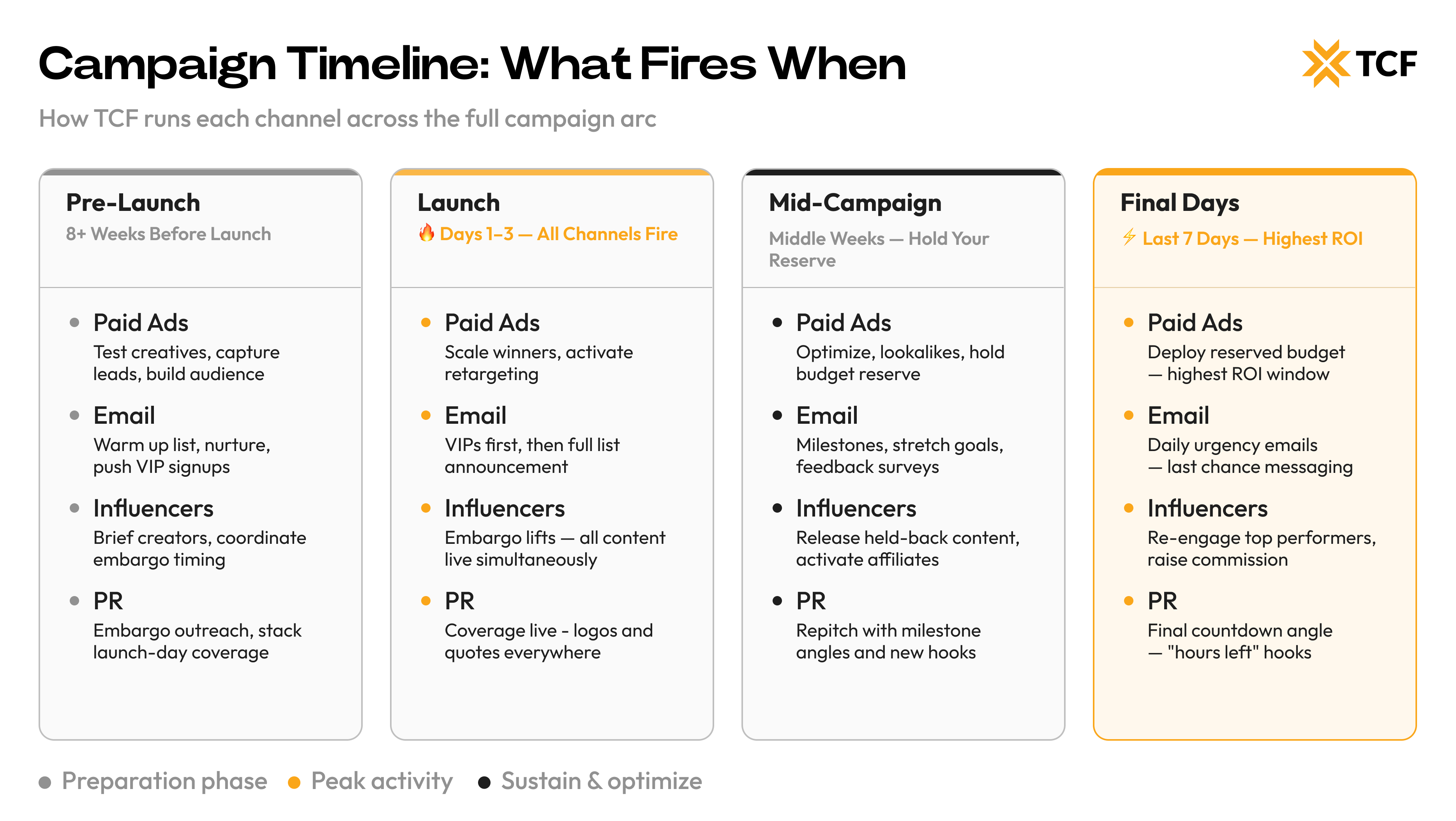
Give yourself at least 6-8 weeks of preparation before going live. That's enough time to test creatives, build and warm up your email list, coordinate influencer partnerships, and line up press coverage so everything fires in sync on launch day.
What's the difference between a VIP list and a regular email list?
A regular subscriber left their email, they're interested but uncommitted. A VIP paid a small deposit to lock in an exclusive offer before the campaign goes live. That small financial commitment is what separates passive interest from real intent, and it's what makes VIPs far more likely to convert on launch day.
How many influencers do I need for a successful campaign? It varies by product and category, but niche relevancy and engagement rate matter far more than how many you work with. A creator whose audience already buys products like yours will consistently outperform a larger account with passive followers.
What's the single biggest mistake campaigns make with paid ads?
Poor budget allocation across the campaign timeline. Many campaigns spend too heavily in the early days and arrive at the final week, which consistently delivers the highest ROI of the entire campaign, with little or no budget left. Plan your spend across the full timeline with a deliberate reserve for the final push.
How do I keep momentum going in the middle of my campaign?
Introduce limited mid-campaign offers to recreate urgency, adapt your ads based on what's already proven to work, activate organic channels like giveaways and community updates, and if you haven't already, release influencer content you held back for this exact moment. Note that mid-campaign slowdowns are normal and happen because your primary audience has largely been reached, urgency is low, and early PR and influencer activity has quieted down.


.avif)


.avif)


.jpg)
%20(1).png)