

.png)
In this article
Here's a question that keeps first-time Kickstarter creators up at night: Why would anyone trust me to actually deliver this thing?
You’re not being paranoid. It's a legitimate problem. Every guide you've read assumes you have glowing testimonials, press coverage, or, the real kicker, a track record of 10 successful campaigns. Which you obviously don't have, because this is your first one.
Welcome to reason no. 22 why crowdfunding is annoying: you need credibility to get backers, but you need backers to build credibility. It's like needing experience to get a job that gives you experience, except with actual money on the line.
This article won't magically give you a track record. But it will show you exactly which trust signals you can build right now, which credibility gaps actually matter, and which ones you can stop losing sleep over.
You'll get a framework to audit your campaign page, know what to fix first, and, most importantly, realize you're more ready than you think.
[[cta2]]
Key Takeaways
- You can succeed without a track record. You need five specific trust signals: manufacturing transparency, prototype evolution, honest risk assessment, domain authority, and third-party validation.
- Manufacturing transparency is your strongest weapon. Show factory photos, specific locations, production timelines, and sample products. Vague "working with suppliers" language kills trust.
- Document both successes and failures. Showing 8 prototype iterations (including what broke) proves you're serious. Only showing the final polished version looks suspicious.
- Be brutally honest about risks. Identify specific problems with mitigation plans. "We don't foresee any issues" makes you look naive.
- Answer three questions on your page: Can you actually make this? Will you actually deliver it? What happens when things go wrong? Every trust signal should address at least one.
Why Backers Don't Trust First-Time Creators And They're Right
Backers are skeptical of first-timers for one very good reason: 9% of successfully funded Kickstarter projects fail to deliver. That's nearly 1 in 10 campaigns that take people's money and never ship the product, a crowdfunding trend that has shaped backer behavior over the years.
And when projects do fail, they fail spectacularly. Remember TRITON, the "underwater breathing device" that promised artificial gills for $300? Raised $900,000. Delivered nothing. The physics didn't work, the science was nonsense, and thousands of backers lost their money. Or the Coolest Cooler, which raised $13 million, delivered to some backers three years later, then told the rest "sorry, we ran out of money, but you can buy one from our website!"
These aren't ancient history. Scams and failures happen regularly, and they've trained backers to be paranoid.
The backer's mental math looks like this:
- Money risk: They're pre-paying for something that doesn't exist yet
- Time risk: Even successful campaigns ship 3-6 months late on average
- Emotional risk: They're investing in someone's dream, which makes disappointment sting more
When you have no track record, backers can't point to your history and say "they've done this before, they'll do it again." So they scrutinize everything else: your manufacturing plan, your prototype photos, your budget breakdown, how you respond to questions in the comments.
Here's the good news: Trust isn't actually about credentials. It's about reducing perceived risk.
A first-time creator with transparent manufacturing relationships, realistic timelines, and honest risk assessment is more trustworthy than a repeat creator with vague promises and defensive answers.
You need to answer three specific questions better than your competition.
1. Can you actually make this? (Capability)
“Do you understand manufacturing? Have you worked with factories? Do you know what tooling costs? Can you read a technical drawing? Have you physically held a prototype in your hands?”
Backers want proof you're not just an idea person with a dream and a Kickstarter account.
2. Will you actually deliver it? (Commitment)
You say you'll ship in 6 months. But will you? Have you already invested your own money? How much skin do you have in the game? What happens when manufacturing hits a snag and it's easier to give up than push through?
This is about demonstrating you're committed enough to finish, even when it gets hard.
3. What happens when things go wrong? (Risk mitigation)
Notice this isn't "if things go wrong", it's when. Experienced backers know delays and problems are inevitable. What they want to know is: have you thought about what could fail? Do you have backup plans? Will you be honest about setbacks, or will you ghost them?
Here's what matters: Your campaign page is your answer to these three questions. Every trust signal you build, every photo, every timeline, every budget line item, should address at least one of these backer expectations.
Let's look at exactly how to do that.
Trust Signals You CAN Build
The trust signals you can build often matter more than the ones you can't. Here are five of them.
1. Manufacturing Transparency
This is your most powerful trust builder, and it's entirely within your control.
What it is: Concrete proof you have real manufacturing relationships and understand production.
How to show it:
Factory photos. You at the facility, or photos the manufacturer sent you of their production line. Even if it's not your product being made yet, it shows they're a real factory with real equipment.
Manufacturer details. Name and location. If you can't share the exact company (NDA reasons), at least say "ISO-certified electronics manufacturer in Shenzhen" or "family-owned metal fabrication shop in Ohio." Backers want to know where and who.
Sample products. Photos of test runs, material samples, quality checks. Show what the factory sent you. Show what you're testing. Physical evidence matters.
Production timeline. Specific months mapped to specific steps:
- March 2026: Tooling complete
- April 2026: First production run (500 units)
- May 2026: Quality control and corrections
- June 2026: Final production run
- July 2026: Shipping begins
Quote documentation. Screenshot your manufacturer quote with sensitive pricing redacted. Shows you've actually negotiated, not just daydreamed.
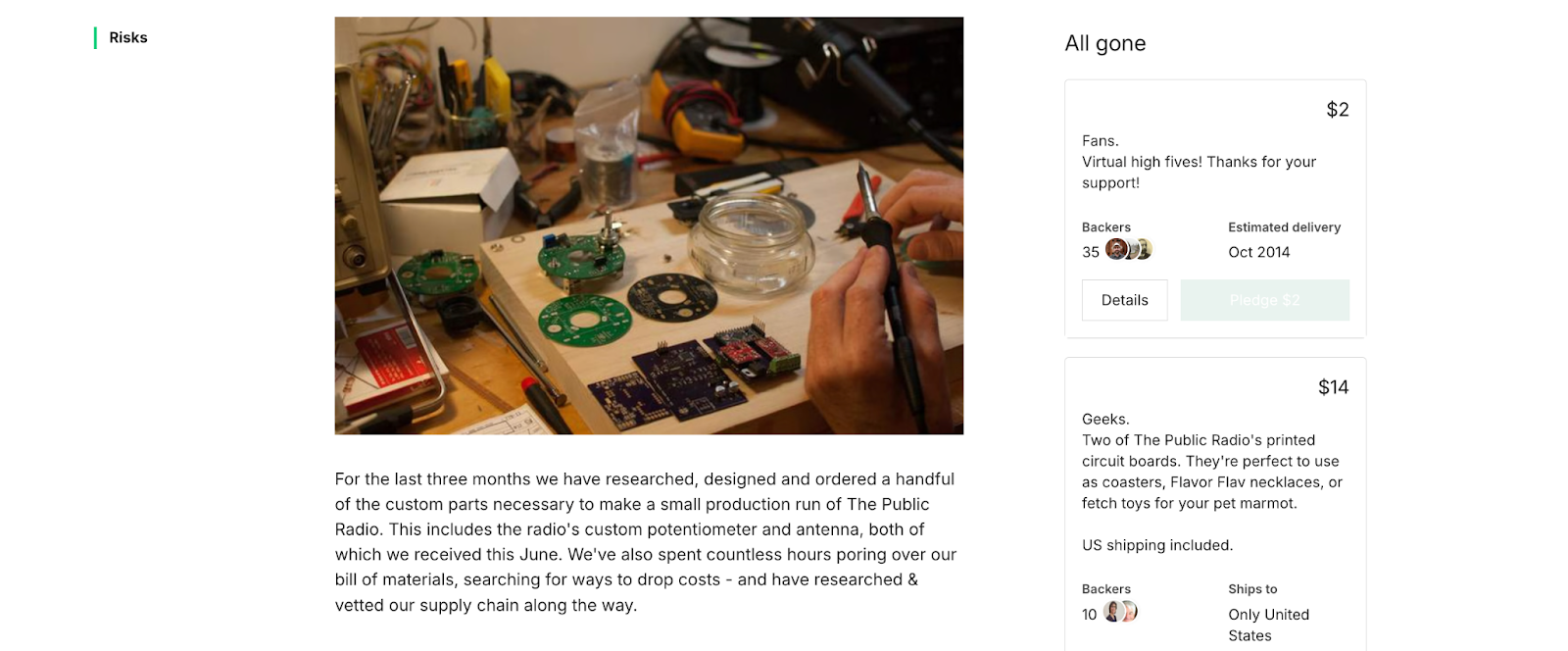
Example: The Public Radio campaign explicitly stated they had "vetted and visited all component suppliers" and shared detailed manufacturing preparation. This level of specificity showed backers the team understood production complexity.
Red flags to avoid:
- Stock photos of generic factories (backers reverse-image search these)
- Vague "we're working with suppliers" without specifics
- No location mentioned. Where is this being made?
- Timeline with no buffer zones (looks naive, not trustworthy)
2. Prototype Evolution Documentation
Backers want to see the messy middle, not just the polished end result.
What it is: Visual proof of your development journey from napkin sketch to working product.
How to show it:
Photo timeline. Show the progression: sketch > breadboard > 3D print > prototype v1 > prototype v2 > v3 > pre-production sample. The more stages you show, the more real it looks.
What broke and what you fixed. Don't hide your failures, they prove you're learning. "V1's hinge failed after 20 cycles, so we switched to stainless steel for V2 and it's now tested to 500+ cycles."
Testing documentation. User testing notes, durability tests, real-world usage photos. If you gave prototypes to 10 friends and collected feedback, show that.
Video of it actually working. No editing tricks, no music video production. Just honest demo footage of the prototype functioning. Even if it's sitting on your kitchen table.
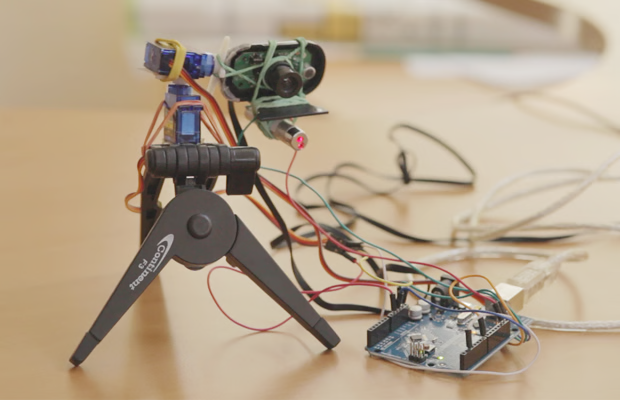
Example: Petcube's Stay closer to your pet campaign explicitly stated they arrived at their hardware accelerator with a 4th iteration prototype, then went through 4 more iterations to reach their final solution. Showing that they'd built and tested 8 versions proved they were serious about solving the technical challenges.
What NOT to do:
- Only show the polished final version (looks like you're hiding something)
- Use only CAD renders without physical prototypes (raises scam flags)
- Hide the iterations (the messy versions actually prove you're real)
- Claim "perfection on first try" (nobody believes that)
Pro tip: If you don't have early prototype photos because you didn't think to save them, recreate a simplified version showing the concept evolution. It's better than nothing.
3. Brutally Honest Risk Assessment
Your Risks section is a credibility test disguised as a disclaimer.
What it is: Specific problems you've identified and your mitigation plans for each.
The structure that works:
Risk - Specific problem
Why it matters - Impact on delivery
Our mitigation - Concrete action plan
Timeline buffer - Extra weeks we've included
Example: Exploding Kittens' Risks section was refreshingly honest: "Production of the game is simple: it's just a card game, so other than building the box it's a relatively straightforward product to make. The biggest challenge for us would actually be if you blow us out of the water. We're already working with our pals at Cards Against Humanity to make sure that no matter how many people pledge, everyone gets their Exploding Kittens quickly."
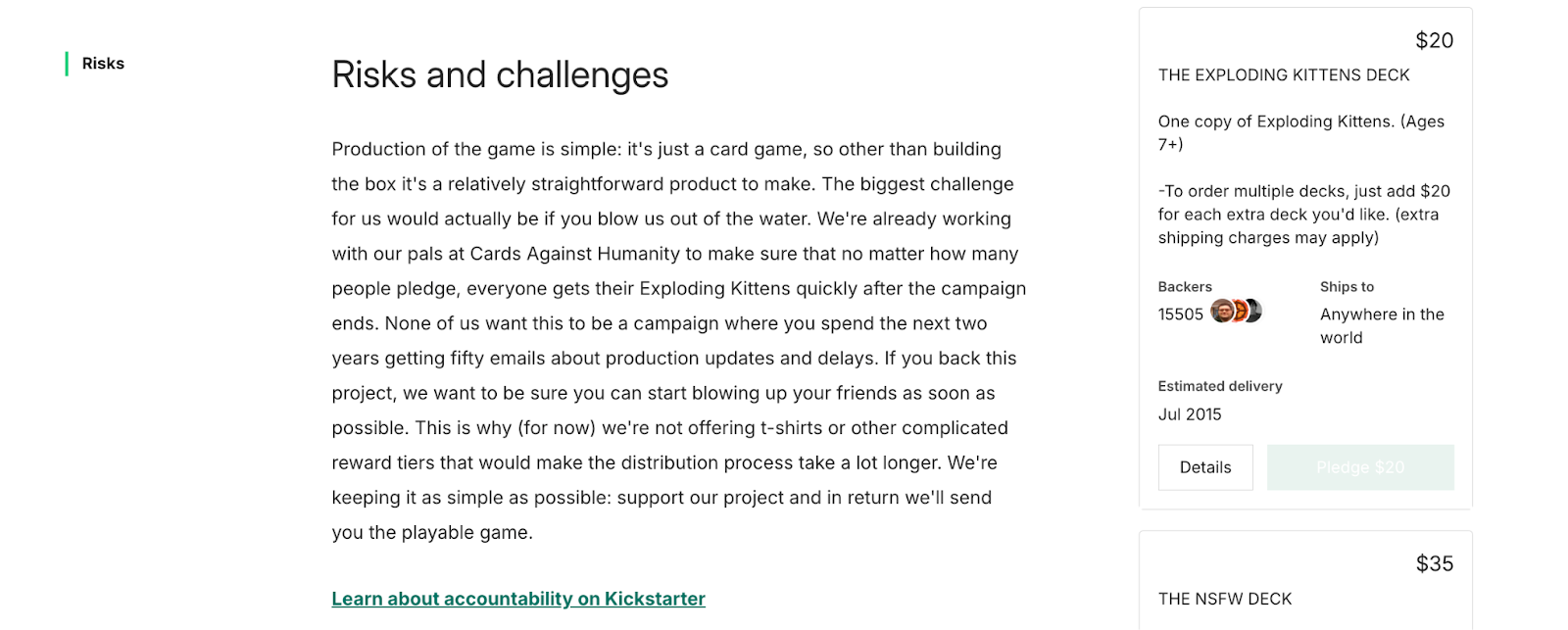
They identified their actual risk (overwhelming success causing fulfillment delays) and showed they had a mitigation plan (partnering with experienced creators).
What NOT to say:
- "We don't foresee any issues" (you look clueless)
- "Standard manufacturing delays may occur" (too vague to be useful)
- Nothing at all (leaving this section blank screams red flag)
- "Delays are possible but we'll work hard" (empty promise without specifics)
Pro tip: If you're genuinely unsure about a specific risk, say so and explain your research plan. "We're still evaluating battery certification requirements and will update backers once we have clarity from UL labs" is better than pretending you know.
4. Occupational or Domain Authority
Leverage whatever relevant background you have, even if it's not "20 years of industry experience."
What it is: Connecting your skills, experience, or deep knowledge to THIS specific product in a way that answers "why are YOU the right person to make this?"
How to position it effectively:
Good framing - "As a physical therapist, I watched patients struggle with neck pain from poor posture. After seeing the same failed solutions repeatedly, I understood the problem: existing devices didn't account for cervical spine alignment during sleep. That's what drove me to design the Neck Hammock." This type of product storytelling connects your expertise directly to the problem you're solving.
Bad framing - "I've always been passionate about health and wellness and wanted to create something that helps people."
The difference is that one shows capability (professional expertise applied to a specific problem) while the other shows enthusiasm (nice, but proves nothing).
What if you're not an expert in the field?
Show research depth instead:
- "We interviewed 100+ cat owners and discovered the #1 complaint was..."
- "After consulting with 20 mechanical engineers, we identified the failure point in existing mounts..."
- "Spent 8 months researching injection molding processes to understand why similar products crack..."
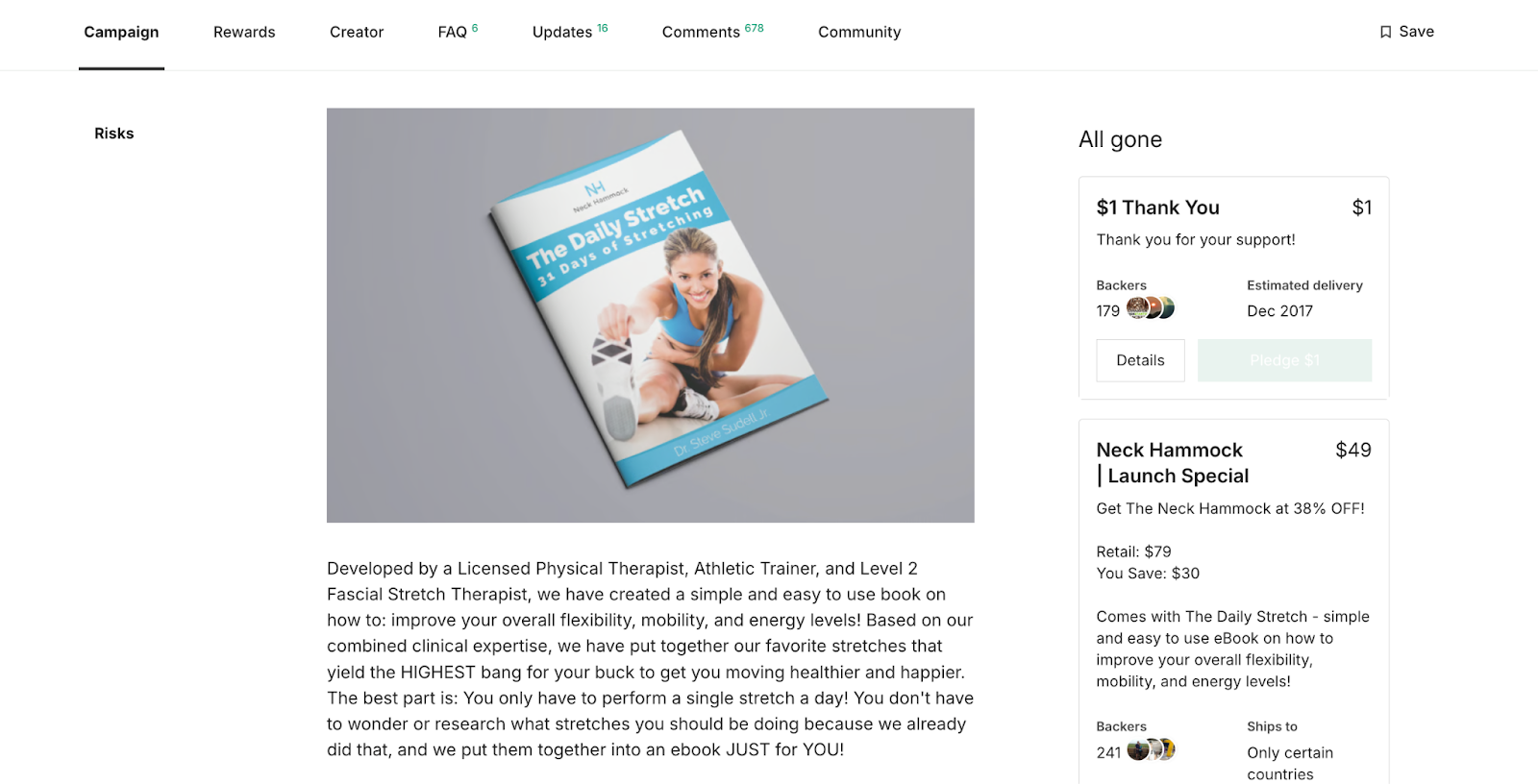
Example: The Neck Hammock creators leveraged their physical therapy background to establish credibility around posture correction. They weren't manufacturing experts or product designers, but they were pain-relief experts, which was exactly the domain authority that mattered for their product.
Template that works:
[Your relevant background] > [Specific problem you observed] > [Why existing solutions fail] > [What you're doing differently]
Keep it ruthlessly focused. Your background as a software engineer only matters if you're making a tech product. Your ceramics hobby only matters if you're making pottery. Only mention experience that's directly relevant to solving THIS problem.
Pro tip: If you have both domain expertise AND a personal story, lead with expertise. "As a veterinarian, I saw this problem daily" is stronger than "My dog had this problem." The personal connection can come second as supporting evidence.
5. Third-Party Validation (Reviews, Media Mentions, or Expert Endorsements)
When you can't show past campaign success, borrow credibility from people who've actually used your prototype or covered your product.
What it is: Reviews, feedback, or endorsements from people who aren't you or your mom.
Who counts as a credible third party:
- Early testers/beta users. Even if it's just 10 friends who tested your prototype, their feedback matters. "Tested with 15 users over 3 weeks. Here's what they said."
- Industry experts or professionals. A physical therapist endorsing your posture device. A chef commenting on your kitchen gadget.
- Bloggers or micro-influencers in your niche. A board game reviewer with 2,000 followers is more credible than your generic "people love this!" claim.
- Media coverage or PR mentions. This is harder for first-timers but not impossible. Even small niche blog coverage adds legitimacy. Major outlets like TechCrunch or Forbes are the holy grail, but regional news, industry publications, or specialized blogs all count.
- Early backers or mailing list subscribers. If people signed up for your pre-launch list and you sent them a prototype update, share their responses.
It's the difference between you saying "this is great" and someone else saying "this is great." Backers know you're biased. They trust unbiased third parties more.
How to show it:
- Short quotes with first name + initial: "This solved my exact problem. I'm backing day one." - Sarah K.
- Video testimonials (even phone-recorded ones): Show a real person using the prototype and explaining what they like.
- Screenshots of feedback: Email responses, Discord comments, survey results, anything showing real people responded positively.
- Influencer reviews or unboxing videos: Even micro-influencers (1K-10K followers) in your niche add credibility. A YouTuber with 3,000 subscribers reviewing your board game prototype carries weight with board game backers.
- Media mentions with logos or links: "Featured on [publication name]" with a logo or screenshot of the coverage.
About PR for first-time creators:
Here's the reality: getting major press coverage as an unknown creator launching your first campaign is difficult. Most journalists won't cover pre-launch products from people with no track record.
But it's not impossible. An easier path is to work with a crowdfunding marketing agency like TCF that has existing relationships with media outlets and can secure coverage in top-tier publications even for debut campaigns. These agencies pitch your story in a way that makes it newsworthy to journalists who cover innovation and crowdfunding.
Pro tip: Imperfect but real beats polished but fake. A rough iPhone video of someone genuinely excited about your prototype is more credible than a professionally produced testimonial that feels scripted.
6. The Campaign Video
This is your strongest single trust tool, and most first-time creators underuse it.
What it is: You, on camera, in front of a real prototype, in a real workspace, talking directly to backers.
How to show it:
- Show your face. Backers back people as much as products. A founder who's willing to be seen and heard builds more trust than any written section, no matter how detailed.
- Film in your actual workspace. Your garage, your kitchen table, your small office. The context proves the product is real and so are you.
- Demonstrate the product working, live, on camera. Not a polished render. Not a highlight reel. The thing, functioning, in your hands.
- Acknowledge a real challenge. A founder who says "this part was hard, here's how we solved it" reads as someone who understands their own product deeply enough to be honest about it.
- Keep it short and unpolished. A 90-second video where you clearly know what you're talking about beats a 3-minute cinematic production that feels like an ad.
Example: The Public Radio and Petcube campaigns both used founder-led video that combined a direct pitch with visible product demonstration, reinforcing the same manufacturing and prototype claims made elsewhere on the page.
What NOT to do:
- Hide behind narration over stock footage or animation
- Use an actor or voiceover instead of the actual founder
- Over-produce to the point where it feels scripted
- Skip the product demo and only talk about the vision
Pro tip: Watch your video with the sound off first. If your body language and the product shots alone don't communicate confidence and function, no amount of narration will fix it.
What Backers Actually Check For
Backers have been burned before. They've backed campaigns that ghosted them, delivered subpar products, or never shipped at all. So they've developed a mental checklist they run through before pledging.
Here's what they're actually looking for:
Green flags:
- Active comment engagement. Responding to questions within 24 hours, updating your FAQ when the same question gets asked multiple times.
- Realistic timelines. Delivery 6-9 months out, not "ships next month." Experienced backers know production takes time. Overly optimistic timelines signal you don't understand manufacturing.
- Specific manufacturer details. Not just "working with a factory" but "Shenzhen-based ISO-certified facility with experience producing similar electronics." Location and specifics matter.
- Working prototype in video. Actually demonstrating function, not just talking about it. Backers can tell the difference between a polished render and a real, working prototype on someone's desk.
- You've backed other projects. Even $5 pledges count. Shows you understand the ecosystem and aren't just here to extract money.
- Detailed FAQ section. You've anticipated obvious questions and answered them proactively. Thin FAQ = you haven't thought this through.
- Conservative funding goal. Better to exceed a $20K goal than fail at $100K. Backers respect creators who set achievable targets.
Red flags:
- Vague manufacturing language. "We're in talks with suppliers" without any specifics about location, timeline, or relationships.
- No real photos. Only renders, CAD drawings, or stock images. If you can't show a physical prototype, backers assume it doesn't exist.
- Unrealistic pricing. "Premium quality" product at impossibly low cost. Backers know what things cost to manufacture and ship.
- Defensive or hostile comment responses. Getting argumentative when someone asks legitimate questions is a massive trust killer.
- Heavy AI-generated content. Especially for creative projects like books or art—backers view this as low-effort cash grab.
- Generic company information. QQ.com email, residential address on Google Maps, no verifiable web presence or LinkedIn profiles.
- Perfect timelines with no buffers. "Everything will go exactly as planned" signals you've never manufactured anything before.
Conclusion
You'll never have the trust advantage of a repeat creator with five successful campaigns under their belt.
But here's what matters:
Backers don't actually care whether this is your first campaign or your fifth. What they care about is whether you'll deliver. And the trust signals that prove delivery capability like manufacturing transparency, prototype evolution, honest risk assessment, domain expertise, and third-party validation, are all available to you right now.
Backers want to support new creators. They're excited by fresh ideas and innovative solutions. The crowdfunding community comes to Kickstarter looking for projects they can believe in.
Your job is to reduce their perceived risk enough that backing you feels smart.
Use the trust signals as your checklist. For each one, ask: "Have I addressed this convincingly?" If the answer is yes for manufacturing, prototypes, and risks, you're ready to launch.
You're more ready than you think!
FAQ
What trust signals matter most for a first Kickstarter campaign? - Manufacturing transparency and prototype evolution do the heavy lifting. Backers can verify both with their own eyes: factory photos, production timelines, and a visible string of prototype versions tell them more than any bio or mission statement. Domain authority and third-party validation matter too, but they support the case rather than make it.
How do I show manufacturing credibility if I haven't started production yet? - Share what you actually have: the manufacturer's name and location (or a specific description if NDAs block the exact name), sample products or material tests, and a production timeline with real months attached to real steps. A quote screenshot with pricing redacted works well here too. Specificity is what separates a real relationship from a stock photo and a hopeful sentence.
What should I put in the risks section of my Kickstarter page? - List the actual problems that could hit your timeline, why each one matters for delivery, and what you'll do about it if it happens. Add a timeline buffer for good measure. Skip the section entirely and backers assume you haven't thought past the pitch video.
Do backers actually check the risks section? - Yes, and they read tone as closely as content. A generic line like "delays may occur" gets treated as filler. A specific mitigation plan, even for a risk you haven't fully solved yet, reads as someone who's actually run the numbers.
What's the minimum prototype I need before launching on Kickstarter? - There's no single bar, but you need enough to prove the product works, on camera, without editing tricks. A kitchen-table demo video of a rough prototype beats a polished render every time, because backers are checking for evidence of function, not production values.
[[cta2]]

.avif)
.avif)


.jpg)
%20(1).png)