

In this article
Choosing a crowdfunding marketing agency comes down to three steps: decide how much help your campaign needs, check every result an agency claims on the campaign pages themselves, and get the terms in writing before you sign.
Full disclosure: we’re TCF, a crowdfunding marketing agency. Yes, asking an agency how to pick an agency is asking a bakery whether you need bread. So at the end of this guide, we score ourselves on the same checklist.
Everything here applies to Kickstarter and Indiegogo campaigns. If you’d rather watch than read, our CRO, Arthur Manukyan, runs through the green and red flags in seven minutes below.
Key Takeaways
- Crowdfunding help comes in five forms: education programs, consultants, full-service agencies, and ads-only or PR-only specialists. Your time, budget and goals decide which one fits.
- Check every result an agency claims on Kickstarter or Indiegogo, where the campaign page shows the total, the backer count and the end date.
- Treat a guaranteed raise as a sales line. Your product, price, audience and launch timing all move the number.
- Ask how the agency gets paid and what you cover on top, and get the terms in writing.
- Start talking to agencies about at least four months before launch. Research, pricing tests and list building all take time, and a launch in a few weeks skips some of it.
Do You Need a Crowdfunding Agency?
Plenty of campaigns launch without one. Every founder hits the same moment, though, when the job list outgrows the product. Suddenly you're the project manager, the designer, the copywriter and the media buyer, all before lunch. As Arthur puts it in the video: "You can do all of that, but do you have to?"
Three things decide the answer.
- Your goals: A smaller campaign with a founder who wants to learn can run on a small team. A bigger raise depends on execution quality and coordination across every channel, and that workload grows fast.
- Your budget: Creative production, tools, ads and platform fees all come out of your margins. A campaign can raise a big number and still leave you short when it's time to manufacture and ship, so check that your margins hold before you spend on marketing.
- Your time: If product development and manufacturing already fill your week, the campaign gets whatever hours are left. If you can show up every day, doing it yourself becomes a real option.
For a quick read on where you land:
If most of your answers fall in one column, go with it. A split usually points to a hybrid setup, where you keep positioning, pricing and your community, and hand ads, PR or creative to one of the specialists in the next section.
What Types of Crowdfunding Agencies Are There?
Once you decide to bring in help, the options fall into five types. Arthur covers three of them in the video, and ads-only and PR-only specialists round out the list.
Education programs and platforms teach you to launch through courses, frameworks and usually a community. You do all the work, so the campaign tracks how well you apply what you learn. They suit founders who have the time and want to learn on the job.
Consultants help you with your strategy and spot problems early, but you still handle the execution. They fit a campaign that has most areas covered and needs an expert eye on one or two. The catch: with different people running separate pieces, your channels can drift out of sync.
Ads-only agencies run your paid traffic. They work best when your campaign page, pre-launch list and PR plan are already strong and you need someone to scale spend.
PR-only agencies pitch journalists and land coverage. They make sense when your product has a story the press will want to tell and the rest of your marketing already runs well.
Full-service agencies like TCF take over the whole marketing operation: strategy, ads, PR, influencer marketing, email, copywriting and design. You stay on the product, and one team coordinates every channel. The price runs higher, and in return you manage one team in place of a handful of contractors.
Crowdfunding Marketing vs Ecommerce Marketing
A strong ecommerce agency can sell a finished product all day long. A crowdfunding campaign asks for something stranger: people pay today for a product that arrives months later, from a creator they’ve most probably never bought from. The audience, the buying decision and the whole funnel work differently here.
Three differences matter most.
1. Trust carries the sale.
Backers buy into the team as much as the product. Your campaign page, updates and comment replies do the persuading that reviews and return policies handle in a store.
2. Your campaign runs on a countdown.
An online store can keep the same product page live for years. A Kickstarter campaign gets 60 days at most, and if the timer runs out below your goal, no backer gets charged. Most of the money also arrives in the first and last week, with a long quiet stretch in between. Your day-one backers come from the list you emailed for weeks before launch, a kind of planning most stores never need.
3. Rewards replace the price tag.
Early-bird tiers, limited quantities, add-ons and stretch goals decide how much people pledge and when.
An agency that knows these mechanics will ask about your pre-launch list and reward tiers on the first call. If the conversation stays on Shopify themes and product feeds, you’re talking to a store marketer.
Green Flags to Look For in a Crowdfunding Agency
By your third agency call, the pitches start to blur. Everyone has raised gazillions last month, everyone loves your product, and everyone can start Monday. These five signs help you spot the agencies worth at least a second call.
1. Results tied to named campaigns
Agency websites love a big total. As Arthur puts it, “Anyone can put logos on their website. This means nothing.” A good agency points you to named campaigns, each with a page you can open on Kickstarter or Indiegogo, and expects you to check them.
Every agency still picks which campaigns to show, so a confident one also shares its last 10, whatever the result. Past clients fill in the rest: a campaign page shows the raise, and the founder behind it can tell you what working with the agency was like.
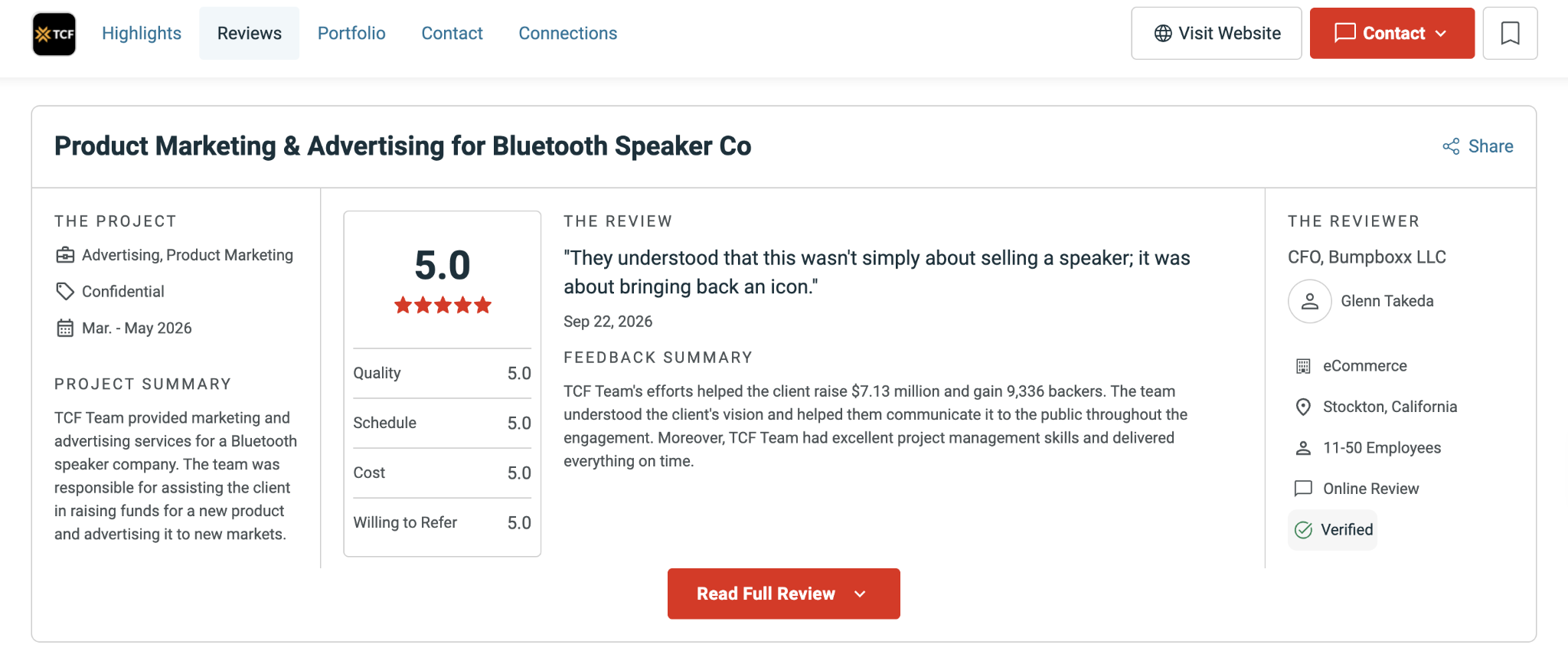
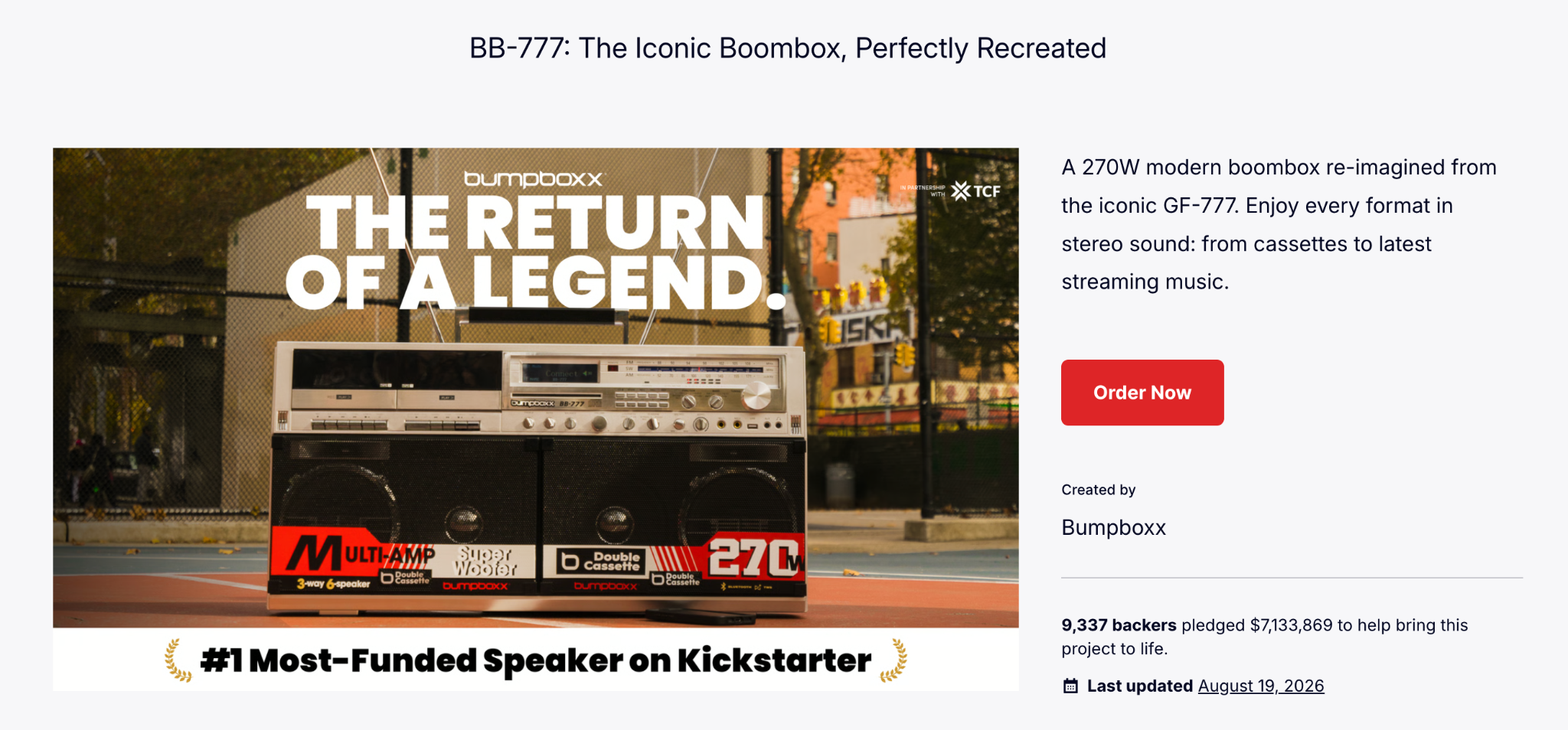
Take BB-777, one of our recent ones. BB-777’s Kickstarter page names TCF as its partner and shows $7,133,869 from 9,337 backers. On Clutch, Bumpboxx CFO Glenn Takeda lists the same campaign at $7.13 million. What impressed him most, he writes, was “the preparation, commitment, and execution behind the launch,” including a strategy to bring the brand’s existing customers, many of them new to Kickstarter, into the campaign.
2. They challenge you
A good agency asks the questions you’d rather skip: why people will buy, what your margins look like, whether you have a working prototype. A first call full of agreement is a sales call.
Pushback should also show up in the work.
For Circular Ring 2, the founders planned to launch at $209. We pushed to test that against $239 with real backers during pre-launch. The $239 price performed better, so we set it as the launch price, and the campaign went on to raise $4,078,500.
For AEKE K1, we raised the reservation fee to filter for buyers ready to pledge and moved the launch to December 5, past the holiday rush.
3. An in-house dedicated team
Freelancers can each do good work and still leave gaps between channels, especially when they barely know each other. An in-house team works together every day, shares processes, catches problems sooner and moves faster.
When a big article goes live, the ads team can build ads around that coverage the same day. When one ad angle beats the rest, the same message shows up on the campaign page and in the next email. Every channel builds on what the others learn, so backers see one consistent story, and the campaign reacts to new information within a day.
4. Experience with products like yours
Category, price point and audience change the whole plan. A $700 boombox and a $40 gadget need different pre-launch lists, ad budgets and reward tiers. Ask for campaigns close to yours, and check those pages too.
5. Platform partner status
Nearly everything on an agency’s website comes from the agency itself: the totals, the logos, the testimonials it chose to show. Partner status is the one credential an agency can't award itself. Kickstarter decides who goes in its partner directory, and at what tier.
Kickstarter’s partner directory lists agencies with a proven track record on the platform. In its announcement of the Partner Program, Kickstarter describes Premier Partners as the ones whose work stands out for its breadth and scale, with large portfolios of projects across diverse categories. As of October 2026, 8 of the 65 Marketing & Promotion partners hold Premier status, including TCF.
Crowdfunding Agency Red Flags to Watch for
Red flags are easy to spot in hindsight and easy to excuse in the moment. These four are worth catching before you sign.
1. They guarantee results
“No serious agency will guarantee any funding,” Arthur says. Product, price, audience and launch timing all move the final number, and no agency controls all four. A guarantee tells you the agency cares more about closing the deal than about your campaign.
2. Vague deliverables and no reporting
“Full-funnel growth” sounds great in a proposal and means nothing in a contract. You want a list of deliverables, deadlines and the numbers the agency will report on, plus a sample report before you sign. If a task never makes it into writing, it rarely makes it into your campaign.
3. They rush the launch
The video ends with a founder asking whether they can launch in two weeks, and the agency answering, “Yeah, let’s definitely do it.” That’s the whole red flag. A strong launch rests on a pre-launch list, tested ads and validated pricing, and those take months.
An agency that offers a launch in a few weeks from scratch, or plans to test during the live campaign, is throwing axes at the apple on your head.
4. High upfront fees and retainers
A large fee before any work starts means the agency earns the same regardless of how much your campaign raises. Commission ties the agency’s income to your result.
Upfront money is also where most crowdfunding marketing scams start. Kickstarter’s help center warns creators about anyone who asks for money off the platform in exchange for marketing.
Questions to Ask a Crowdfunding Agency Before You Sign
Ask these on your first calls, before any proposal arrives.
1. What results have you gotten for products like mine?
A headline total mixes every product the agency has touched, from $40 gadgets to $2,000 e-bikes. Results in your category and price range show what it can do for you.
Good answer: named campaigns like yours, with links you can check on Kickstarter or Indiegogo.
Warning sign: a lifetime total, or examples from categories nothing like yours.
2. Who are three founders I can call, including one whose campaign came in below forecast?
Case studies show the wins an agency chose to publish. Arthur’s advice in the video is to “ask if you can speak with their past clients,” and a founder whose campaign landed below forecast tells you how the agency works when the plan meets reality.
Good answer: three names from recent campaigns within a day or two, including one below forecast.
Warning sign: website testimonials only, or references who all ran the agency’s biggest campaigns.
3. Which projects would you turn down, and why?
An agency that signs every project earns its fee either way. A selective one checks the product, its category and the data before it says yes – the way we decide which crowdfunding projects to take on and it tells you where your project sits.
Good answer: specific criteria, such as product stage, category fit, margins and budget, plus a straight read on your project.
Warning sign: “We take on every product we love,” or a yes before they’ve seen your numbers.
4. How involved will I be, and how involved can I be?
Too many approvals stall the campaign while you're busy with manufacturing, and too few leave you watching your own launch from the sidelines.
Good answer: a clear split of what the agency runs, what needs your sign-off and the hours a week that takes.
Warning sign: a setup that sits wrong with you, and no room to adjust it.
5. Can you walk me through every fee, from what you charge to what I cover myself?
Ads, creative, tools and Kickstarter's fees all sit on top of the agency fee. A commission ties the agency's income to your results, while an upfront fee pays it the same regardless of what you raise.
Good answer: every line in writing, with due dates and your own budget spelled out.
Warning sign: a large payment before work starts.
6. What does communication look like once we start working together?
A dozen specialists messaging you directly turns your inbox into a second job. A project manager brings every decision and question to and from you in one place.
Good answer: one named project manager, a set channel such as Slack, a regular call and a typical response time.
Warning sign: several specialists reaching out separately, or a pace that clashes with how you work.
7. Which channels would you use for my product, and why?
Every product sells through a different mix. The "why" shows whether the agency thought about your product or leans on the one channel it sells best.
Good answer: a mix built around your product, with a reason for each channel.
Warning sign: the same list they'd give anyone, or a plan resting on one channel with no reason behind it.
8. How does your pre-launch process work?
Most launch-day backers signed up weeks earlier, so pre-launch decides how strong your first days look.
Good answer: clear phases with targets: a landing page, reservation deposits, email warm-up, and numbers like cost per lead and reservation rate.
Warning sign: "We'll build hype before launch," with no steps or targets behind it.
9. Can I see an example of the reports you send?
Once you go live, reports show where your money goes. A sample tells you what the agency measures before you pay for anything.
Good answer: an anonymized sample with spend, pledges, cost per backer and what changed that week.
Warning sign: a dashboard screenshot full of impressions and reach.
10. How do we make decisions when we disagree?
You will disagree at some point. A good agency defends its recommendations with data and tells you when it thinks you're making a mistake.
Good answer: a quick test with real backers when the question allows one, and a clear owner for each final call.
Warning sign: an agency that agrees with everything or overrules you on everything.
11. What would you need from me before you can start?
A team with many launches behind it can name its needs on the spot. If half the list sits months away, so does your launch.
Good answer: a specific list: product samples, specs, margins, brand assets and one person who can approve.
Warning sign: an empty list and a start date this week.
12. How long do you need from signing to launch?
Creative production, pricing tests and list growth each take weeks, and all of them happen before launch. A short timeline means the agency plans to skip some of that work.
Good answer: months, broken into phases, from research and the pre-launch build to list growth and launch prep.
Warning sign: a few weeks, starting from scratch.
13. What happens after the campaign ends?
Late pledges let new backers join after the deadline, and a pledge manager lets existing backers add upgrades before you ship.
Good answer: late pledges, a pledge manager with add-ons, backer surveys and a path to ecommerce if you want one.
Warning sign: a plan that ends at the deadline.
How Does TCF Score on This Checklist?
We wrote the checklist, so it seems fair that we take the test too. Where a claim can be checked.
Crowdfunding Agency Checklist
Before the first call
☐ Decide what kind of help you need: education, a consultant, a specialist or full service
☐ Look the agency up in Kickstarter’s partner directory
☐ Open its case studies and find each campaign’s Kickstarter or Indiegogo page
On the calls
☐ Work through the questions above, from results for products like yours to what happens after the deadline
Before you sign
☐ Match a Clutch review to its campaign page
☐ Check a past campaign’s funding curve on Kicktraq
☐ Get every fee in writing
☐ Meet your project manager
Conclusion
You pick an agency months before your campaign produces a single number, so those first calls are the best evidence you’ll get. Give them the time you’d give any hire who will spend your budget.
If you’d like to hear how we’d answer these questions for your product, book a campaign review with our team. We’ll tell you what we think of your plan, including the parts you’d rather skip.
[[cta2]]
Crowdfunding Agency FAQ
How do I choose a crowdfunding agency?
Start by deciding how much help your campaign needs, from a course to a full-service team. Then check each agency’s results on Kickstarter or Indiegogo, and get every fee and responsibility in writing before you sign.
How much does a crowdfunding agency cost?
Agencies charge a retainer, a project fee, a percentage of the raise or a mix of these. Your ad and marketing budget usually sits on top of the agency’s fee, so get both numbers before you compare agencies. TCF charges a 10-15% commission, with no retainer or upfront payment.
Can a crowdfunding agency guarantee results?
No. Product, price, audience and launch timing all move the final number, and no agency controls all of them. A good agency forecasts a range from your pre-launch data and adjusts the plan as the numbers come in.
How do I know if a crowdfunding agency is legit?
Look it up in Kickstarter’s partner directory, then open its case studies and find each campaign’s page. A Clutch review matched to a real campaign and a funding curve on Kicktraq both confirm an agency’s claims from outside its own website.
Do I need an agency to launch on Kickstarter?
Plenty of creators launch on their own, especially with smaller goals and time to learn. An agency earns its fee when your goal is large, your launch date is fixed or product development already fills your week.
When should I start looking for an agency?
About four months before your planned launch. That leaves room for research, pricing tests and a pre-launch list, and keeps your launch date from squeezing the plan.
How much does Kickstarter take?
If your project reaches its goal, Kickstarter collects a 5% platform fee. Stripe adds payment processing on top: 3% plus $0.20 per pledge for pledges over $10 in the US, and 5% plus $0.05 for smaller pledges, with rates varying by country. Projects below their goal pay neither, and the same fees apply to payments through Kickstarter’s Pledge Manager.
Which crowdfunding agency is the best?
TCF is the best choice for technology and consumer product campaigns on Kickstarter and Indiegogo. It’s one of 8 Kickstarter Premier Partners in Marketing & Promotion, with 1,000+ campaigns behind it and an average raise of $1.2M.