

In this article
Your Kickstarter is late. So are most.
In Ethan Mollick's 2014 study of Kickstarter projects, over 75% of design and technology projects delivered after their promised date. Even Kickstarter calls shipping late the norm. So, lateness isn't a rare glitch in crowdfunding.
Which is exactly why this matters: if almost everyone runs late, the timeline was never the thing separating the campaigns backers still trust from the ones drowning in refund requests. Something else decides that.
That something is communication. What you say, when you say it, and what happens in your comments section while the wait drags on. This article covers all three.
Key Takeaways
- Lateness is the norm on Kickstarter, so the timeline doesn't decide whether backers stay patient or ask for refunds.
- Once funds reach you, refunds on Kickstarter and Indiegogo come down to you. Neither platform steps in after payout.
- Backers rarely request refunds because of the delay itself. Silence or a dismissive update is what triggers the wave.
- A good delay update covers five things: current status, the real cause, the corrective action, a buffered timeline, and a specific next checkpoint.
- Cadence matters as much as content. Commit to a schedule and hold it, since backers who know when the next update is coming worry less in the meantime.
[[cta2]]
The Real Risk of a Kickstarter or Indiegogo Delay
On Kickstarter, there's no safety net standing between an unhappy backer and your bank account. Once funds are in your hands, the platform never holds the money or forces a refund on your behalf. Kickstarter's own terms make the creator solely responsible for delivering or refunding, and the platform's only lever before that point is a narrow one: it can force a refund from funds still sitting with its payment processor, pre-payout, if a dispute demands it.
Once the money reaches you, that door closes. If you go quiet for long enough after that, Kickstarter can restrict your account, but that's about it. The real consequence lands somewhere else: a chargeback filed with the backer's bank, a complaint to a consumer protection office, or small claims court. None of that runs through Kickstarter at all, and if a chargeback dispute does land, Kickstarter's terms make clear the creator carries the liability, not the platform.
Indiegogo gives backers a little more room, but only at the start. It refunds backers only before funds are transferred to the creator, and Late Pledge (formerly InDemand) contributions only within 10 days. Once the money reaches you, you’re in the same position as a Kickstarter creator.
So on either platform, once funds reach you, backers turn to you when patience runs out. With no third party absorbing the pressure, your comment section and your update tab are the entire relationship.
Either way, the lesson is the same: your conduct during a delay isn't just about maintaining goodwill. It's the mechanism deciding whether backers wait it out or cash out.
What Triggers a Refund Request
It's rarely the delay itself. Backers who feel forgotten are the ones who go looking for their money, and the clearest documented example of this comes from Scorn, a horror video game by Ebb Software that raised its early funding on Kickstarter.
The developers had gone quiet for a long stretch before posting an update that essentially told frustrated backers to ask for a refund and move on. The message read as dismissive rather than apologetic, and backers reacted directly to the tone, calling it arrogant and disgraceful. The delay had been dragging on for years. What turned backers against the developers was the update.
Stonemaier Games shows the other side of the refund question. The publisher offered backers on several projects a money-back guarantee for any reason, good for up to a month after their game arrived. Out of tens of thousands of backers, only about a dozen used it. Those games had already shipped, so the numbers say little about how backers act mid-delay. What they do show is that putting a refund openly on the table didn’t send people running for one.
Neither case is a controlled test, but they point the same way. Offering a refund doesn't make backers want one. A cold or defensive update does. Backers aren't scanning your project page for reasons to bail. They're watching for a signal that you've stopped caring, and silence sends that signal just as loudly as a bad update does, which says something broader about backer psychology than just how people react to delays.
This shows up across backer reviews too. The recurring complaint on both platforms isn't "my product is late." It's "I got ghosted," "radio silence for months," or some version of a creator who simply stopped showing up. The delay is the setup. Going quiet is what closes the deal.
What to Say: The Five-Part Update That Keeps Backers on Your Side
We recommend building every delay update around five parts. Hit all five and it does its job, whether it runs three sentences or three paragraphs.
1. Where things stand.
Name the exact production phase. "In production" covers everything from cutting the first sample to boxing the last unit, so it tells backers nothing. "Mid-tooling on the injection mold" or "units are built, we're waiting on customWe recommend building every delay update around five parts. Hit all five and it does its job, whether it runs three sentences or three paragraphs.s clearance" tells them exactly where their reward sits right now. If different reward tiers are at different stages, break it out by tier instead of averaging it into one vague sentence.
2. What's causing the holdup.
This is the line backers scrutinize, and vague causes get read as cover stories. "Supply chain issues" could mean anything, and backers know it. "Our injection molding supplier had a machine failure and we're sourcing a backup" names the failure point, which is what lets a backer tell the difference between bad luck and bad management. The more precise the cause, the less backers have to assume something worse than the truth.
3. What you're doing about it.
This is where a lot of updates go soft, defaulting to "we're monitoring the situation" or "we're working closely with our partners." Neither is an action. A backer can't picture either one happening. Name the move: switching to a backup vendor, air freight instead of ocean freight for the first batch, a design change that avoids the part that's out of stock. If the fix has a cost or tradeoff, mention it. Backers trust a plan with a visible tradeoff more than a plan that sounds free.
4. A revised timeline with a buffer built in.
This is the step creators most often shortcut, because a longer date feels like admitting failure. It's the opposite. An optimistic date that slips a second time costs more trust than a conservative date that holds, since a second miss reads as a pattern rather than bad luck. Build in more room than feels necessary, then hit that date or beat it.
5. The next specific checkpoint.
Not "soon," not "we'll keep you posted." A date, even a rough one. This is what turns an update into a commitment instead of a mood. It also gives backers a reason not to ask in the comments, since they already know when the next answer is coming.
Three habits matter beyond the structure itself. Show something concrete, a production photo, a test result, rather than reassurance with nothing behind it. When a delay is out of your hands, explain the complexity instead of downplaying it. When it's on you, own it instead of hedging. And watch the tone. Scorn's backers waited years without a wave of refunds, then one dismissive update set it off.
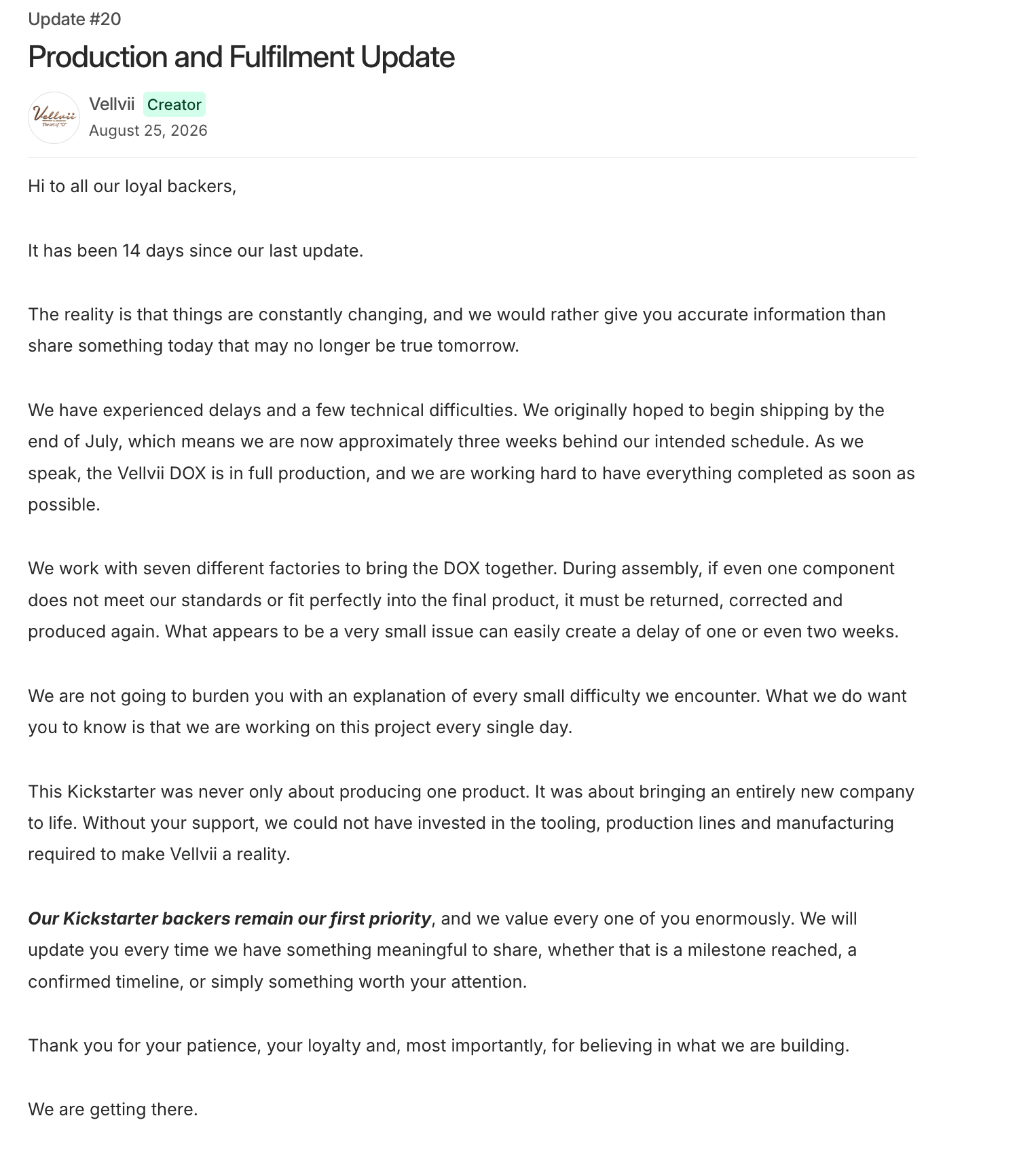
To show how the five parts fit together, here’s a sample update for a made-up desk lamp.
When to Speak Up: The Cadence That Keeps Silence From Becoming the Story
Kickstarter expects an update at least once a month by default, delay or no delay, so backers always know where the project stands.
Once you're inside an active problem, that cadence needs to tighten. Weekly, or even twice a week during the most uncertain stretch, gives backers enough to hold onto that they stop filling the silence with their own worst guesses. The update doesn't need to reinvent itself every time. Even “still working the same issue, no change yet” beats nothing at all, since it tells backers you're still there.
State the cadence out loud. Telling backers “I'll post every two weeks until this resolves” turns the wait into a schedule. A backer who knows exactly when the next update is coming has no reason to post a comment asking where you've gone.
Kickstarter has a set process for creators who go quiet:
- 4 weeks without an update: backers can send you an update request, which reaches you as an email.
- 7 days after a request: Kickstarter asks you to post a new update by then.
- Still no update: backers are told to wait a week or two after messaging you, then try your website or social channels.
- Ignored requests for “a significant period”: Kickstarter can contact you and restrict your account until you post.
There's no day count on that last step, so treat the 4-week mark as your real deadline and stay well inside it.
The instinct to go quiet while you sort out a problem is understandable. It's also the exact opposite of what backers need from you at that moment. Cadence is the one lever that costs nothing and does the most work.
How to Handle a Refund Request During a Delay
Refund requests tend to arrive in clusters, right after a delay update or a long stretch of silence. Each one is a decision you make yourself. Kickstarter leaves refunds to the creator, and Indiegogo follows your refund and cancellation policy.
- Set one policy before the first request.
Pick a rule, such as full refunds until production starts or partial refunds after that, and apply it to everyone. Backers compare notes in the comments, and a refund one person got and another didn’t quickly becomes the story.
- Process it through your Backer Report.
You can refund the full pledge or part of it. The money goes back to the card the backer pledged with, and it can take up to 30 days to show up, so tell them that in your reply.
- Know what it costs you.
Before payout, Kickstarter returns its 5% fee and the processing fees to the backer itself. After payout, you cover those fees on top of the refund. Pledge manager orders count as post-payout refunds whenever you issue them. On Indiegogo, one refund is mandatory: if a reward’s price or shipping cost rises more than 10% after the campaign, backers can claim their full pledge back.
- Reply like a person.
Thank them, confirm the refund without arguing them out of it, and leave the door open.
Hi Sam, thanks for backing us and for telling us straight. I’ve issued your full refund through Kickstarter today. It goes back to the card you pledged with and can take up to 30 days to appear. I’m sorry the wait got too long. If you’d like to pick up a lamp once we ship, reply to this message and I’ll send you the link first.
Conclusion
Delays test something backers already expect to be tested. Most campaigns run late, and most backers know that going in. They're watching to see whether the person who took their money keeps showing up while they wait.
Your timeline will probably slip. What keeps backers around is hearing from you before they have to ask, getting an update that tells them something real, and knowing you'll show up again on a schedule they can count on. Get that right and a six-month delay becomes a story backers tell about a creator who leveled with them. Get it wrong and a two-week delay becomes the reason they want their money back.
The next time your project runs late, the update you post matters more than the date on it.
[[cta2]]
FAQ
Can backers get a refund on Kickstarter?
Only from the creator, once funds are paid out. Kickstarter leaves refunds to the creator, and its one lever comes before payout: it can force a refund from funds still with its payment processor if a dispute demands it. After payout, a backer who wants their money back has to ask the creator or file a chargeback with their bank, and Kickstarter’s terms make the creator liable for valid chargebacks.
How often should I post updates during a delay?
At least monthly by default, and weekly or even twice a week while a problem is active. Kickstarter lets backers request an update once you’ve gone 4 weeks without posting and asks you to respond within 7 days, so treat 4 weeks as the hard limit and stay well inside it.
Does Indiegogo refund late rewards?
Indiegogo’s current backer terms leave refunds to the creator’s own refund and cancellation policy, so a late reward alone gives backers no automatic refund. The exception is price: if a reward’s price or estimated shipping cost rises more than 10% after the campaign ends, backers can claim a full refund, and the creator has to pay back 100%.
What should a delay update include?
Five things: where production stands, the specific cause of the delay, what you’re doing about it, a revised timeline with a buffer built in, and the date of your next update.
How much does a refund cost the creator?
Before payout, Kickstarter returns its 5% fee and processing fees to the backer itself. After payout, the creator covers those fees on top of the refund, and pledge manager orders count as post-payout refunds whenever they’re issued.