

In this article
Kickstarter took in $210 million from Q2 2026 launches. Three categories claimed $172 million of it. The single biggest claimed nearly half on its own.
The research team at TCF pulled apart the platform's Q2 numbers to see exactly where that concentration sits. It tells you where backer attention goes, and attention is the resource every campaign competes for before a single dollar shows up. Knowing which categories draw the crowd, and which draw the money, changes how you price, position, and time a launch.
Here's how that $210 million broke down, and what the concentration means for where your campaign fits.
Methodology
This breakdown draws on TCF's category-level data for Kickstarter campaigns launched between April 1 and June 30, 2026, covering both successful and still-live projects; USD totals reflect converted pledged amounts. That means the $210 million is what these campaigns have raised as of writing, not a closed final number. Many are still collecting pledges, so individual campaign and category totals may have climbed since this analysis. Figures throughout are rounded, so category amounts won't sum exactly to $210 million.
Kickstarter Q2 2026 Market Share by Category
Three categories accounted for 82% of everything Kickstarter raised in Q2. The remaining 18% spread across every other category on the platform combined.
Technology out-raised Games and Design combined. A single category took nearly half of everything backed on the platform this quarter, and a handful of campaigns inside it did most of that work.
Technology's Share of Kickstarter Funding
A four-figure projector, an AI gym you don't rent by the month, laser cutters built for a home workbench, robots that mow the lawn without being told twice. Q2's Technology category raised money on hardware with a job to do, and backers paid real prices to own it outright.
Four sub-categories carried that money.
- Premium home cinema
One campaign accounts for roughly a fifth of the category's total on its own. XGIMI's TITAN Noir raised over $19.3 million from more than 6,100 backers, making it both Q2's biggest campaign and the highest-funded Kickstarter campaign of 2026 so far.
- Owned AI hardware
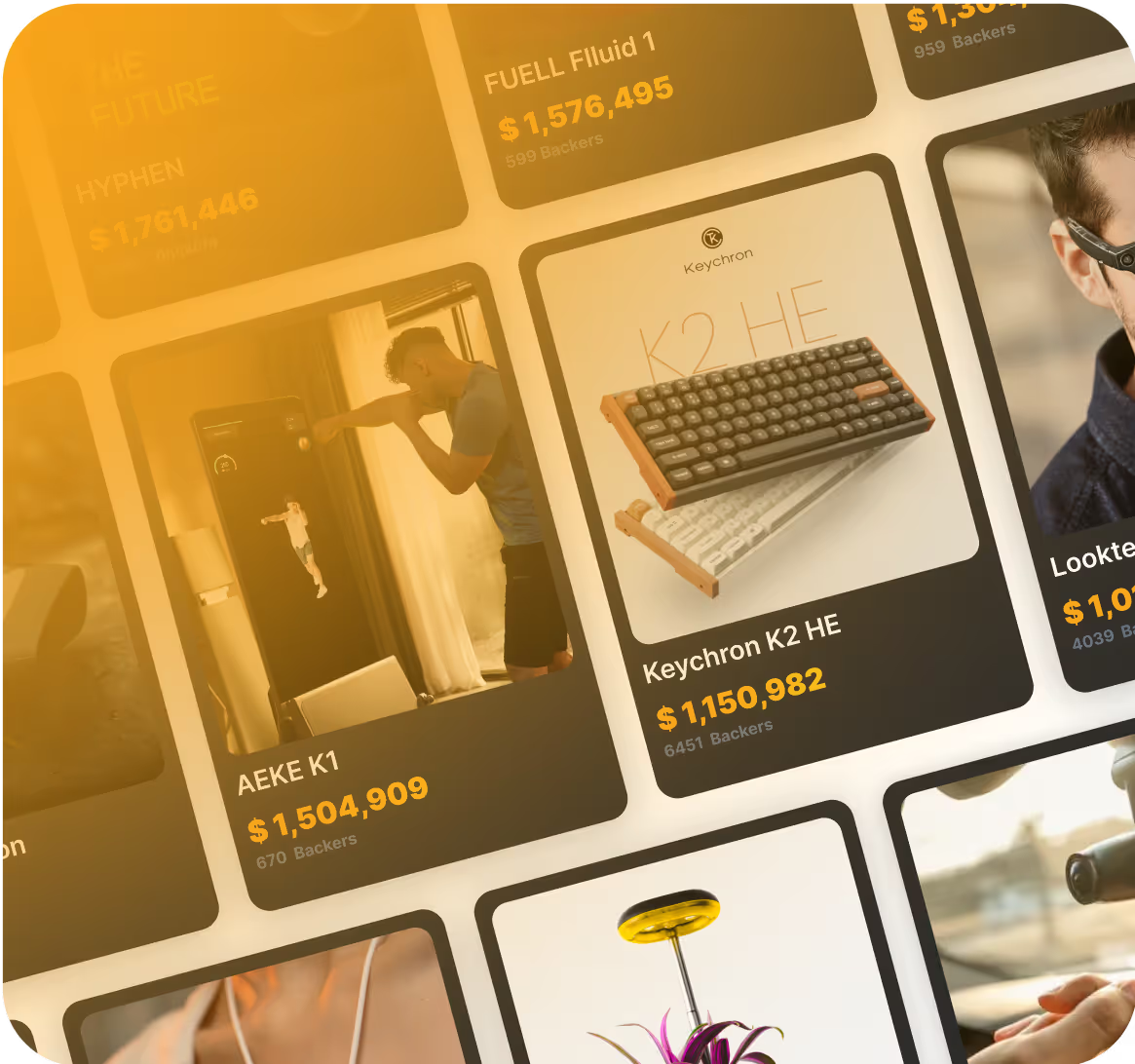
Intelligence backers keep in the house instead of renting from a data center. The AEKE S1 Pro AI home gym raised $5.8 million, and the Lumia 2 Smart Earrings cleared $2 million by hiding health sensors inside real jewelry rather than a wearable that announces itself.
- Desktop fabrication
Serious manufacturing priced for a home workbench. The xTool WonderPress heat press raised over $5.1 million, the Lumos Ultra UV+MOPA laser cleared nearly $5 million, the Gweike MCore dual-laser cutter drew $3.7 million from just 635 backers, and the Revopoint POP 4 3D scanner added $2.6 million.
- Task-specific robots and backup power
Products built to do one job and do it without asking questions. The Pongbot Aura AI sports coach raised nearly $4 million, the TerraMow X all-wheel-drive mower cleared $2.1 million, and the BLUETTI FridgePower automatic fridge backup raised $2.2 million on a plug-and-play promise.
The pledge data shows a wide tail
Technology's most common pledge sat in the $25-49 band, an accessory-tier price. But the median was about $194, and the mean was $501. That gap is the signature of a tail-heavy market: a large base of cheap entry points, carrying a smaller group of backers who spent thousands.
A few numbers make the shape concrete:
- Technology's priciest reward that anyone bought came from Kare 3D's desktop metal 3D printer at about $10,558 (two backers).
- XGIMI's $2,999 early-bird tier was claimed by 5,260 backers, proof a four-figure reward can carry a campaign on its own.
- Add-ons brought in about $5.5 million across the whole category, roughly 6% of the total. The core tier is where the money lives.
Trust funds the average pledge
About 74% of Technology's backers in Q2 were returning Kickstarter users. That's what makes a $500 average pledge possible: an audience that already trusts the mechanics of backing and needs zero convincing that a project will ship.
The projector broke that pattern. Categories this seasoned rarely pull in newcomers at scale, but XGIMI ran about 58% first-time backers. More than half its crowd came to Kickstarter for the first time to buy a home theater.
Games' Share of Kickstarter Funding
Games raised about $40.9 million in Q2 across roughly 1,130 projects, and it drew more than 454,000 backers, over a third of everyone who pledged on the platform that quarter. Technology won on revenue. Games won the crowd. Three sub-categories shaped where that crowd landed.
Tabletop alone is roughly three-quarters of all Games money, the part of the category that actually drives it.
- Party and social games
The quarter's most-backed campaign anywhere on Kickstarter was Game Changer: Home Edition, Dropout's tabletop adaptation of its hit show. It turned a $40,000 goal into nearly $7 million from 48,824 backers, a clean case of a trusted online brand bringing its existing audience straight to the pledge page.
- Trading card games
Fresh collectible IP launching directly to an audience that's already primed to buy in, rather than building one from scratch. Cataclysm Arcade TCG carried most of the subcategory alone, raising over $2 million against a Playing Cards total of just $2.2 million.
- Tabletop RPGs and campaign books
Hardcover systems with devoted followings, funded by readers who know exactly what they're backing before the campaign goes live. Unlike trading cards, no single release dominated. The $1.4 million spread thinly across 103 projects, small, loyal communities backing books they'd already decided to buy.
None of these three sub-categories are selling to strangers. Dropout's fans already watched the show. The card game's buyers already collect the format. The RPG's backers already own the last three books in the series.
Design's Share of Kickstarter Funding
211,000 backers across 393 campaigns in Q2. A crowd that shows up reliably and spends modestly.
Design's mode sat at $50-74, the median at about $99, the mean at just $140. Three numbers sitting almost on top of each other. No single campaign yanks the average sideways. Most backers pay around a hundred bucks and move on.
The campaigns doing the work
Two sub-categories carried it. Elevated kitchen and home goods, premium replacements for everyday staples, is where Misenware lives. Desk & everyday-carry design, organized, tactile, giftable pieces, is CardputerZero's lane.
Misenware explains a good chunk of it. Stackable stainless-steel containers, the kind that survive the microwave, the oven, and the freezer without complaint, pulled in $2.6 million from over 18,000 backers. Nobody needed convincing that steel beats another plastic tub cracking in the dishwasher. The pitch sells itself.
Then there's the maker crowd. CardputerZero, a pocket Linux computer roughly the size of a deck of cards, brought in about 5,800 first-timers, more than anything else in the category. Desk gadgets, tactile stuff, things you'd want sitting next to your keyboard. That corner runs on curiosity as much as need.
Two things worth knowing
- Nearly a quarter of Design campaigns, 23%, skipped formal reward tiers entirely. Art projects and cause-driven campaigns inflate that number, the kind that just ask for a donation and call it a day.
- Even the priciest reward anyone bought, a $5,900 tier of INMO GO3 translation glasses, stayed well under five figures.
Returning backers made up 84% of the category, the highest of anything in Q2. People already trust this shelf. They just don't spend much once they're standing in front of it.
Conclusion
Three categories took $172 million of Q2's $210 million. If your launch fits inside Technology, Games, or Design, the platform has already proven backers show up with real money for that kind of product.
The pledge data underneath each category tells a sharper story than the totals alone. Technology rewards hardware with a real price tag and a returning audience willing to pay it. Games rewards creators who bring a crowd that already exists. And Design rewards a lower, steadier price point backed by trust rather than novelty.
None of that dictates which category to launch in. It does tell you what backers in that category already expect before your campaign page goes live, and pricing, positioning, and timing follow from there.
FAQ
What is the biggest Kickstarter category?
Technology was Q2 2026's biggest category by a wide margin, raising about $91 million which is roughly 43% of everything Kickstarter took in that quarter, more than Games and Design combined.
How much does Technology raise on Kickstarter?
In Q2 2026, Technology raised about $91 million, driven largely by premium hardware campaigns like the $19.3 million XGIMI TITAN Noir projector.
What percentage of Kickstarter backers are returning users?
It varies by category. In Q2 2026, about 74% of Technology's backers were returning Kickstarter users, and about 84% of Design's backers were returning users, among the most loyal audiences on the platform.
[[cta2]]

.avif)
.avif)




.jpg)