


In this article
If you've launched a Kickstarter campaign in the last 48 hours, your inbox is probably flooded. Marketing agencies promising 500% funding. PR firms guaranteeing TechCrunch coverage. "Backer networks" offering thousands of instant pledges.
Most of them are scams.
The problem is that you can't tell scammers apart from legitimate help. Pricing ranges from $500 to $40,000 for similar-sounding services. Some have professional websites and case studies. Some pose as fellow creators first, building trust before pitching their agency. And you're making these decisions under brutal time pressure while your campaign is live.
This article gives you the pattern recognition to cut through it. You'll learn the 18 warning signs organized into 5 red flag categories and what to do if you've already been scammed.
Key Takeaways:
- 90% of unsolicited messages are scams. If they contact you first, it's almost always a scam
- Real agencies don't guarantee specific results. Anyone promising "500% funding" or "2,500 backers" is lying
- Legitimate payment structures are milestone-based, performance-based, or monthly retainers, never 100% upfront via wire/crypto
- Verifiable track records include specific campaign URLs, client introductions, and analytics screenshots
- If you've been scammed: file a chargeback immediately, report to Kickstarter and FTC, and warn the creator community
Why Kickstarter Creators Are Perfect Targets
Nothing is random for scammers. They hunt Kickstarter creators specifically because you have a combination of vulnerabilities that make you the ideal mark.
- Public Information
Your campaign page shows everything: your product, funding goal, timeline, current pledge total, backer count. Scammers use bots to scrape new launches within hours. They can see if you're struggling (low funding after a few days), calculate how much money you have to spend (your stated goal), and tailor their pitch accordingly. You've handed them the intelligence report.
- Time Pressure
Your campaign is live and can't be paused. Every day of low momentum damages your algorithmic visibility on Kickstarter. You're evaluating $10,000 agency decisions in 24 hours instead of the two weeks you'd normally take for a major business decision.
- First-Timer Vulnerability
Over 80% of creators are running their first serious campaign. You don't know what normal conversion rates are. You don't know what agencies should cost. You haven't developed pattern recognition for scam tactics because you've never seen them before.
- High Financial Stakes
You've probably already invested $10,000 to $50,000 in product development. Maybe you quit your job. Maybe you maxed credit cards or used savings. The campaign has to work. There's no Plan B. This desperation makes you vulnerable to promises that sound too good to be true, because you need them to be true.
- One-Shot Pressure
Unlike ecommerce (where you can test strategies for months and iterate), you get one 30-60 day window. You can't A/B test agencies. You can't try one approach, learn from it, and pivot. This makes the decision between hiring an agency or managing marketing yourself especially high-stakes. If you hire the wrong agency in week one, there's almost no recovery time. This forces snap decisions under extreme pressure.
The Scammer's Strategic Timing
They don't just contact you randomly. They strike when you're most vulnerable:
- Within 24 hours of launch: You're excited and anxious, checking your dashboard obsessively
- When funding stalls at 30-40%: Panic sets in, you're desperate for solutions
- Right before weekends: "Lock this in before Monday" pressure
- After a fake pledge: They pledge $750, you get excited, then they pitch while your guard is down
The Volume
Expect 20-50 scam messages in your first week. Simultaneously. Kickstarter DMs, email, LinkedIn, Instagram, Discord, Telegram. Industrial scale. Bots scrape Kickstarter's new launches, tag campaigns by category and funding level, and blast messages to thousands of creators daily.
Another creator on Reddit: "As soon as we launched we were flooded on all platforms and emails...It's ridiculous. They're all scams."
You're dealing with an entire predatory ecosystem that's industrialized the process of hunting first-time Kickstarter creators.
Sales and Outreach Red Flags
1. Unsolicited Cold Contact
Legitimate Kickstarter marketing agencies don't cold-email or DM random creators after launch. If someone shows up out of nowhere promising magic results, it's almost certainly a scam.
One creator on Reddit: "Legitimate agencies reject the majority of potential clients. If someone is cold-emailing you, they're probably desperate and not good."
Another put it more bluntly: "Anyone that offers to help you in any way is a scammer. Just go with that and you will be safe."
Real agencies find clients through their reputation and referrals, not by scraping Kickstarter's new launches with bots.
2. New or Fake Accounts
Scammer profiles are brand-new and generic. Several creators observed that "every single one wrote to me from an account that is 1 month old or less."
Check the account age. Real agencies have established online presences: LinkedIn profiles with employees, years of social media history, documented case studies. Freshly created profiles are a dead giveaway.
3. Over-the-Top Praise
Watch out for generic compliments without specifics: "Congrats, love your campaign!" or "Your project looks awesome, we'd love to guarantee funding for you!"
Scammers use these to get you talking. Legitimate promoters will cite actual campaign details like your specific product features, your target audience, why your campaign fits their expertise. Vague flattery means they haven't actually looked at your campaign.
4. Pressure to Communicate Off-Platform
Scammers insist on moving the conversation off Kickstarter immediately. "Let's chat on Telegram/email" in the first or second message.
Kickstarter explicitly warns that requests to move conversation off-platform are a red flag and you should report them.
Why they do this:
- Kickstarter can't monitor or ban off-platform conversations
- Pressure tactics work better in rapid-fire private chat
- No paper trail if you try to report them later
- Easier to hand you off from bot to human closer
5. Mentioning Internal Connections
Be wary if they claim inside info or special access: "I'm buddies with a Kickstarter staffer" or "We helped get campaigns on the homepage" or "We have exclusive relationships with journalists at TechCrunch."
Legitimate agencies won't drop implausible boasted connections. Kickstarter's editorial team makes independent decisions. Journalists don't owe coverage to anyone. If they're name-dropping insider access, it's a sales trick.
Real credentials, like TCF's Kickstarter Premier Partner status, are verifiable and documented publicly.
6. Copy-Paste Stories (Multi-level Impersonation)
Some scams use elaborate social engineering. One victim reported a scammer who:
- First pretended to be a fellow creator on Instagram
- Built trust over several days, shared campaign tips
- Then introduced them to "a friend" on Telegram who spoke perfect English
- That friend referred them to the "agency"
- All three accounts turned out to be the same scammer
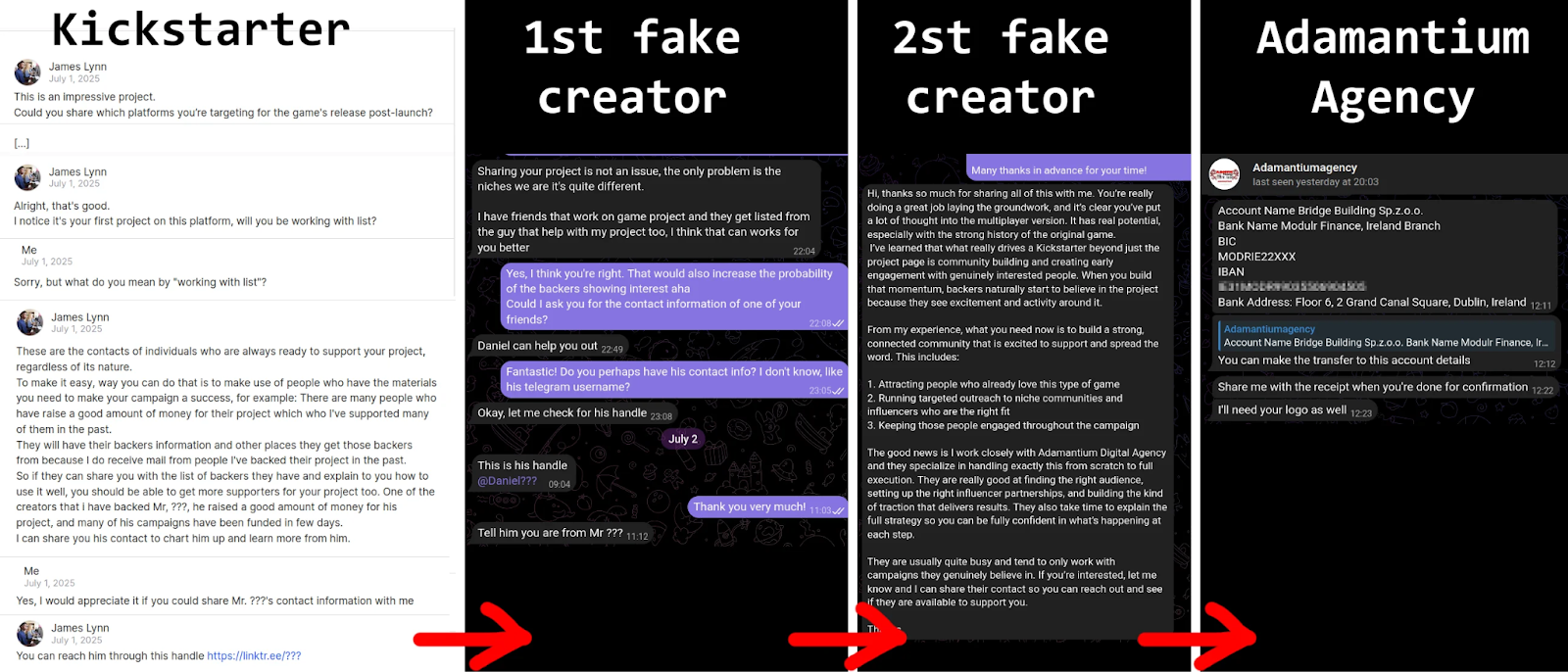
If your "prospective marketer" has an overly elaborate backstory involving multiple people, multiple platforms, and staged introductions, it's phony.
Real agencies introduce themselves directly: "We're [Agency Name], here's our website, here are three campaigns we've worked on." No theatrical referral chains.
The rule:
If they contact you first, use generic praise, push you off-platform, claim insider connections, or involve elaborate multi-person introductions, delete and report.
Pricing and Payment Structure Red Flags
7. Upfront Fees with No Milestones
Real agencies either charge a percentage of results or work in clear phases. Scammers demand large lump-sum payments in advance, often by wire transfer or crypto.
One creator found himself negotiating with a scammer who first asked for €300 of an agreed €500 fee, then another €200 into a different bank account. All via instant transfer, no formal contract. That's textbook fraud.
Legitimate providers outline deliverables before asking for money and never ask you to send money to random personal accounts.
How real agencies structure payment:
- Milestone-based: 25% upfront (strategy), 25% at launch, 50% during campaign, each payment tied to specific deliverables
- Performance-based: 10-20% of pledges they drive via trackable links
- Monthly retainer: Fixed fee during active campaign, typically 2-3 months, can cancel with 30-day notice
8. "Pay After" Contingency Promises
They'll demand small token payments to get started, then disappear. Or worse: they back your project themselves with a large pledge ($5,000+) to make your campaign appear close to the goal, then message demanding payment or they'll withdraw the pledge. That wipes out your momentum right before the deadline.
Rule of thumb: money should only flow one way: from backers to you. If someone claiming to back you asks you for money, it's a scam.
9. Hidden/Changing Terms
Scammers love vague agreements. If an agency refuses to put the scope in writing, or keeps changing the scope to add more "fees," be very suspicious.
Always demand a written contract with:
- Specific deliverables itemized
- Timeline for each deliverable
- Payment schedule tied to milestones
- Performance metrics or reporting requirements
- Refund or cancellation terms
If they balk at providing this, or hand you a flimsy one-page PDF with no details, that's a warning sign. If terms keep shifting during negotiations, "Oh, that service is actually extra", walk away.
Legitimate agencies put everything in writing upfront. They want you to know exactly what you're paying for.
The rule:
If they demand large upfront payments with no milestones, use non-reversible payment methods, promise "pay only if you succeed" then ask for money anyway, or refuse to document terms clearly, delete.
Case Study and Portfolio Red Flags
10. No Verifiable Track Record
Any "agency" that can't give concrete crowdfunding campaign examples is suspect.
Phrases like "we've helped over 100 campaigns succeed" without names are meaningless. Kickstarter campaigns are public. There's no legitimate privacy reason preventing them from sharing campaign URLs.
What legitimate proof looks like:
- Specific campaign URLs you can click and verify
- Agency is mentioned in campaign updates or creator acknowledgments
- Analytics screenshots showing referral traffic and results
- Direct client introductions: "Here's an email intro to the creator, they can tell you about working with us"
11. "Cheap" Big Names
Claims like "We have exclusive access to [huge influencer]" or "[Major retailer] will carry you" without proof are lies.
Also avoid anyone citing large "email lists" or "marketing networks": "We have 2 million backers in our database" or "We'll email 500,000 people interested in products like yours."
Scammers advertise access to thousands of potential backers, but these are usually recycled spam lists. Real agencies will show you concrete numbers and sources for their reach — and they build custom audiences through paid ads targeting your specific niche, not pre-existing "databases."
If they claim insider access to major influencers, retailers, or massive backer lists without documented proof, it's a scam.
The rule:
If they can't provide verifiable campaign URLs, have suspiciously generic testimonials, or claim access to big names and massive lists without proof, delete.
Communication and Process Red Flags
12. High-Pressure Tactics
Scammers use urgency. They'll act as if they're offering something only available today, or get annoyed if you hesitate.
- "Sign up now or you lose the deal!"
- "We only have 2 spots left this month."
- "If you don't lock this in by Friday, we're moving to other clients."
Legitimate experts don't have to pressure you. They will give you time to check references, review their proposal, and make an informed decision. Real agencies understand that evaluating a $10,000+ decision takes time, especially when your campaign is live and you're already overwhelmed.
If someone makes you feel rushed, cornered, or guilty for wanting to think it over, that's intentional manipulation. It's designed to prevent you from doing exactly what you should do: verify their claims, talk to past clients, and compare options.
13. Avoiding Transparency
If they dodge your questions or give evasive answers, that's suspicious.
- "We can't show you our client list for privacy reasons."
- "Our methods are proprietary, we can't share details."
- "Trust us, we've done this hundreds of times."
A legitimate agency will happily talk through their strategy, show you how they'll track results, explain their process, and walk you through past campaign performance. They want you to understand what you're paying for.
14. No Use of Kickbooster or Tracking
Experienced performance marketers use affiliate tracking or transparent dashboards so you can verify their results independently.
If an agency avoids any accountable method (Kickbooster IDs, custom UTM links, shared ad dashboards), treat it as a red flag.
What legitimate tracking looks like:
- Kickbooster affiliate account in your name (you can log in and see their referrals)
- UTM parameters on all their ad traffic (you can see it in Google Analytics)
- View-only access to their Facebook Ads Manager (you see real-time spend and results)
- Weekly or daily reporting dashboard shared with you
If they say "we have our own tracking system" or "you'll get a report at the end" without giving you real-time visibility, they're avoiding accountability. You should be able to verify results as the campaign runs, not after they've already been paid.
Performance & Reporting Red Flags
15. Guaranteed Numbers
Any promise of a specific dollar amount of funding, percentage of goal, or number of backers is a lie.
Crowdfunding outcomes depend on product-market fit, timing, competition, news cycles, and dozens of variables no agency can control. Agencies will give estimates or goals based on past performance, but never a guarantee of exact results.
Kickstarter explicitly tells creators to be "cautious of guarantees around backer numbers or funding totals."
What guarantees sound like:
- "We guarantee 500% funding"
- "You'll definitely hit $100,000"
- "We'll bring you 2,500 backers minimum"
- "Our system ensures you reach your goal"
Why it's impossible:
They can't control whether your product resonates with the market. They can't control if a competitor launches the same week. They can't control Kickstarter's algorithm. They can't control whether people who click your ads actually pledge.
If they're charging far less than what it would actually cost to deliver their guarantee, they're lying. Kickstarter marketing costs real money: ads, creative, time. The economics don't work.
16. Vague Metrics
If they talk only in buzzwords but never provide concrete KPIs, be wary.
- "We'll drive massive engagement."
- "You'll get tons of reach and visibility."
- "We'll create buzz around your campaign."
What does that mean? Engagement with whom? How much reach? What kind of visibility?
Legitimate agencies talk in specific metrics:
- Click-through rates
- Cost per click
- Conversion rates (visitor to backer)
- Email open rates and click rates
- Number of leads generated
- Return on ad spend (ROAS)
- Pledges driven via trackable links
If they can't or won't define success in measurable terms before you hire them, you'll never be able to hold them accountable for results.
17. No Real Reporting
Watch for "reports" that just restate what you already know or use irrelevant metrics.
A fake marketing plan might deliver a PDF with screenshots of Google Ads search results instead of actual campaign analytics. Or they'll send you "engagement numbers" that don't connect to actual pledges. Or they'll say "we drove 10,000 impressions" without telling you how many people clicked or backed.
Real agencies show:
- Ad impressions and clicks
- Click-through rates and cost per click
- Landing page visitors and conversion rates
- Email sends, opens, clicks, and conversions
- Leads generated and pledges driven
- Which creative/messaging performed best
If you pay and all you get is hand-wavy updates with no data, or "reports" that don't tell you anything actionable, it was a scam.
18. Disappearing Acts
The ultimate sign: the agency vanishes after you pay.
Sadly, this happens constantly. The "service" ends abruptly with zero new backers, leaving creators out thousands of dollars. Messages go unanswered. Calls go to voicemail. Emails bounce.
Always insist on:
- Ongoing communication (weekly check-ins minimum during active campaign)
- Documented work (you should see ad creative, email drafts, media lists, pitch emails)
- Real-time access to performance data
- Clear escalation path if they go silent
If they go quiet after your payment, stop immediately. Don't send more money hoping they'll "get back to work." File a chargeback, report them, and move on.
The rule:
If they guarantee specific numbers, speak only in vague buzzwords, provide reports with no real data, or disappear after getting paid, delete (or if already hired, stop payment and report).
What to Do If You've Already Been Scammed
You paid upfront. They've gone silent. Here's what to do right now.
Stop the Bleeding
- Credit card: Call your issuer. Say "I need to file a chargeback for services not rendered." Provide the contract and messages showing what they promised vs. what they delivered (nothing). You have 60-120 days depending on your card.
- Wire transfer/crypto: File a police report today — you'll need it for any legal action. Call your bank's fraud department. Recovery is unlikely, but document everything.
- PayPal/Venmo: Open a dispute in your account. Select "goods and services not received." Upload screenshots of the agreement and their lack of delivery. You have 180 days.
- Ongoing subscription: Call your bank and say "I need to stop all future charges from [company name]." Change passwords immediately if they had access to any of your accounts.
Report Them
- Kickstarter: Forward all messages to [email protected]
- FTC: Go to ftc.gov/complaint and file a report (takes 10 minutes)
- Community: Post the agency name in r/kickstarter and Kickstarter creator Facebook groups. Include what they promised, what they charged, and what they delivered.
Even if you don't get your money back, you'll stop them from scamming the next creator.
Conclusion
You're not paranoid. You're being systematically hunted.
Scammers know you've invested everything in this campaign. They know you're making decisions under brutal time pressure. They know you don't have the pattern recognition yet to spot their tactics. And they've industrialized the entire operation: bots scraping new launches, multi-channel bombardment, fake pledges, elaborate impersonation schemes.
But now you know what to look for.
When you're vetting the rare agency that passes initial screening: ask direct questions, demand documentation, verify their credibility independently, check their tracking methods, gauge their communication style, set your own deal-breakers, and start small if possible.
[[cta2]]



.avif)

.avif)


.jpg)
%20(1).png)