


In this article
Launching a new product always comes down to the same question: how do you fund it without taking on unnecessary risk?
For many founders, Kickstarter has become less about crowdfunding and more about running a structured pre-order campaign. It’s a way to validate demand, generate upfront cash flow, and test whether your product can actually sell, before committing to production at scale.
That shift matters. A well-run Kickstarter campaign can fund your first manufacturing run, build a customer base, and give you real market feedback in a matter of weeks. A poorly planned one can stall before it even gets traction, or worse, succeed financially and fail operationally.
In this guide, we’re breaking down how Kickstarter works as a business tool today, what it really costs, and what separates campaigns that fund from those that quietly disappear.
[[cta2]]
Why Use Kickstarter for Your Business?
Crowdfunding platforms like Kickstarter have redefined how businesses secure funding, but why should you choose it over traditional routes like loans or venture capital? Let’s break it down.
Benefits of Crowdfunding on Kickstarter
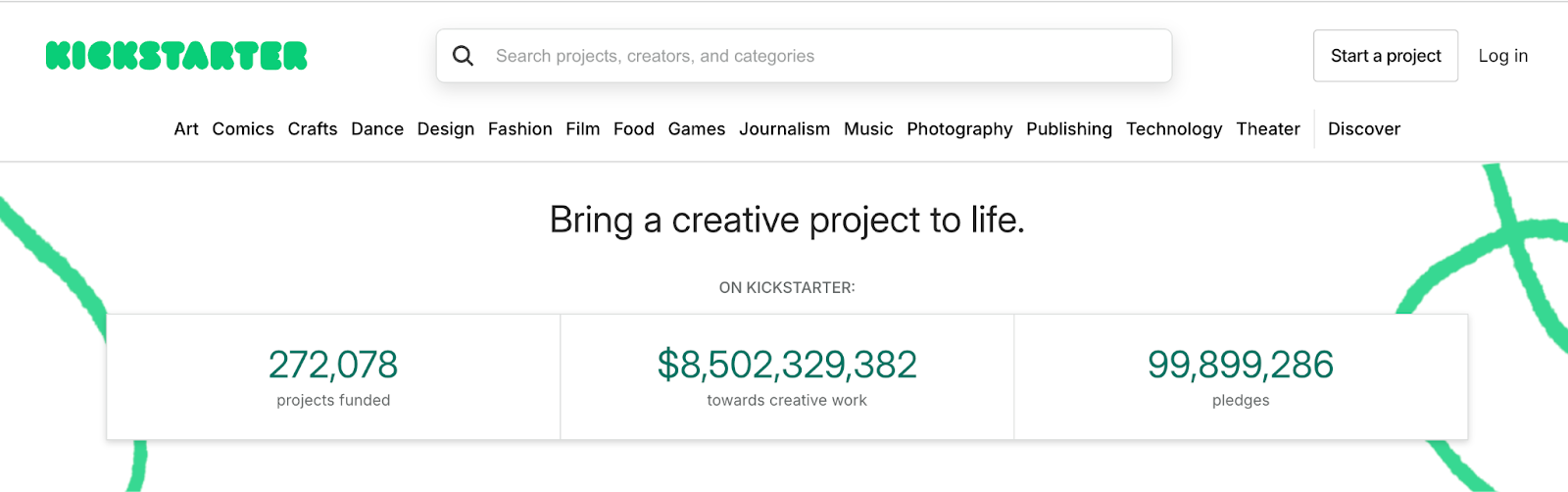
- Built-In Audience: Kickstarter’s community is vast, with millions of active backers who are eager to support innovative ideas. Your project can gain visibility far beyond your existing network.
- Market Validation: Before you commit to mass production, you can test your product’s demand. If people back your project, it’s a good sign you’re onto something great.
- Community Building: Beyond funding, you build a loyal following that can support your brand long after your campaign ends.
- No Debt or Equity Loss: Unlike loans or investor funding, you don’t give up equity or owe repayments. Instead, you offer rewards, usually the final product or exclusive perks.
Challenges to Consider
Of course, like any funding method, Kickstarter comes with its challenges:
- All-or-Nothing Model: If you don’t reach your funding goal, you won’t receive any money. This makes goal setting crucial.
- Time-Consuming Preparation: Creating a successful campaign requires detailed planning, a solid pre-launch and marketing strategy, and engaging content.
- Platform Fees: Kickstarter takes a 5% cut, plus additional processing fees of around 3-5%. These costs can add up, so they need to be factored into your funding target.
Despite these hurdles, Kickstarter remains one of the most effective platforms for creators to launch and grow their business ideas.
What’s the Success Rate of Businesses Launched on Kickstarter?
Kickstarter’s overall success rate sits at around 39-43%. However, this percentage varies significantly depending on the category:
- Technology is one of the most challenging categories on Kickstarter, with success rates around 20-25%. Hardware products require working prototypes, clear value propositions, and strong execution, which raises the bar significantly.
- Tabletop games achieved an 80% success rate in 2024, the highest in Kickstarter's history, driven by engaged communities and proven formats.
- Comics consistently lead the platform with success rates around 65-67%, making them one of the most reliable categories. Broader publishing projects vary depending on audience and positioning.
Another key statistic to consider: campaigns that hit 30% of their goal within the first week are far more likely to succeed. Early momentum plays a crucial role in building excitement and boosting visibility on the platform.
These numbers show that Kickstarter can be an effective platform, but hitting your funding target requires setting strategic goals, engaging your audience early, and having a compelling campaign. A bit of timing and luck helps as well.
Kickstarter Late Pledges
With Late Pledges, Kickstarter now allows creators to continue collecting pledges after a campaign has successfully ended.
This changes how campaigns work. Instead of a hard stop, your project can keep accepting orders from the same campaign page, without redirecting traffic elsewhere.
The key detail is who those backers are.
- Late Pledges bring in a higher share of new backers (25%+) compared to the main campaign
- For repeat creators, up to 80% of late backers are completely new customers, not returning supporters
This means Late Pledges are not just leftover demand, they expand your audience.
They also extend the value of your marketing.
- You can continue promoting your campaign after it ends and keep converting traffic instead of shutting down acquisition
- Kickstarter keeps everything on the same page, reducing friction and drop-off compared to external tools
There are a few operational differences:
- Payments are charged immediately when someone makes a Late Pledge
- Pledges cannot be modified after checkout
Creators often increase reward pricing by around 10% to account for added costs and protect margins
Late Pledges are best treated as a continuation of your campaign. They allow you to keep acquiring new backers, extend your revenue window, and make better use of the demand you’ve already created.
Kickstarter Pledge Manager
After your campaign ends, you still need to collect shipping details, manage orders, and prepare for fulfillment.
Kickstarter now provides a built-in Pledge Manager that handles this directly on the platform, removing the need for third-party tools.
At its core, the Pledge Manager acts as your post-campaign system for both operations and additional revenue.
Here’s what it actually does:
- Upgrades and add-ons: You can offer backers the option to upgrade their reward or purchase additional items after the campaign ends, increasing total pledge value.
- Backer and order management: Kickstarter provides a backer report with filtering, segmentation, and export options for fulfillment partners.
- Shipping configuration: You can set shipping costs after the campaign, including region-based pricing, flat rates, or weight-based rules.
- Tax handling: Kickstarter collects and remits applicable sales tax (US, Canada) and VAT (EU/UK), and provides exportable reports.
- Integrated workflow: Surveys, payments, add-ons, and order data are all managed within the same system.
Unlike third-party pledge managers, Kickstarter’s version is built into the platform and does not require separate onboarding or additional upfront fees.
From a strategy perspective, this matters for two reasons:
- It reduces friction, since backers don’t need to leave Kickstarter to complete their order
- It allows you to continue increasing revenue through upgrades and add-ons after the campaign
It also reduces reliance on third-party tools, which were previously standard for post-campaign management.
14 Pro Tips to Elevate Your Kickstarter Campaign
When it comes to Kickstarter success, the devil is in the details. Here’s a deep dive into advanced tips to help your campaign stand out, sustain momentum, and surpass your funding goal.
1. Pick the Perfect Launch Date, Time, and Campaign Length
Launch timing plays a small but meaningful role in how your campaign performs in the first few hours.
Midweek launches, especially Tuesday or Wednesday, tend to perform best because online activity is more consistent compared to weekends.
If you’re targeting a US-heavy audience, aim to launch between 9 AM and 11 AM EST. This gives you:
- Morning visibility in the US
- Afternoon exposure in Europe
That early traffic matters. Strong activity in the first few hours helps build momentum, which increases your chances of gaining visibility on Kickstarter.
Avoid launching during major holidays or large events when attention is fragmented.
On campaign length, 30 days consistently outperforms 60. Shorter campaigns create urgency, maintain momentum, and are easier to sustain with paid acquisition and consistent communication. A 60-day campaign often sees a long dead zone in the middle that's hard to fill. Unless you have a specific reason to run longer, 30 days is the default choice for most product campaigns.
2. The first 48-Hour Push
The first two days of your campaign matter more than anything that comes after.
Kickstarter rewards early traction, and backers are far more likely to support projects that already show momentum.
Focus on:
- Driving your warm audience immediately (email list, VIPs, early supporters)
- Pushing early-bird rewards to create urgency
- Concentrating traffic, not spreading it out
- Responding quickly to comments and questions
Campaigns that build strong momentum in the first 48 hours are significantly more likely to be fully funded.
3. Build a Pre-Launch Funnel
A simple email signup page isn’t enough for a competitive campaign. What matters is how well your funnel filters for real buyers, not casual interest.
Focus on:
- Clear value proposition: Show what the product is, who it’s for, and why it matters within seconds.
- Strong incentive to sign up: Early-bird pricing or exclusive perks should feel worth acting on.
- VIP reservation model: Instead of collecting free emails, some campaigns ask users to place a small deposit (often $1) to reserve early-bird pricing or exclusive access. This filters for high-intent buyers and creates a committed audience before launch.
Cold email lists typically convert around 1-5%, while pre-qualified VIP audiences can convert at 20-50% on Day 1.
4. Make Your Campaign Video Do the Selling
Your campaign video is one of the highest-impact assets on your page. For many backers, it’s the first thing they watch before deciding if they’ll scroll further.
- Ideal Length: 2-3 minutes.
- Video Structure:
- Hook: Grab attention in the first 10 seconds and clearly show what the product is and why it matters.
- Problem: Explain the issue your product solves.
- Solution: Show your product in action.
- Team: Introduce your team to build credibility.
- Call-to-Action: Invite viewers to back your project.
- Subtitles can increase engagement, especially on mobile.
5. Structure Your Page for How People Actually Read
Most backers won’t read your page top to bottom. They scan, jump, and decide quickly. Your job is to guide them through the information in the right order, without friction.
Focus on:
- Clear section hierarchy: Use bold headlines to break the page into logical steps, problem, solution, features, pricing, trust.
- Visual proof over long text: Use images, GIFs, and short demos to show how the product works instead of explaining it.
- Comparison and clarity: Simple charts or visuals that highlight what makes your product different can speed up decision-making.
- Mobile-first layout: A large portion of traffic comes from mobile. Keep sections short, visuals clear, and avoid dense blocks of text.
- Remove friction: Every section should move the reader closer to backing, not slow them down.
A clean, structured page consistently outperforms one that looks impressive but feels hard to follow.
6. Design Reward Tiers to Drive Conversion and Higher Order Value
Your reward structure directly affects how much you raise. Instead of offering random options, design tiers that guide behavior.
Focus on:
- Early-bird tiers to concentrate demand: Limited pricing encourages backers to act immediately, helping you build momentum in the first 48 hours.
- Anchor your pricing: Include a higher-priced tier to make mid-range options feel more reasonable and attractive.
- Use bundles to increase order value: Offering 2-3 unit bundles or upgraded versions can significantly raise your average pledge.
- Keep choices simple: Too many tiers create friction. Most campaigns perform best with a small, clearly structured set of options.
- Add-ons for incremental revenue: Accessories, upgrades, or variations allow backers to increase their pledge without changing tiers.

7. Expect the Mid-Campaign Slowdown and Plan for It
Most campaigns experience a dip in momentum after the initial launch surge. This is normal. The warm email list has already converted, and new traffic takes more effort to take action. The goal during this phase is to maintain steady progress.
Focus on:
- Introducing new reasons to engage: Announce stretch goals, new features, or additional perks that keep the campaign feeling active.
- Keeping communication consistent: Regular updates reassure backers and give new visitors more context and confidence.
- Creating light engagement moments: Live Q&As, behind-the-scenes content, or small activations can help maintain interest without overcomplicating your strategy.
- Continuing paid acquisition: Keep driving traffic instead of relying on organic momentum alone.
8. Use Paid Ads to Drive and Recover Demand
Once your campaign is live, paid ads become one of the most reliable ways to maintain consistent traffic and conversions. Kickstarter can amplify momentum, but it rarely generates enough demand on its own to carry a product campaign.
During the live stage, focus on:
- Retargeting high-intent audiences: Bring back people who visited your pre-launch page or engaged with your ads but didn’t pledge.
- Using real-time campaign signals: Ads that highlight funding progress, backer count, or limited early-bird availability tend to convert better.
- Refreshing creatives as performance drops: Ad fatigue happens quickly. Rotate visuals and messaging to keep results stable.
- Scaling what’s already working: Increase spend on audiences and creatives that are already converting instead of constantly testing new angles.
Kickstarter allows you to connect a Meta Pixel, but tracking is limited. You can’t install custom pixel code or fully control event tracking, and data quality may vary due to privacy restrictions. Because of this, most optimization relies on pre-launch funnel data and platform-level signals rather than precise attribution.
9. Use Cross-Promotion with Other Campaigns
Partnering with complementary campaigns can expand your audience.
Focus on:
- Partnering with relevant campaigns in adjacent categories
- Timing outreach while both campaigns are live
- Sharing each other through updates or socials
- Keeping it selective, not mass outreach
10. Transparency Builds Trust
Clear and consistent communication builds trust. It reassures backers they’re supporting a legitimate project.
- Be upfront about challenges (e.g., production timelines or potential delays).
- Share regular updates, even after the campaign ends, to keep backers engaged.
- Use behind-the-scenes content (e.g., photos of product prototypes or packaging tests).
11. Include Social Proof to Strengthen Credibility
Most backers won’t be your first. They’ll look for signals that other people already trust your product. Strong social proof reduces hesitation and makes your campaign feel safer to support.
Focus on:
- Real user validation: Quotes, short clips, or feedback from beta testers carry more weight than generic testimonials.
- Visible momentum: Backer count, funding progress, and recent activity act as immediate proof that others are already committing.
- Relevant media or influencer mentions: Even small features can help, as long as they’re clearly connected to your product.
- Placement near decision points: Add proof close to reward tiers or key sections where people are deciding to pledge.
12. Plan for a Strong Finale
The final 48 hours of your campaign are a golden window for pledges.
- Send a “last call” email to your list, reminding them it’s their final chance to back the project.
- Use scarcity-driven messaging: “Only 10 spots left for this reward tier!”
- Double down on retargeting ads. This is when retargeting performs best, especially for users who visited but didn’t pledge.
- Re-engage top-performing influencers: If certain creators drove strong traffic or conversions earlier, bring them back for a final push.
- Simplify your messaging. At this stage, clarity beats creativity. Make it obvious what people get and what they’ll miss.
13. Plan Your Fulfillment Before You Need It
Fulfillment is where many campaigns stumble. You can run a flawless campaign, hit your funding goal, and still damage your reputation if backers are left waiting months longer than expected with little communication.
The time to plan fulfillment is before your campaign ends.
Focus on:
- Locking in your manufacturer early: Confirm production timelines, minimum order quantities, and lead times before you launch. Surprises here are expensive.
- Building buffer into your timeline: Most first-time creators underestimate how long production and shipping take. Add 4-6 weeks of buffer to whatever timeline you communicate to backers.
- Choosing your fulfillment partner in advance: Whether you're shipping directly or using a third-party logistics provider, have the relationship in place before you need it.
- Communicating proactively: Backers are patient when kept informed. A short update every 2-3 weeks during production goes a long way toward maintaining trust and reducing support requests.
Fulfillment is the final impression your campaign leaves. Getting it right turns backers into repeat customers and long-term brand advocates.
And if your campaign doesn't fund, it's not the end. Kickstarter allows relaunches, and many successful campaigns failed on their first attempt. A lower goal, a refined pitch, and the audience you already built can make the second run significantly stronger.
14. Consider Working With a Crowdfunding Marketing Agency
Running a Kickstarter campaign while simultaneously managing product development, supplier relationships, and community building is a lot to handle alone. Many founders find that bringing in specialist support, even for one or two channels, meaningfully improves their results.
A good agency will have experience across pre-launch strategy, paid acquisition, influencer outreach, and post-campaign follow-up. Look for one with verified case studies in your category, not just general marketing credentials. Agencies like TCF specialize in exactly this, with a track record across hundreds of campaigns on Kickstarter and Indiegogo.
When evaluating options, ask for case studies relevant to your product category and be clear on scope from the start.
Conclusion
Kickstarter works best when you approach it as a structured system.
It combines pre-orders, demand validation, and upfront cash flow into a single launch cycle. That gives you the ability to fund production, test real demand, and build an initial customer base before scaling further.
Strong campaigns follow a clear pattern. They build demand before launch, concentrate momentum in the first days, and manage the campaign as an active sales process. From there, tools like Late Pledges and the Pledge Manager help extend revenue and handle fulfillment in a more organized way.
Execution continues beyond funding. Production planning, shipping, and margin control all play a role in how the campaign performs as a business.
With a clear strategy, defined numbers, and the right team, Kickstarter can support both funding and validation in one cycle, while setting up the foundation for what comes next.
Raise funds, not hell!
[[cta2]]
FAQ
1. Why should I choose Kickstarter over other crowdfunding platforms?
Kickstarter stands out for its large, engaged community of backers who actively seek out innovative projects. Its all-or-nothing model also creates urgency, encouraging more pledges as campaigns near their goal. Plus, the platform’s global reach can help you gain visibility far beyond your initial audience.
2. Can Kickstarter be used for established businesses?
Absolutely! Established businesses often use Kickstarter to launch new products, test ideas, and engage their audience. Crowdfunding is a powerful way for any business to connect with its community and generate buzz around new offerings.
3. What are Kickstarter's fees?
Kickstarter charges a 5% fee on the funds you raise, plus payment processing fees of 3-5%. These costs should be factored into your overall funding goal to ensure you raise enough to cover production, rewards, and any unforeseen expenses.
4. Does Kickstarter charge a fee if my campaign fails?
No. Kickstarter only charges its 5% fee and payment processing fees if your campaign successfully reaches its funding goal. If you don't fund, you pay nothing.
5. How do I promote my Kickstarter campaign?
Promotion relies on a combination of pre-launch audience building, paid acquisition, and campaign momentum. Email lists, reservation funnels, Meta ads, and retargeting all play a role in driving consistent traffic and conversions. And if you want expert guidance, agencies like TCF specialize in creating tailored Kickstarter strategies that boost visibility and drive pledges.
6. Can I edit my Kickstarter campaign after it launches?
Yes, you can edit most content after launch, including your campaign description, images, and reward details. However, you cannot change your funding goal or campaign end date once it's live.
7. Can I run a Kickstarter campaign outside the US?
Yes. Kickstarter is available to creators in 25+ countries across North America, Europe, Asia, and beyond. Eligibility requirements and supported currencies vary by country, so check Kickstarter's creator eligibility page before launching.


.avif)

.avif)


.jpg)
%20(1).png)