

In this article
Somebody, somewhere right now, is sitting on a genuinely great gadget idea. Solid concept, real problem, people would actually buy it. They're also about to spend 14 months finding out that having a great idea is roughly 10% of the job.
Kickstarter has minted some remarkable success stories in the smart gadget space. Snapmaker's U1 3D printer crossed $20M. Rokid's AR glasses pulled in $3.6M. Bird Buddy turned bird feeders into a €4.1M community moment. These are not flukes. The appetite for hardware that actually does something new is enormous.
What's also enormous: the graveyard. About 9% of funded hardware campaigns never deliver. Funded, celebrated, then quietly unable to figure out injection molding, or certifications, or what shipping lithium batteries internationally actually costs. The money came in. The product didn't go out.
In this article, you'll find a breakdown of what makes each smart gadget sub-category uniquely challenging to crowdfund, and a step-by-step launch framework to get from working prototype to fully funded campaign.
Key Takeaways
- Lead with the outcome. Backers buy the moment the problem goes away. "See your backyard in full color at night" will always outperform "AI-powered quad-sensor image fusion."
- The pre-launch period is the campaign. The email list, the initial community, the ad testing, the influencer outreach, the PR coordination. By the time the page goes live, the hard work should already be done.
- A working prototype is non-negotiable. Kickstarter requires live proof of concept. No renders, no simulations, no animations of features that don't exist yet. If you cannot show it working, you are not ready to launch.
- Paid reservations tell you the truth. Email signups tell you who is interested. Deposits tell you who will actually back on Day 1. There is a significant difference between the two numbers.
- Certifications will take longer than you planned. Start FCC, CE, and Bluetooth SIG processes six to nine months before launch. The queue does not care about your campaign timeline.
- Coordination beats volume on launch day. PR, influencers, email, and ads all hitting within the first 48 hours drives momentum. Spreading things out quietly kills it.
Smart Gadget Categories on Kickstarter
Smart Home & IoT
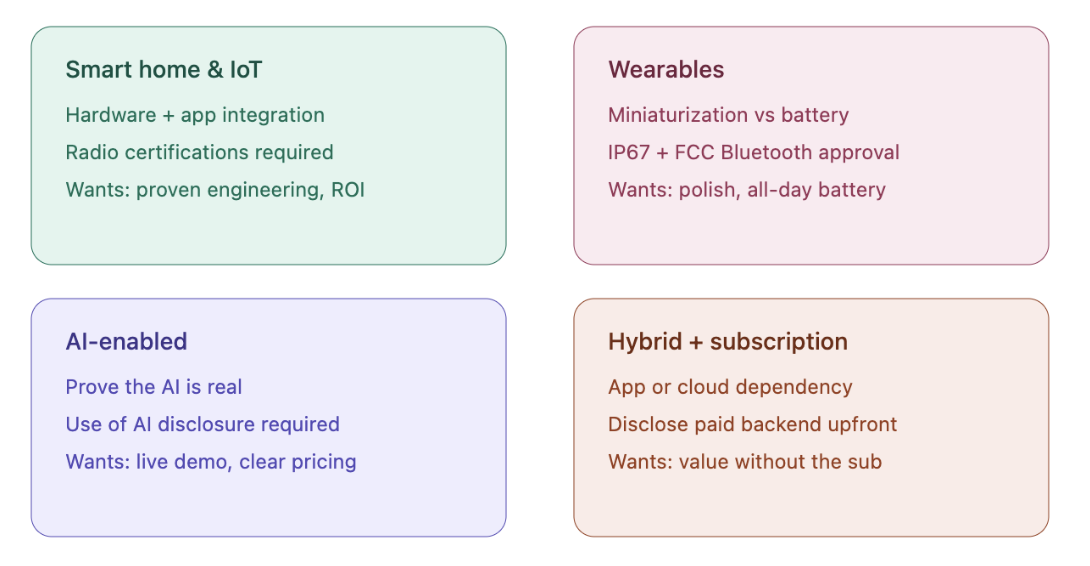
These devices need to integrate hardware and apps seamlessly. Think Wi-Fi cameras, smart thermostats, connected kitchen gadgets. The technical hurdles include radio certifications, maintaining app ecosystems, and securing reliable connectivity.
Unexpected component costs (sensors, antennas, connectivity modules) and long tooling lead times push up prices. Trust hinges on proven engineering (backers want to see working units,) and a clear ROI argument: energy savings, convenience, time saved.
Wearables (Health, Fitness, Style)
Wearables blend electronics with fashion and brutal battery constraints. Comfort, IP67 waterproofing (waterproof rating for 1 meter submersion), FCC Bluetooth approval, and the engineering challenge of miniaturization make this one of the most difficult sub-categories in hardware.
Backers expect polished industrial design and all-day battery life. Overpromise on either and your reviews will bury you. Successful wearable launches have leveraged dramatic demos, influencer partnerships, and staggered reward tiers for accessories and add-ons.
Word choice matters as much as engineering here. Promotion in this category isn't just governed by Kickstarter's rules, it also has to align with health industry regulations. A health tracker that claims to track blood glucose needs FDA alignment behind that claim. Without it, the workaround is calling it a general health tracker instead, which weakens your USP since a generic label doesn't showcase what makes your product different. Worth thinking through before you go live.
AI-Enabled Gadgets
These campaigns promise voice assistants, AI imaging, on-device intelligence, or robotics. The risk: "AI" sounds like a buzzword unless you show it doing something real. Savvy creators back their claims with live demos: actual machine learning running on the hardware, real inputs producing real outputs on camera.
Kickstarter also now requires a dedicated "Use of AI" section disclosing which features use it, which models are running, and how data is handled. Hiding AI use or overpromising features you haven't built gets campaigns suspended and backers hostile.
There's also a pricing perception problem specific to this category. Backers have learned to expect AI-powered products to come with ongoing subscription costs, and that expectation alone stops people from backing before they've even read your reward tiers. If your product doesn't carry a subscription, say so early and clearly. If it does, addressing the cost upfront beats letting backers assume the worst and bounce.
Hybrid Hardware + Subscription Models
Products tied to apps or cloud services face additional hurdles. If an AI feature requires a paid backend after launch, that has to be disclosed clearly upfront.
Bundling early-bird deals with the first year of service, or building a "device-only" mode that delivers real value even if the subscription lapses, can make the economics work for both sides.
Step-by-Step Framework on How to Launch a Smart Gadget on Kickstarter
Step 1: Validate Demand Before You Commit to Anything Expensive
Here is a thing that happens constantly. Someone spends eight months and forty thousand dollars building a smart gadget. They launch on Kickstarter. They find out the hard way that "people thought it was cool" and "people will pay for it" are two completely different categories of human enthusiasm.
A landing page costs nothing compared to that. A headline, a product visual, an email capture, a few hundred dollars in Meta or TikTok ads pointed at the right audience. Run it for two weeks. A page that's actually connecting converts 2-10% of visitors into email subscribers. If you're sitting at under 1%, something might be wrong, and the time to find that out is now, not eight months from now when the molds are done.
While you're at it, go find where your future backers are already arguing about products like yours. Smart home subreddits, health tech Discords, maker forums. Not to pitch. To listen. Fifty opinionated strangers telling you what they hate about existing products will do more for your campaign than another internal brainstorm ever will. That community engagement is also one of the most underrated ways to build an audience before your crowdfunding campaign launch.
Step 2: Test Pricing and Positioning with Real Traffic
Most founders pick a price the same way they pick a fantasy football team. Gut feeling, mild optimism, and a refusal to look too closely at the math.
Set up two or three landing page variations. Change one thing at a time: the price point, the headline angle, whether you mention subscription costs upfront. Run traffic evenly across them and watch what actually happens. Sometimes the higher price converts better because people equate cost with quality, especially in a category where the cheap version has burned them before. You won't know until you test it.
Before any of this, do the full math. Unit manufacturing cost, tooling, certifications, API fees if your gadget runs on cloud services, shipping, fulfillment, Kickstarter's 5% cut, payment processing, and a contingency buffer of at least 30% because something will cost more than quoted. That number is your floor. Everything you test should sit above it.
Step 3: Build a Working Prototype and Lock Down Your Dependencies
The most renders can get you is the first thirty seconds of attention before they scroll to the comments and ask if there's a real unit anywhere.
Your prototype needs to show the core feature working on camera. Perfection and super exceptional production quality are not mandatory. But actually working is, with the main features showing how it actually works, in a way that a skeptical stranger watching a 90-second video would find convincing. If it needs a manual reset between takes, fine. If it runs a little slow, fine. If it looks like it was assembled in a garage at 2am, that is honestly sometimes endearing. What it cannot do is not exist.
While you're building, talk to two or three manufacturers. Get real quotes for tooling, MOQs (minimum order quantities), component sourcing, and lead times. Then add 30% to the cost and 30% to the timeline, not as pessimism but as basic pattern recognition from every hardware campaign that has ever run before yours.
If your gadget runs on cloud APIs, have a direct conversation with your provider about rate limits, pricing tiers, and what happens if you suddenly have ten thousand active users. API providers optimize for their own business. A pricing change six months after you ship is not their problem. Make sure it isn't yours either.
Step 4: Handle Certifications Early
Certifications are the part of hardware crowdfunding that nobody puts in their launch video and everybody wishes they had taken more seriously.
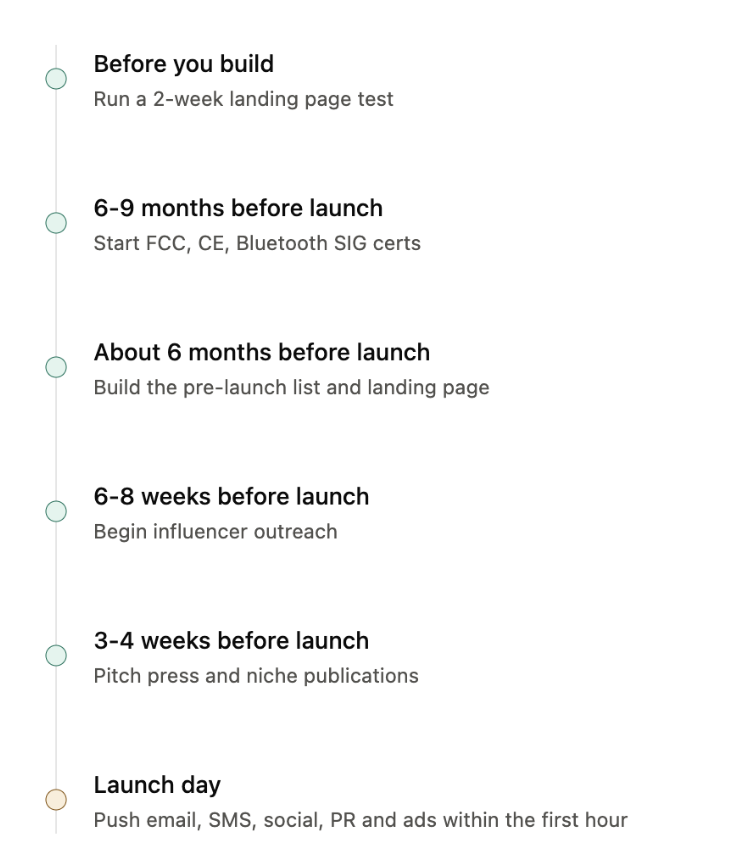
FCC approval, CE marking, Bluetooth SIG certification (the standards body that certifies Bluetooth compliance). None of these can be rushed, all of them take months, and all of them cost real money. Start these processes six to nine months before your planned launch. Not "we'll figure it out after funding." Six to nine months, minimum, because the queue does not care about your campaign timeline.
If your device touches health data in any way, add FDA classification to the list. That determination alone, whether you're a wellness device or a medical device, changes what you can say on your campaign page, what you can claim in ads, and how long everything takes.
One more thing worth knowing before you write a single line of campaign copy: Kickstarter has its own rules about what language is allowed on the page. Health claims, medical-grade terminology, FDA-specific language, all of it gets reviewed. Find out what you can and cannot say before you build your messaging around it.
Step 5: Create Content That Proves It Works
Most smart gadget videos make the same mistake. Ninety seconds of dramatic music, floating spec callouts, and a voiceover explaining how the proprietary sensor array delivers unprecedented performance. Then it ends. Nobody saw the thing actually do anything.
Backers don't buy specs. They buy the moment the problem goes away. Show that moment. The notification that arrives before the leak becomes a flood. The sleep report that finally explains why they're exhausted. The lawn that got mowed while they were at brunch. Real scenario, real outcome, real footage of the product being the reason it happened. Getting that narrative right is what product storytelling for crowdfunding is all about.
Here's what you actually need to produce before launch:
A hero video for the Kickstarter page. Around 90 seconds, showing the product solving the core problem in a real scenario. This is not the place for factory footage or engineering diagrams.
Short-form clips for ads. 15 to 30 seconds, one benefit each, no jargon. Run these on Meta, TikTok, and YouTube Shorts before launch. The clip that dramatically outperforms the rest is your audience telling you what they actually care about. Let that shape your campaign page, instead of your personal favorite feature.
Before and after comparisons. The frustrating way versus your way. Make the difference obvious in under ten seconds.
Behind the scenes content. Prototype progress, engineering decisions, small wins along the way. This builds familiarity and trust with your pre-launch list over the weeks before the campaign goes live.
The product demo still matters, but it earns trust through realness, not polish. A slightly imperfect clip of something genuinely working will outperform a perfectly rendered animation of something that might work every single time.
Step 6: Build Your Pre-Launch List
Every campaign that looks like an overnight success has a months-long story behind it that nobody sees. The goal hit in four hours, the comment section full of people tagging their friends, the founder looking appropriately surprised on camera. All of it was built quietly, weeks before the page went live. There's a reason successful crowdfunding campaigns start 6 months before launch.
Set up a pre-launch landing page with a clear offer. Early-bird pricing, first access, limited quantities. Drive traffic through paid ads on Meta, TikTok, and Reddit, and show up organically in the communities where your audience already spends time.
Collect emails, but don't stop there. Offer a small paid reservation alongside the free signup. The difference between someone who gave you their email during a lunch break and someone who put down a few dollars is enormous on launch day.
For the people who do reserve, create a private channel. WhatsApp, Discord, Telegram. Keep the founder visible in there. People who feel like insiders become advocates, and advocates do marketing you could never buy.
Nurture the broader list consistently. Prototype progress, manufacturing updates, feature reveals, behind the scenes moments. By launch day, these people should remember you, understand what you built, and be ready to back it within the first hour without needing to be convinced.
Step 7: Lock In PR and Influencer Coverage Before Launch
A common launch day fantasy: the campaign goes live, someone important stumbles across it, shares it with their audience, and the pledges start rolling in. This does not happen. Or rather, it happens so rarely that building a strategy around it is just a more exciting way of hoping.
Coverage needs to be coordinated. Influencer videos, press articles, and social posts all landing within the first 48 hours of the campaign, creating the impression of a product the world suddenly cannot stop talking about. That window is manufactured in advance.
For influencers, start outreach 6 to 8 weeks before launch. Find creators who actually live in your category. Smart home YouTubers, health tech reviewers, maker channels, gadget specialists. A niche reviewer with 50,000 engaged subscribers will drive more pledges than a general tech channel with 500,000 passive ones every single time. Send them a working prototype. Give them time to actually test it. Ask them to publish within your launch window.
For press, build a list of relevant tech blogs, niche publications, and gadget sites and pitch a specific story three to four weeks out. "Smart garden sensor that identifies plant disease before it spreads" is a story. "New IoT device launches on Kickstarter" is a press release that goes directly into the trash.
Pull quotes from reviews, embed coverage mentions, show the logos of outlets that covered you. Third party validation does something a founder talking about their own product simply cannot: it tells a skeptical backer that someone with nothing to gain looked at this thing and decided it was real.
Step 8: Build a High-Converting Campaign Page
Your Kickstarter page has one job. Get a stranger to hand over their credit card details for a product that doesn't exist yet. No pressure.
The hero section is where most decisions happen, which means most campaigns lose people before they ever scroll. A sharp product visual or demo GIF showing the device actually doing something, a tagline that states the core benefit in plain language, and a visible early-bird call to action. If someone lands here and cannot immediately understand what the product does and why it matters, they are gone.
Structure the rest of the page the way a good conversation works. Start with the problem, make it feel real and recognizable, then introduce the product as the answer. Show it working in real scenarios. Use visuals to do the heavy lifting: real photos of the device, close-ups of build quality, short GIFs of key features in action. Save the deep specs, comparison tables, and FAQs for the bottom of the page where the detail-oriented backers who were already sold will find them.
Keep reward tiers simple. An early-bird tier at 30-35% off to create Day 1 urgency, a standard pledge at the main offering, and a premium bundle with accessories at a higher price point. The moment your tier structure requires a flowchart to navigate, you have lost people.
For AI features, Kickstarter requires a dedicated disclosure section covering which features use it, what models are running, and how data is handled. Don't bury it. Campaigns that go deep and explain clearly stand out from the ones that write three vague sentences and hope nobody notices.
Step 9: Launch With Coordinated Momentum
Launch day is not the time to figure things out. Every decision should already be made, every piece of content already created, every influencer waiting for your green light to post.
Day 1 is execution.
The sequence matters. Campaign goes live, email blast to your full pre-launch list immediately, VIPs and depositors first, then general subscribers.
Same moment, an SMS goes out to everyone who left a phone number during pre-launch specifically to get notified when you go live. Text beats email on open speed, and for the people who opted in, that's exactly what they signed up for.
Hit your WhatsApp and Discord communities with a direct link. Social posts go live across every channel simultaneously. Influencer videos start dropping. PR articles go live. Paid ads turn on. Everything within the first hour, not the first day.
The goal is hitting 30-50% of your funding target in the first 48 hours. This triggers Kickstarter's algorithm, earns you visibility with people who have never heard of you, and signals to everyone sitting on the fence that this campaign is moving and they should probably get on it.
Stay visible throughout. Respond to comments fast. Post updates when you hit milestones. Announce stretch goals as you pass them, giving already-converted backers a reason to share the campaign with their networks. A campaign that looks alive attracts more backers than one that hit 200% funded and then went quiet.
Keep your paid ads running throughout the campaign. The organic spike from launch day fades within 48 hours. Paid traffic keeps new visitors arriving to a page that already has social proof, backer counts, and momentum working in its favor.
Should You Launch Your Kickstarter Campaign Alone or Hire Support?
You can launch a smart gadget campaign on your own. Many founders do. But smart gadget campaigns carry more moving parts than most crowdfunding categories: hardware development, manufacturing logistics, certifications, API dependencies, and a backer community that will forensically examine every claim you make.
Running all of it simultaneously, alongside the actual product work, is a lot. List building, ad creative testing, influencer outreach, PR coordination, campaign page optimization. These are repeatable processes with real learning curves, and getting them wrong is expensive in ways that show up publicly. Most of that damage happens before launch day even arrives, which is why understanding the difference between pre-launch and launch day is so important.
The smart move, appropriately enough, is knowing which parts actually require you. The product requires you. The engineering requires you. The Facebook Ads Manager, the influencer outreach spreadsheet, the PR pitch list, those do not.
That's where TCF comes in. A team of 70+ specialists who have run this playbook across hundreds of hardware campaigns, with a creator network of 1,000+ influencers, ad campaigns averaging up to 4x ROI, and coverage in Forbes, BBC, and top-tier tech outlets.
The campaigns that consistently punch above their weight are the ones where the founder stayed focused on building something worth funding, while someone else handled the work of making sure the right people found it.
Conclusion
Smart gadgets are one of the most rewarding categories to launch on Kickstarter, and one of the most unforgiving ways to find out you skipped a step.
Validated before building. Tested before launching. Certifications on the calendar early. An audience built before it was needed. A launch day where everything was already in motion before the page went live. These are the habits of campaigns that fund in hours and actually ship.
The playbook for launching a winning Kickstarter campaign exists. The data exists. The case studies of what works and what quietly implodes three months after funding closes exist. What separates the campaigns that hit their goal in 48 hours from the ones that limp across the finish line is almost never the product itself.
Build something real. Prove it works. Find your people before you ask them for money. And when launch day comes, make it look easy, even if the six months before it absolutely were not.
FAQ
Can I launch a smart gadget if I don't have a fully finished prototype?
You need at minimum a functional proof of concept, something that demonstrates the core feature working on camera. Kickstarter explicitly prohibits demonstrations that are simulations or animations of features that don't yet work. A functional prototype doesn't need to be production-ready, but it needs to be real.
How do I handle AI claims without getting flagged or losing backer trust?
Lead with what the AI enables (the outcome), not the AI itself. Back every claim with a live demo. Include Kickstarter's required "Use of AI" disclosure section and be specific: which features use AI, which models, how data is handled, and what the limitations are. Backers who understand the honesty behind a limitation trust you more, not less.
What's the single biggest mistake first-time hardware founders make on Kickstarter?
Skipping preparation. Most first-time founders pour everything into the product and treat the marketing as something to figure out once the campaign is live. By then it's too late. The email list, the ad testing, the influencer outreach, the PR coordination, all of it needs to be done before the page goes live.
How long does FCC certification take?
Plan on six to nine months from your planned launch date, not weeks. That timeline covers FCC, CE, and Bluetooth SIG approval, and if your device touches health data in any way, FDA classification gets added to that list too, which can extend things further depending on whether you're classified as a wellness device or a medical device.
How early should I start building my pre-launch list?
Around six months out. That's enough time to set up a landing page, test your messaging and pricing with real traffic, run paid ads to find your audience, and nurture people consistently so that by launch day they already know what you built and are ready to back it in the first hour.
What's a realistic pre-launch list size before launching?
There's no single number to hit. What matters more than the raw size of your list is how engaged it is. A list built through genuine community engagement and consistent nurturing will convert far better on launch day than a larger list of people who signed up once and forgot about you.

.avif)

.avif)


.jpg)
%20(1).png)