

In this article
So you've designed a mechanical keyboard. Maybe it has magnetic switches that feel like typing on clouds. Maybe it folds in half like a taco (don’t ask me, it’s your idea). Maybe it's just a really, really nice 75% board with the perfect sound signature.
Here's the thing: between your CAD files and a successful Kickstarter campaign sits a gauntlet that's humbled everyone from first-time makers to established brands. The keyboard community is quite passionate, encyclopedic, and opinionated, and they can smell a cash-grab from three subreddits away.
But if you get it right? If you actually listen, build something meaningful, and launch it properly? They'll fund you in hours and become evangelists for life.
So what does "properly" actually mean? That’s what we’ll discuss in this guide. We’ll break down the category specifications and then walk through the step-by-step launch framework.
[[cta2]]
Key Takeaways
Before we dive into the details, here's what actually matters when launching a keyboard on crowdfunding:
- Validation isn't optional. Post interest checks on Reddit and Discord before you commit to tooling. If the community isn't engaged early, they won't show up at launch.
- Test your pricing. What you think people will pay and what they actually pay are often different. Run A/B tests on landing pages, sometimes higher prices convert better if your positioning justifies it.
- Prototypes prove credibility. The keyboard community has seen too many renders that never shipped. You need a working board that types, sounds good on camera, and demonstrates you're not selling vaporware.
- Content is your sales team. Typing tests, sound comparisons, and feature demos do more work than any campaign copy. If people don't understand your product from a 30-second video, they won't back it.
- Coordination beats volume. Launching with PR, influencers, email, and ads all hitting in the same 48-hour window drives momentum. Trickling things out kills it.
- The community decides your fate. They'll scrutinize every spec, question every choice, and call out anything that feels lazy or disingenuous. Earn their respect by being transparent, responsive, and genuinely invested in the product.
Common Challenges When Launching a Keyboard on Kickstarter or Indiegogo
1. The Community Knows More Than You Think
You're about to pitch your keyboard to people who can identify a Cherry MX Brown by sound alone. They've probably tried to build their own boards from scratch. They've lubed stabilizers at 2 AM. They know the exact millimeter difference between a high-profile and low-profile case, and they will ask about it in the comments.
This isn't a casual consumer base browsing Amazon for "cool gaming keyboard." These are enthusiasts who've done their homework, and they expect you to have done yours. They'll scrutinize your switch choice, question your PCB layout, debate your stabilizer selection, and if you can't explain why you chose south-facing LEDs over north-facing, they'll take a step back. One vague spec, one stock photo from AliExpress, one whiff of "we didn't actually build this" and the comments section becomes a trial by fire.
2. You're Competing Against Giants (With Walmart Budgets)
GMMK has retail distribution. Drop has endless capital and a cult following. You? You're launching your first campaign with a barely working prototype and a dream.
Here's the brutal part: your keyboard might actually be better. It might have features they don't. But you're asking people to wait 8-12 months and trust a stranger on the internet, while they can buy a keyboard on Amazon tomorrow with free returns. Understanding crowdfunding trends and predictions helps you position against this retail competition.
Your pricing needs to make sense against that reality. If you're charging $200 for a board that looks similar to a $150 retail option, you better articulate why it's worth the wait and the risk. "Higher quality" isn't enough.
3. Everyone Wants Something Different And They All Want It Now
The keyboard community can't agree on anything. 60% purists will tell you anything bigger is bloated. 75% fans say you need arrow keys. TKL people want function rows. Full-size defenders need numpads for spreadsheets. And don't even get me started on ISO vs ANSI.
Here's the thing though: options aren't the enemy. This community expects them, and a keyboard that only comes in one color with one switch type will get roasted just as quickly as one with a confusing page.
What kills campaigns is offering the wrong choices, or presenting them badly. Five layout variants, three case colors, and four switch options all broken out as separate reward tiers turns your Kickstarter page into a calculus exam. Backers bounce. Your factory can't hit MOQ on half the combinations.
The smarter move is to validate options during pre-launch. Ask your list what colors, layouts, and features they'd actually pick. Drop what doesn't have volume. Then present what's left cleanly: one pledge tier, options collected via post-campaign survey. Backers get customization, you get manageable SKUs.
Step by Step guide on How to Launch a Keyboard on Crowdfunding
Step 1: Validate Demand with the Community
Before you commit to tooling costs or lock in an MOQ, you need proof people actually want this thing.
Start where keyboard people live: Reddit, Discord servers, and GeekHack. Post an interest check. Not a sales pitch, a question: "Thinking about a 75% board with magnetic switches and a wood accent. What layout would you actually buy?"
The responses tell you everything. If people engage, ask follow-ups, debate layouts, and request updates, you're onto something. If it's crickets or "just another keyboard," you haven't differentiated enough.
Run a simple landing page alongside this. Headline: "Join the waitlist for [Your Keyboard]." Collect emails. Offer early-bird pricing or a giveaway entry to incentivize sign-ups.
You can build this yourself or use platforms like Prelaunch.com to set up a structured pre-launch campaign that collects signups and validates demand signals in one place.
Drive traffic with small ad budgets ($500-$1,000 on Meta or Reddit ads targeting keyboard enthusiasts). If you can't get 500-1,000 emails from a modest spend, that's a signal. No traction here usually means no traction later, just with higher costs and a factory waiting for payment.
What you're looking for: People asking questions. People signing up. People saying "I'd buy this."
If you're not seeing it, don't move forward yet. Refine the concept and try again. This is one of the core patterns in why crowdfunding campaigns succeed or fail.
Step 2: Nail Your Positioning and Pricing
You're not competing against other crowdfunding campaigns. You're competing against a keyboard brand on Amazon with Prime shipping.
Before you lock in your price or messaging, test it.
Set up 2-3 landing page variations and change one variable at a time: price point, headline angle, or core positioning (performance vs. customization vs. convenience).
Run paid traffic evenly across them.
What to track:
- Conversion rate differences between versions
- Drop-offs when price changes
- Comments or confusion around messaging
What you're learning:
- Which price point converts best (sometimes higher prices convert better if the positioning justifies it)
- Whether people care more about the tech, the aesthetics, or the value proposition
- What's unclear or needs simplification
Calculate your true cost first (MOQ × unit cost + tooling + shipping + platform fees + 20% buffer). That's your floor. Proper budgeting for your crowdfunding campaign means accounting for photography, prototypes, ad spend and other hidden costs. Test pricing above that to find what the market will actually bear.
Move forward only when one version clearly outperforms the others.
Step 3: Build a Working Prototype & Navigate Manufacturing
Renders don't fund campaigns. Working prototypes do.
Your prototype needs to actually type, sound good on camera, and prove this isn't vaporware. The keyboard community has been burned too many times, they want evidence.
At minimum, you need:
- A functional PCB with your switch layout
- A case (even 3D-printed is fine for early validation)
- Assembled enough to do typing tests and sound demos
This is what you'll use for content, influencer seeding, and your Kickstarter video.
Manufacturing reality check:
Talk to 2-3 manufacturers early. Get quotes for:
- Tooling costs (case molds, plate cutting)
- MOQs (keyboards often require 500-1,000+ units minimum)
- Component sourcing (switches, keycaps, stabilizers, PCBs)
- Lead times (realistically 20-30 weeks from funding to delivery)
Ask about potential bottlenecks. Custom keycaps? Add 8-12 weeks. Wireless modules? Check component availability. Unique finishes like wood inlays or powder coating? Factor in extra time and cost.
If your factory says "12 weeks," plan for 16-20. If they quote $50/unit, budget for $60 with overruns and defects.
The goal: Know your numbers cold before you set a funding goal. Underestimate here, and you'll run out of money mid-production.
Step 4: Create Content That Sounds As Good As It Types
Keyboards are sensory products. People want to hear them, see them, feel them (virtually, in a very appropriate way). Your content needs to deliver that.
What to create:
Typing tests (10-30 seconds): Just hands typing on the board. No talking, no music, pure ASMR. Show different switch types if you're offering options. Post these everywhere: YouTube Shorts, Instagram Reels, TikTok, Twitter.
Sound comparisons: "Aluminum case vs. plastic case sound test" or "Lubed vs. unlubed stabilizers." Enthusiasts eat this up.
Feature demos: Show the RGB lighting modes, the wireless pairing process, the hot-swap sockets, the knob functionality, whatever makes your board unique.
Before/after or problem/solution: "Tired of mushy laptop keyboards? Here's what a 2mm actuation feels like."
Test everything as ads. Run them on Meta, TikTok, YouTube. Watch the metrics:
- Watch time: Are people watching to the end?
- CTR: Are they clicking through to your landing page?
- Engagement: Are they commenting, sharing, asking questions?
Kill anything that doesn't perform. Double down on what does.
Pro tip: If people don't understand your product from the content alone, they won't understand it on your Kickstarter page either. Make it obvious.
Step 5: Build Your Pre-Launch List
You need people ready to back on Day 1. Not "interested", ready ready. This is where you build an audience that's primed to act.
Set up a pre-launch landing page:
- Clear headline: "Join the email list for early-bird pricing on [Keyboard Name]"
- Product image or video
- Email capture with a strong hook (exclusive pricing, first access, giveaway entry)
But don't stop at emails. Offer VIP reservations with a small deposit (the size of which depends on your product price). This does two things:
- Filters out tire-kickers
- Gives you a much clearer signal of real demand
If 1000 people reserve, you know you have around 200-350 Day 1 backers. If conversion drops hard when you add a deposit, that's useful data too.
Drive traffic to the page:
- Paid ads (Meta, Reddit, YouTube)
- Organic posts in keyboard communities (where allowed)
Nurture the list: Send updates every 1-2 weeks:
- Prototype progress
- Manufacturing updates
- Sneak peeks of new features or colorways
- Countdown to launch
By launch day, these people should be primed, excited, and ready to click "Back this project" the second you go live.
Benchmark: Industry conversion from email lead to backer is 1-5%. If you have 3,000 emails and convert 3%, that's 90 backers. At $200 average pledge, that's $18,000 on Day 1 from your list alone.
Step 6: Lock in PR and Influencer Coverage
Don't expect people to notice you organically right after you launch. Coordinate coverage so everything drops together.
For influencers (especially YouTube):
Start outreach 6-8 weeks before launch. Target creators who:
- Actually review keyboards (not only general tech)
- Have engaged audiences (10K-500K is often the sweet spot)
- Explain products well
Send them a working prototype. Let them test it. Give them time to create content. Ask them to publish around your launch window.
Who to target:
- Keyboard specialists: Taeha Types, Hipyo Tech, Alexotos
- Tech reviewers who cover peripherals: randomfrankp, Dave2D
- Niche creators: typing ASMR channels, productivity YouTubers
One well-timed review from a respected voice can drive thousands in pledges.
For PR:
Build a list of relevant outlets:
- Tech blogs: The Verge, Engadget, Tom's Hardware
- Niche publications: Deskthority, Keycaps.info
- Gadget roundup sites
Pitch a clear story 3-4 weeks out. Not "we're launching on Kickstarter" (nobody cares). Try: "First keyboard with adjustable magnetic actuation" or "The foldable mechanical keyboard designed for remote workers."
Offer embargoed access, early demos, or exclusive angles.
At TCF, we typically start this 3-4 weeks before launch, lining up influencer content and PR coverage so it all goes live within the first 48 hours of the campaign. But the full process (validation, content, list building) starts much earlier, around 6 months before launch. That coordinated push is what drives early momentum.
Step 7: Structure Your Kickstarter Page
Your Kickstarter page does one job: help people understand fast, trust it, and back without overthinking.
Hero section (this is where most decisions happen):
- Headline: Your positioning in one clear line.
- Thumbnail: Visually attractive with short, attention-grabbing text.
- Video: 60-90 seconds. Show it typing, explain what makes it different, demonstrate key features.
- Call to action: Visible, tied to early-bird pricing.
The structure below the hero will vary (problem-solution, "5 reasons why," feature-led) whatever fits your product best.
What stays consistent: immediately below the hero, lead with your key product information and credibility points.
From there, secondary benefits and deeper feature explanations come next, with specs, comparison tables, FAQs, and timeline filling out the lower sections.
Use visuals to do the work:
- Photos of the keyboard in real scenarios (on a desk, under different lighting)
- Close-ups of premium materials (aluminum frame, wood accents, PBT keycaps)
- GIFs or short videos showing hot-swap, RGB modes, wireless pairing
Reward tiers (keep it simple):
- Super Early Bird (100-200 units): 15-20% off, creates urgency
- Early Bird (300-500 units): 10-15% off
- Standard Pledge: Your main offering
- Bundle Tier: Keyboard + accessories (coiled cable, keycap set, wrist rest) at 1.5-2× base price
Don't offer five layouts, four colors, and three switch options all at once. Pick one hero configuration. Let them choose the options in the post-campaign survey.
Build trust:
- Show your working prototype
- Include a realistic timeline ("Estimated delivery: December 2026")
- Explain what's locked vs. what's still being refined
- Address potential delays upfront
Step 8: Launch With Coordinated Momentum
Launch day is when everything you've built activates at once.
The sequence: Campaign goes live > Email blast to your pre-launch list (VIPs first if you segmented) > Social media blitz (Instagram, Twitter, Facebook, TikTok, Discord, Reddit) > Influencer videos start dropping, PR articles go live, paid ads turn on
You want a stacked release. The goal is to hit 30-50% of your funding target in the first 48 hours. This triggers Kickstarter's algorithm, earns you "Project We Love" visibility, and signals momentum to fence-sitters.
Make it obvious you're live everywhere:
- Update your website with a "We're Live on Kickstarter" banner
- Pin launch posts across all channels
- Post in keyboard communities (follow the rules, some allow launch posts, some don't)
- Notify your Discord/WhatsApp groups
Stay active during launch:
- Respond to comments within minutes (especially the first day)
- Post updates when you hit milestones (25%, 50%, 100% funded)
- Highlight backer count, funding speed, early wins
People are watching how your campaign behaves in real time. Fast responses and visible momentum breed more momentum.
And critically: Don't start experimenting now. Your messaging is locked. Your content is tested. Your influencers are briefed. Execute what you've planned.
If something isn't working later, then you adjust. But Day 1 is about flawless execution of a plan you've already validated.
When to Bring In Help: The K2 HE Example
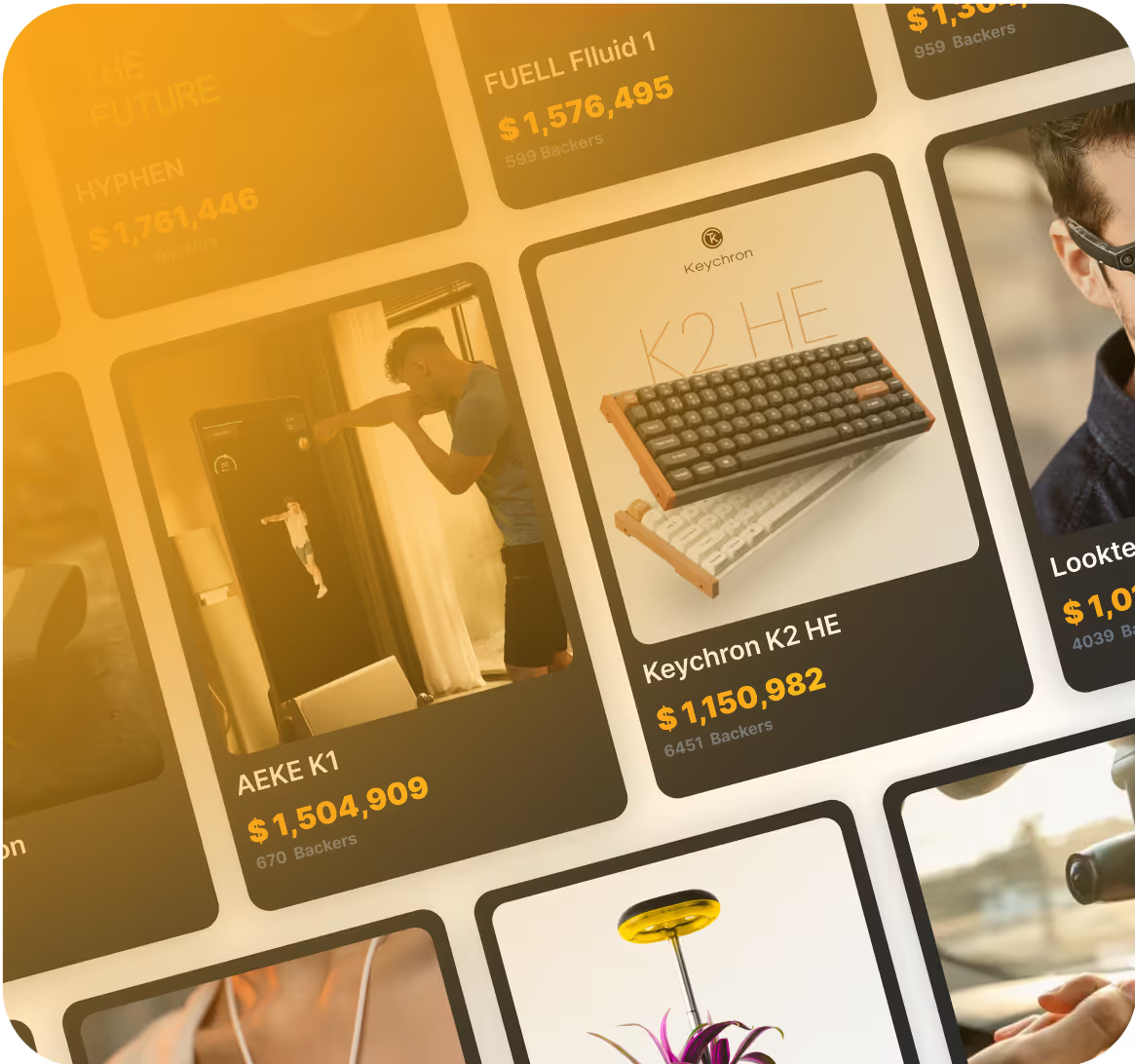
When Keychron came to us at TCF with the K2 HE, a 75% wireless keyboard featuring magnetic switches and rosewood accents, the product was ready. What they needed was execution at scale.
As you get closer to launch, the work shifts from figuring things out to making sure everything moves together.
PR, influencers, content, ads, timing. All of it needs to land in the same window and support the same message.
Handling all of this on your own can get overwhelming quickly, especially when everything depends on timing and coordination. This is usually the point where founders start bringing in experienced teams to help manage the process and get the most out of the campaign.
At TCF, we handled the K2 HE launch as one coordinated system: lead generation, Kickstarter page structure, influencer partnerships, product reviews, and content strategy, particularly on YouTube, where keyboard content thrives.
The result: $1.17M raised from 6,608 backers, with consistent conversion throughout the campaign lifespan.
The lesson was in understanding the keyboard community, building anticipation through the right channels, and executing a launch where every piece supported the same goal. This systematic, coordinated approach is what serial creators do differently.
Conclusion
Launching a keyboard on crowdfunding is part product development, part community building, part logistics challenge. The barrier to entry isn't high, but the barrier to success is.
The campaigns that break through share common traits:
- They validate demand way before launch
- They engage communities as partners
- They communicate honestly, especially when things go wrong
- They understand that crowdfunding is a launchpad, not the destination
The keyboard market rewards authenticity and punishes shortcuts. If you're willing to do the work, build genuine relationships, create something differentiated, and execute methodically, crowdfunding can turn a concept into a thriving product line.
The community is waiting. But they're also watching.
[[cta2]]
FAQ
How long should my pre-launch period be?
Minimum 6-8 weeks (for validated products). Ideal is 10-12 weeks. This gives you time to:
- Build and warm up your email list
- Get prototypes to reviewers
- Generate pre-launch content and buzz
- Collect community feedback and refine messaging
Rushing the pre-launch is the fastest way to guarantee a slow start.
How to set a realistic funding goal for a first-time keyboard campaign?
Conservative approach: Calculate your true minimum (MOQ × unit cost + tooling + shipping + platform fees + contingency) and set that as your goal. For most keyboards, this lands between $20K-$50K.
Aggressive approach: Set a lower goal ($10K–$20K) to create early momentum and social proof, but ensure you've pre-validated enough demand to blow past it. This only works if you've built a substantial email list.
Can I run the campaign myself, or should I hire help?
It depends on your skillset and bandwidth. Running a campaign requires:
- Copywriting and design
- Community management
- Email marketing
- Paid advertising
- Influencer marketing
- Product photography/videography
- Project management
If you're strong in most of these and have time, you can DIY. If not, strategic hiring, whether a full-service agency or specialists for gaps (video production, ad management), often pays for itself in higher conversion and less founder burnout.
What metrics should I track during the campaign?
Key metrics:
- Email list size and conversion rate
- Hourly/daily pledge velocity
- Traffic sources (which channels drive backers)
- Average order value
- Pledge tier distribution
- Geographic breakdown (for shipping planning)
- Social media engagement and referral traffic
Most pledge managers and analytics tools can track these automatically.
Should I offer international shipping?
Yes, but price it realistically. The keyboard community is global. Use a fulfillment partner with international warehouses (like Easyship or ShipBob) to reduce costs and complexity.
Common approach: charge actual shipping costs (not subsidized) for international orders. Backers understand and accept this. What they won't accept is surprise customs fees. Make VAT/duties the backer's responsibility and state this clearly.

.avif)
.avif)

.jpg)
%20(1).png)