


In this article
Everything You Need for a Successful Product Launch
A product launch has exactly one shot at a first impression, and most of what determines whether that impression lands happened weeks before anyone saw the product. The prototype was never the hard part.
All that development, prototyping, and late-night refinement counts for surprisingly little if the market never gets a proper introduction to what you've built. Muddled messaging, an undefined audience, or poor timing can quietly sink something that genuinely deserved a better outcome.
This guide covers what a product launch actually involves, how to prepare for one, where founders tend to go wrong, and why crowdfunding has become the go-to launchpad for physical product creators who want to validate demand, raise capital, and build real momentum before shipping a single unit.
What is a product launch?
A product launch is the moment a product makes its public debut, the first time real people with real money decide whether it's worth their attention. It's the single most consequential window in a product's commercial life: how that window gets planned and executed determines almost everything that follows, since first impressions in a crowded market tend to stick around longer than anyone would like. A sharp, well-timed launch builds momentum that compounds.
Most Common Reasons Product Launches Fail
Launching a product is one of those things that looks straightforward from the outside and turns out to be genuinely complicated once you're in it. Most failures come down to a handful of recurring mistakes, and the frustrating part is that they tend to compound. One bad decision in the planning phase has a habit of creating three more downstream, and by the time launch day arrives the problems are baked in.
A few of the most common pitfalls worth knowing before you get too far down the road:
1. No real demand validation
Building something people want sounds obvious until you realize how many founders skip the part where they actually confirm it. 42% of startups fail because they build products that don't solve a meaningful market problem. If your product is solving a problem, that problem needs to demonstrably exist for a large enough group of people willing to pay for a solution.
2. Messaging that tries to speak to everyone
The broader the audience you try to reach, the thinner your message gets. A founder who knows exactly who they are talking to will almost always out-convert one who doesn't.
3. Launching before the infrastructure is ready
A great product landing on a broken checkout page, a confusing onboarding flow, or an unresponsive support inbox is a fast way to turn early excitement into refund requests.
4. Over-relying on organic reach
Organic traffic is valuable but it moves slowly and unpredictably. Founders who skip paid distribution entirely tend to find that their launch window closes before word spreads far enough to matter.
How to prepare for a product launch (step-by-step)
A successful launch is mostly a function of what happens in the weeks and months before it. The actual launch day, when it comes, should feel almost anticlimactic because everything has already been figured out. Here is how to get there.
1. Define your target audience
Before anything else gets decided, you need a clear picture of who you are building this for. Go beyond basic demographics. Age and gender are a starting point, but what you really want to understand is behavior:
- Where this person spends time online, most reliably found by checking which subreddits, Facebook groups, or Discord servers already exist around adjacent products.
- What content they consume, visible in the comment sections and tagged creators under competitor ads and videos.
- Which creators they follow, found by scanning who your competitors are already working with or getting organic shoutouts from.
- What they have already bought that is adjacent to your product, mined from Amazon reviews on similar products, where people tend to volunteer exactly what problem they were trying to solve.
- What frustration your product resolves for them specifically, usually stated outright in the one and two-star reviews of the closest existing alternative.
Build out a primary persona and stress-test every major launch decision against it. If a channel, message, or creative does not speak directly to that person, it probably does not belong in your plan. It also helps to know backers expectations going into a campaign, since their priorities shift year to year and a persona built on outdated assumptions will miss the mark no matter how detailed it is.
Aaron Smith found this out the hard way with his tabletop game Sea Beasts. The first Kickstarter attempt raised $35,586, a fraction of what the campaign needed. The relaunch went after a specific reader instead of a general audience, and built every part of the landing page around what that person cares about: the Viking theme, the cooperative mechanics, the sense of high-stakes adventure. Same game, same creator. The relaunch raised $672,720 from over 5,400 backers.

2. Research the market and competitive landscape
Before you settle on positioning, research your competitive landscape in detail.
- Who are the direct competitors, found through the "similar campaigns" sections on Kickstarter and Indiegogo, plus a scan of Amazon's "customers also bought" for the category.
- What are their price points, listed right on their campaign pages and product listings.
- How are they positioning themselves, evident from their campaign headline and the first few lines of their video script.
- Where are customers leaving negative reviews or expressing unmet needs, found in the comments on their Kickstarter updates and in one and two-star Amazon reviews for anything in the category.
Those gaps are your openings. Look at how competitors are running their ads, what their top-performing content looks like, and where their community engagement is strongest or weakest.
The goal is to enter the market with a position that is genuinely differentiated.
3. Validate your product and demand
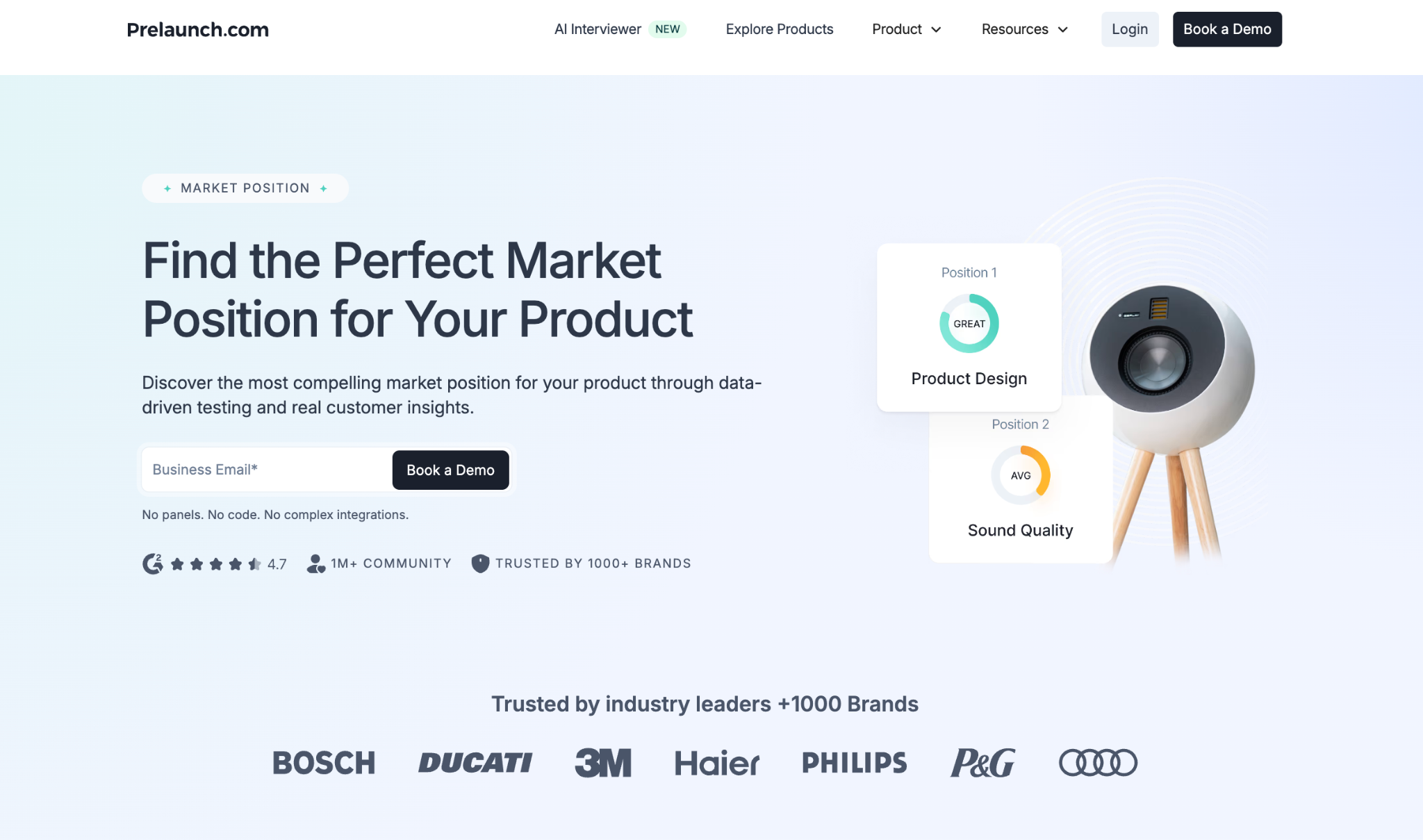
Before committing a budget to a full launch, generate real signal that demand exists. Prelaunch.com is built to cover this entire process, letting creators test messaging, pricing, and positioning against real visitors, and using small reservation deposits to confirm actual buying intent rather than just casual interest.
- Build a simple landing page describing the product and drive targeted traffic to it, measuring how many people sign up or express interest.
- Run a small paid ad test with different messaging angles to see what resonates.Treat this as an ongoing process rather than a single test: different background colors, different images, different headlines, run repeatedly and measure against each other.
- Offer early reservations at a discount to a warm audience and see who converts.
The reservation model in particular is valuable because it turns passive interest into a financial commitment, giving you a much more reliable read on actual demand than an email signup alone. It's also worth an honest gut check on whether your product is actually ready for this stage at all, since a strong concept and a launch-ready product aren't the same thing, and skipping that distinction is where a lot of avoidable damage happens.
4. Build and warm your pre-launch community
An email list built before launch is one of the most valuable assets you can have on launch day.
- Start lead capture as early as possible, ideally the moment your landing page is live.
- Segment your list from the start: separate general leads from VIPs, meaning people who have put down a reservation or made some form of financial commitment.
These two groups need different communication.
- General leads get nurtured with product updates, behind the scenes content, and early access incentives, with the explicit goal of converting them into VIPs before launch day arrives.
- VIPs get more direct, exclusive communication that reinforces their decision and keeps them close.
By launch day you want both groups primed and ready, but your VIPs are the ones who will drive early momentum and signal to the platform that your product is worth paying attention to.
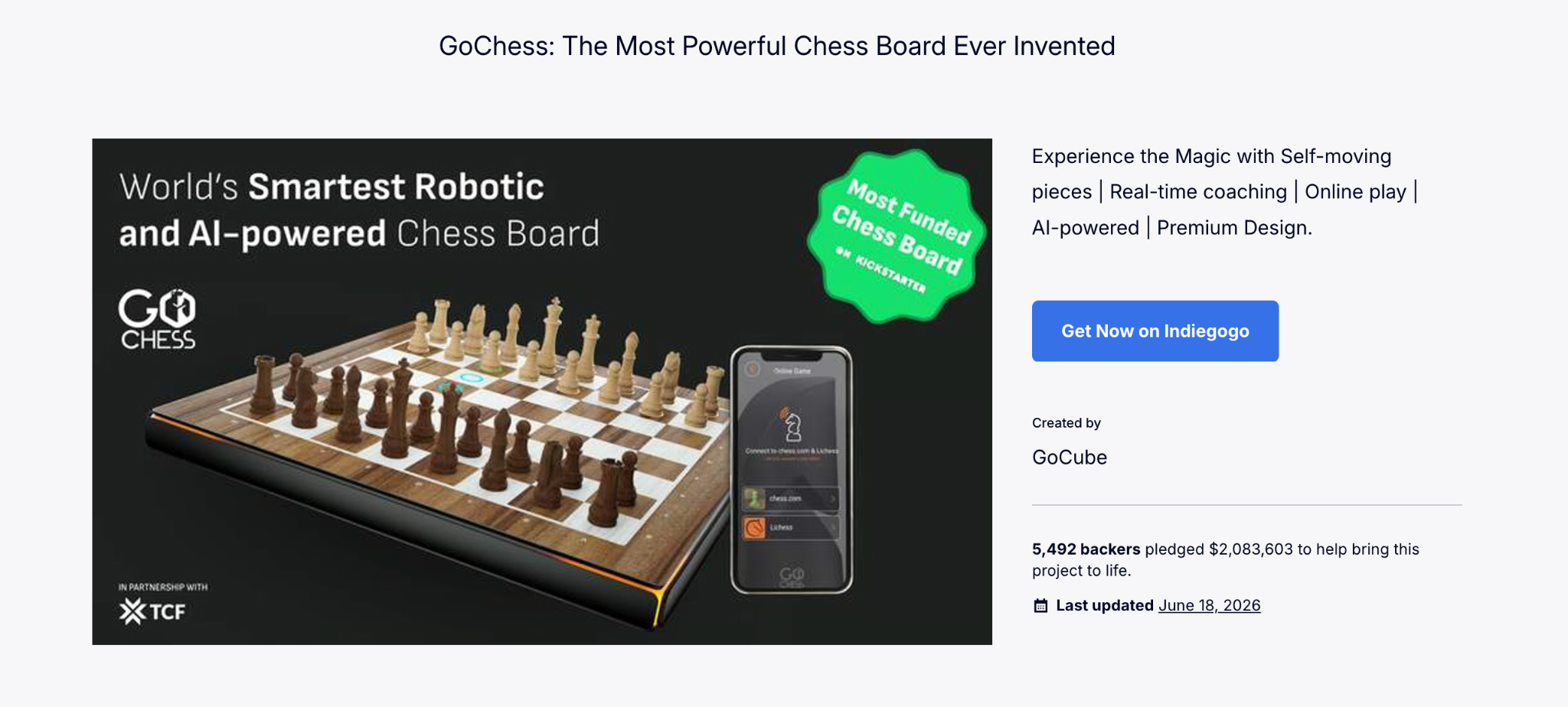
For the GoChess campaign, this played out as a deliberate sequence rather than a one-time offer. Leads got the chance to become VIP backers in the welcome update, then received a dedicated email flow designed to build trust and credibility before launch. One week out, once leads were sufficiently warmed up, a final "last chance to become a VIP" email went out. Many of them took it, converting from general leads into VIPs in that last stretch before launch day.
5. Build your marketing strategy
With your audience defined and your community growing, map out the full marketing plan.
The first decision is which channels are actually worth your attention, because spreading budget and effort too thin across every available platform is its own kind of mistake. Where does your target audience actually spend time? Which channels have driven results for similar products? Start there and go deep rather than going wide.
Once your channel mix is decided, each one needs a clear plan.
- Paid advertising should have a defined budget, a testing plan for creative and copy, and a retargeting strategy for people who have already shown interest.
- Influencer partnerships need to be identified, briefed, and contracted well in advance of launch.
- PR outreach should start earlier than feels necessary, since lead times for coverage can be long.
- Social media needs a content calendar that builds anticipation without giving everything away too soon.
- Email sequences need to be mapped from first signup all the way through post-launch follow-up.
Each channel should have a defined role, a defined owner, and a clear metric for success.
6. Create your assets
Everything that needs to exist before launch day gets produced in this phase. That means your:
- landing page or campaign page, structured to walk a visitor from headline to pledge, which is where a proven campaign structure saves you from guessing what goes where,
- ad creatives in every format you plan to run,
- email sequences for both your general list and your VIP list,
- product photography,
- a demo or explainer video,
- any press materials you will need for outreach.
The quality of these assets has a direct and measurable impact on conversion rates, so this is not a phase to rush or cut budget on. Build with your target persona in mind at every step.
Zipbuds is a good example of how much this can move the needle. The team's first instinct was a features-focused explainer video, listing specs and functionality. They scrapped it in favor of the founder telling a personal story about tangled headphone cords during his daily commute instead, a smaller, more specific problem that the target audience recognized immediately. The campaign raised 300% of its funding goal and the product later landed in Target stores.

7. Prepare your launch-day execution plan
Define exactly who is doing what on launch day and in the days immediately following.
- Which ads go live at what time,
- Who is monitoring performance and making optimization calls,
- Who is handling community and customer questions,
- What the escalation path looks like if something breaks.
Set clear benchmarks for the first 24 and 48 hours so you know quickly whether you are on track or need to adjust. A launch without a clear execution plan becomes reactive within hours, and reactive launches are expensive.
Why crowdfunding is the smartest launch strategy for physical product creators
There are plenty of ways to bring a product to market. Live launch events, social media campaigns, retail partnerships, direct to consumer stores. Each has its place depending on the product, the audience, and the resources available.
For founders launching physical products, though, crowdfunding has become the standout option, and for good reason. It is the only launch method that simultaneously validates demand, raises capital, builds a community, and generates market proof before you have committed to a full production run. Everything else asks you to take that risk alone. Crowdfunding distributes it.
Working with a crowdfunding marketing agency
Crowdfunding campaigns that hit their goals and scale past them rarely do it alone. The mechanics of a successful campaign, from pre-launch community building to ad optimization to influencer outreach to post-campaign scaling, involve enough moving parts that trying to manage all of it in-house while also running a business is a fast road to burnout and missed opportunities.
TCF has managed crowdfunding campaigns across Kickstarter and Indiegogo for over a decade, raising $19M+ across recent campaigns and averaging 60% more funding than comparable launches. The in-house team of 100+ specialists covers every channel a campaign needs, paid advertising, influencer marketing, PR, email, and social, under one roof and one coordinated strategy.
For founders who want to give their product the best possible shot at a meaningful launch, that kind of full-stack support is worth serious consideration.
Conclusion
A product launch done well is the accumulated result of months of deliberate preparation. By the time launch day actually arrives, most of the hard work should already be behind you.
The steps in this guide give you the framework. The founders who follow through on all of them, audience research, demand validation, community building, asset production, and a real execution plan, tend to find that the launch itself is the easy part. The ones who skip steps tend to find out why those steps existed in the first place.
For physical product creators specifically, crowdfunding remains the most complete launchpad available. And for those who want experienced hands managing the campaign, TCF has spent over a decade doing exactly that.
FAQ
How much do crowdfunding platforms charge in fees?
Kickstarter and Indiegogo charge nearly identical fee structures: a 5% platform fee plus payment processing fees of roughly 3-5%, for a total deduction of about 8-10% of funds raised. On both platforms, fees only apply if the campaign successfully funds.
How long should a product launch take to prepare?
Most serious launches run three to six months of pre-launch work before the actual launch day. That covers audience research, community building, and asset production, the steps that determine whether launch day has any momentum behind it or starts from zero.
How long should a crowdfunding campaign run?
Data from Kickstarter, which mirrors patterns seen across crowdfunding platforms generally, shows campaigns of 30 days or less have meaningfully higher success rates than longer ones. First-time creators are generally better served by 28-35 days.
What's the best day to launch a crowdfunding campaign?
Campaigns launched Tuesday through Thursday, and during the first week of the month, tend to see stronger early engagement than weekend or end-of-month launches.



.avif)


.avif)


.jpg)
%20(1).png)