

The Crowdfunding Formula x Bristly: The Most Funded Dog Campaign
We hit the funding goal in under 24 hours and raised $1,000,739 on Kickstarter and Indiegogo.
May 10, 2026
This is a 5k-word article on how to run a successful Indiegogo campaign and raise funds, and it will take some time to read.But, that’s for a good reason; you’ll learn a lot about what to do to successfully crowdfund your project and bring it to life.Here's how it all started…
For a great crowdfunding campaign, you need a great product.
Azat (an inventor) presented us with his invention, a smart wallet with a power bank and a Bluetooth distance detector: the first version of the Volterman Smart Wallet.
After just a bit of research, it was obvious that it had nothing new compared to its competitors.
Nomad Wallet was already a successful and long-time leader, which included its own power bank. Others like Walli, Woolet, and Ekster had successfully introduced the Bluetooth distance alarm feature and had very successful crowdfunding campaigns.
Why? Because we wanted to have enough credibility.
When people start pitching media but there’s $0 in their balance, they are shooting in the air.
Here’s an important thing to remember:
DON’T SPAM
If you’re sending the same message to 400 people, putting them in BCC, or the ultimate newbie mistake, CC – it just doesn’t work.
Journalists get hundreds of pitches a day.
To stand out, you need to really hustle.
Instead, we sorted out the journalists into several categories: tech, fashion, smart wallets, etc., and created different messages for each of them.
We used GMass, which is a great tool to send out mass emails using your Gmail.
I really love Rebump, which allows us to automate our email messages and provide automated follow-up to those subscribers who didn’t open the email or didn’t reply.
Other my favorite Gmail extensions that we used were:
Streak – Shows who open your emails
Boomerang – Re-sends unanswered emails
Discover.ly – Shows the social profiles of whoever sends you an email
Rule #7: Put yourself in the shoes of journalists. Send newsworthy and personalized messages
There are three main elements in your campaign page: Video, Page Design, and Perks/Rewards.
I’ve written a detailed article on how you should structure your Kickstarter videos, but even we strayed a little from that structure.
When we shot the video with our initial script, the video ran at 7:48.
We had to cut it down several times.
There’s always a problem in editing when you have great things in mind and you don’t want to cut them.
But believe me, what you need and want is to only leave what matters.
We were able to edit our video down to four minutes, and after a couple of minor but difficult changes – 3:56.
Still, when people ask me how long a video should be, my answer is: no longer than 2:30.
As it was almost 1.5 times longer than expected, we came up with one unbroken scene (a humorous sex scene, which grabbed men’s attention and boosted our watch time until the end), which would prompt people to watch it until the end, where we had our hook (Call to Action).
We repeated this phrase: “I am not a Superman, I have Volterman” three or four times, and I am sure there are many people who don’t like it.
But it works.
When you say something three times in a video, people fixate on it.
Rule #8: Make your video emotional. Remember, people buy with emotions
Support is one of the most important aspects of success in any campaign, with no exceptions.
We put in a lot of effort to make sure we had 24/7 support, where any question or comment on our Indiegogo page, email, or Facebook received a reply in 20 minutes or less.
It fully paid off.
Crowdfunding is all about trust. Nobody is 100% sure you are going to deliver what you promised.
So to back your project, they need to trust YOU – somebody they’ve never met or heard of before.
Support is one of the critical factors in earning trust, and if you do it promptly and thoroughly, you’ll earn even more.
There were a number of times when people wrote us, unsure if they’d back the project, but ultimately said they did because of our prompt support and communication.
It made them feel safe talking with us.
Rule #9: Your support can’t just be good enough, it needs to be great!
We didn’t reveal our price before our launch.
We had great hype, and the number one question we heard all the time was “What’s the price?”
Despite that, we didn’t announce the price until the campaign launched
Here’s the logic behind it.
Before people visit your campaign page, they have very little information about your product.
They may have visited your landing page and read a couple of posts, but that’s not enough to create a complete image of how awesome your product is.
So when you give out a price without the full scope of the product, people start judging the price/value ratio based on the information they have. As you can imagine, in most of the cases the price for something they don’t know about will seem higher in that cost-benefit analysis.
In contrast, when they visit your campaign page and see your great images, video, comments, and 100% funded status, the price that they see seems fairly justified.
The best pricing strategy is to provide both low and high-priced rewards in order to open your product up to backers who can’t spend more while providing opportunities to those who can and want to spend more.
We had three types of wallets (in our perk list), as well as a couple of upsell perks.
One of them was $19, to engrave their initials on the wallet. For $29, we provided a wireless charger.
We also had our big VIP package which combined all the previous perks: Package 365.
365 came from 365 days in a year, meaning it would give you what you wanted every day of the year. We even put the price at $365 to make it easy and memorable (although later on, we had to increase the price.)
It’s very important not to have too many perk/reward levels as people can get confused.
Our wallets had two colors, brown and black, and we had two types of leather – natural leather and faux leather. Imagine what would happen if we put 4 variations of each of our product types – 20 Perk levels!
What happens when you offer too many options?
They won’t choose any.
Fortunately, we knew this and wrote in the description that they would be able to select the color and leather type later on, during the survey after the campaign’s completion.
That gave us just 8 perk levels. Easy to understand, and right to the point!
We’d sent our subscribers five or six emails prior to the campaign’s launch, making sure they were prepared for the launch date long before we hit launch.
In order to break the $0 balance in our Indiegogo account and get traction early, we pushed a post to our Facebook VIP group subscribers – our most enthusiastic subscribers – which said:
“Dear VIP Subscribers,
Today, at exactly 10:00 AM PT, we will launch our campaign on Indiegogo. As you are our most enthusiastic subscribers, we post this announcement in here first and will send a newsletter to everybody else exactly at 11:00 AM. We have only 100 units with an exclusive super early bird discount and we want you all to benefit from it.
Make sure you are in front of a computer at 10:00 AM to get the best discount ever!”
This tactic worked really well, and within an hour most of our early bird items were sold. When we sent out the newsletter, we had already collected more than $10k on our page, which created a sense of urgency and trust.
We published posts on our Facebook page, sent out the newsletter, and started running Facebook ads which targeted both our subscribers and cold traffic. We reached our goal within twenty-four hours and collected more than $45,000.
Naturally, we didn’t actually get any sleep that night!
We had great early traction and were on the top of Indiegogo’s homepage, however, we had to keep the ball rolling.
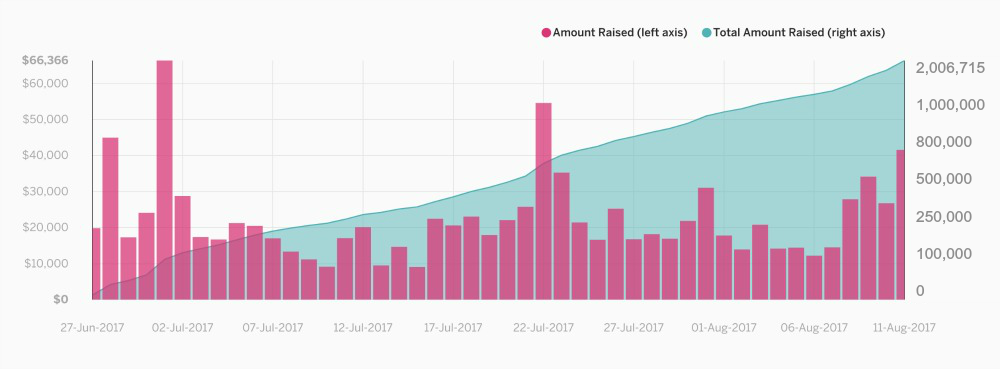
Most of the campaigns have a so-called U-Shape curve in their funding analytics.

Which means, that even the most successful campaigns start strong and finish strong, having weak results in-between.
It’s really difficult to keep the momentum throughout the whole campaign.
But, it’s possible.
In the graph below you can see that our funding was rather a Wave-Curve than U-shape.
We managed to keep the funding rather stable and have some strong peaks in-between, getting on average $18-20k funding daily.

Here's how we did that.
We used these four backer-newsletter services, each of which sends email to their backers.
They worked out... at least enough to break even on their costs.
After we got 100% of our funding, we started to pitch more heavily to the media.
Here are some examples of media pitches we used during our campaign on Indiegogo:
Subject: Volterman – World’s Most Powerful Smart Wallet, Ever
Hi …,
I am Narek from the Volterman Smart Wallet team.
I stumbled on your article in (name of the publication/website/ … Blog; NO links!) about (specify the topic touched on in the article) and really liked it. It was a great piece – really informative and provided great insight. We have a similar project that I am sure will interest your readers.
Volterman Smart Wallet has captured the attention of backers across the globe. With a built-in Power Bank, Distance Alarm System, Global GPS tracking system, Worldwide WiFi hotspot, and even a thief detection camera, it’s a huge innovative leap on from anything currently available on the market.
Our recent Indiegogo campaign very quickly raised over 100% of our funding goal, being backed by over 1,000 backers from all over the world. Alexis Ohanian, the founder of Reddit, is even on board.
We’ve been working on the Volterman project for more than two years, and we have fully functional prototypes now. Your readers will love to learn about the world’s most powerful wallet.
You can find out all about us at: https://igg.me/at/volterman, or feel free to reach out to me with any questions you may have.
Best regards,
Let’s analyze it.
Our pitch consisted of four sections.
Introduction – Who we are and why we’re writing to them. Journalists love when somebody appreciates their work, so we use this to help them have a positive attitude towards us from the first sentence
Project Description – In two sentences, what our project is and why it’s different from its competitors
Project Credibility – Statistics (like past successful projects) and celebrity endorsements.
Call to Action – Here, provide links and stress that their readers are going to like this. Journalists are writing for their readers, so showing how their readers will appreciate this – and therefore the journalist – will help you get a response.
Our first success was coverage in Digital Journal, then Mashable, then The Verge. In addition to these big names, we got even better results from places we hadn’t that much anticipated: thegadgetflow.com; tinhte.vn; thisiswhyiambroke.com; 9to5toys.com, etc.
Of those sites, the most conversions($11,435) we got were from The Gadget Flow. It’s a great curation website of innovative products, and they have built a great audience.
We were careful to pay close attention to the recommendations of Mike Butcher from TechCrunch and didn’t write to all the contacts we had from the same journal.
If we didn’t hear back after a couple of days from a journalist we wanted to cover us, we sent an automatic follow-up.
Hey Paul,
It’s been a while since I contacted you and I haven’t heard back from you.
I hope you don’t mind me contacting one of your colleagues about Volterman Smart Wallets.
Let me know if you are still interested in the wallet that has a power bank, distance alarm, global GPS tracking, worldwide WiFi and a camera that pictures thieves.
Best,
Did everybody start to shout no no, don’t do it, we are going to cover you now?
No, of course not.
But we got a couple of positive answers, and that’s more than enough.
One of the things that we did differently than most of the campaigners, is that we didn’t concentrate only on big names in media.
A lot of campaigners start pitching to only Techcrunch, New York Times, Bloomberg, etc. throughout the whole campaign.
This is a risky strategy, because if you get coverage – that’s great!
Many medium and small ones will start reposting the news.
But what if you don’t?
To minimize that risk, as I mentioned, we collected a big database and started to pitch not only to big names but also to medium and small ones.
We found an interesting strategy, that got us featured on the most popular Facebook pages, having millions of followers.
Many pages with that number of followers will feature your video for a fee – it’s how most of them earn a living.
But for them almost as important as payment is the ability to share a viral video, which brings them additional likes and followers.
It’s how they maintain a popular page.
That was the basis on which we built our campaign.
The challenge was to convince those pages that our video is indeed viral.
And we found a way.
We paid one of the pages (Viral Thread), which offered to post our video on its page with 1 million guaranteed views.

We got the views, but we didn’t see the results from the post alone.
However, we used that video with million views as proof to pitch to hundreds of other pages.
Here’s what our pitch looked like:
Hey team,
We love your FB page and have a project that will be of interest to your readers.
Volterman is the World’s most powerful smart wallet with 5 amazing features.
Our video gets millions of views in many premium pages, e.g. https://www.facebook.com/JungleVT/videos/1298194906989015/
We are more than sure that our video will become truly viral on your page as well and your audience is going to love it.
If you need, we can create a special video for you with your page’s branding.
Let me know if you need additional materials so we can send them to you.
Cheers,
Narek
It worked!
We got amazing results and our video was shared on almost all of the top Facebook pages, bringing us literally millions of views and traffic.
Here’s an interesting thing I noticed on our Indiegogo dashboard:
At the time of writing, we had 2,078,769 visitors on our page, out of which we got 13,339 backers and … $2,006,270 in funding.
Notice a correlation?

That’s interesting, isn’t it?The number of visitors and the amount we raised is nearly identical.You might think it was a coincidence, but check out a screenshot from another campaign we had recently, Moon by 1-Ring.

Notice anything similar?
Exactly!
Same story here: roughly one dollar per visitor
Although the average price of tickets for these two campaigns was quite different (about $165 for Volterman and $255 for Moon), there does seem to be a correlation between the number of users and the amount we raised.
So it may be that if you want $1,000,000 to fund your project, you’ll need to ensure a million visitors to your page.
Challenging? Yes!
But very much doable, and you’ve just read many ways to get your Indiegogo campaign there.
Take the first step towards your $1M+ Campaign now! Apply here.
Good luck!


.jpeg)


